FREE SHIPPING ON ORDERS OVER $150

Cart
0
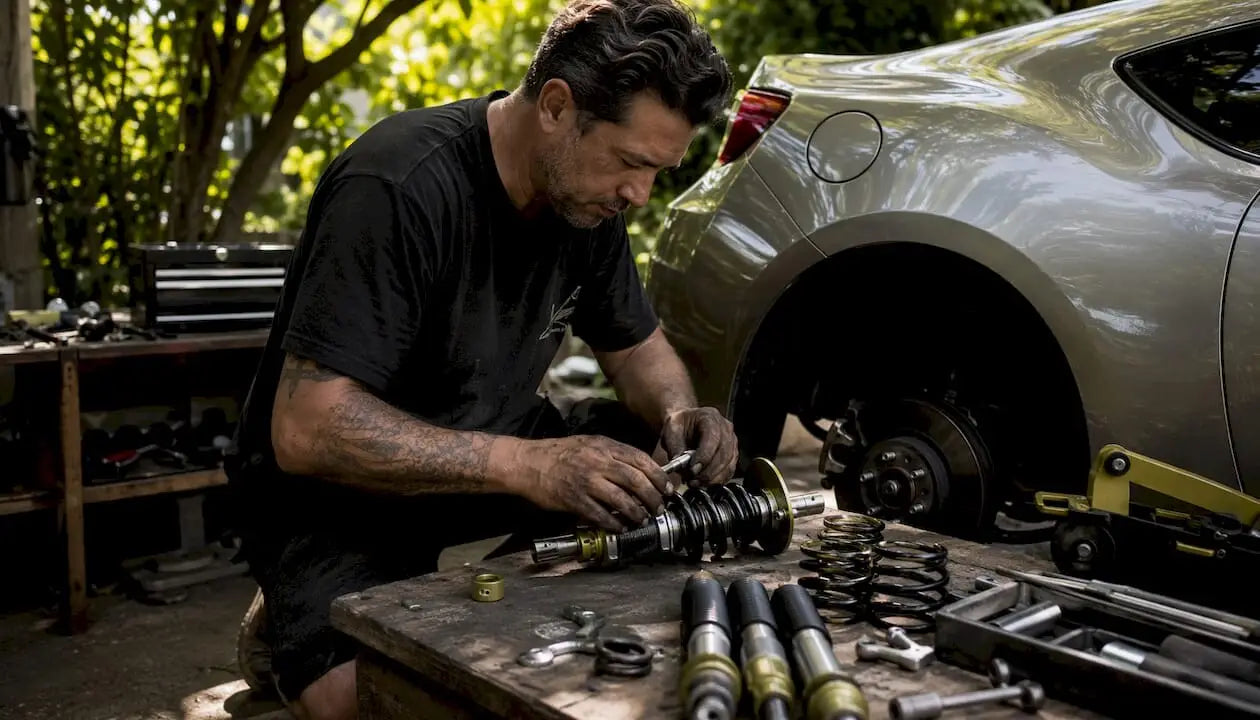
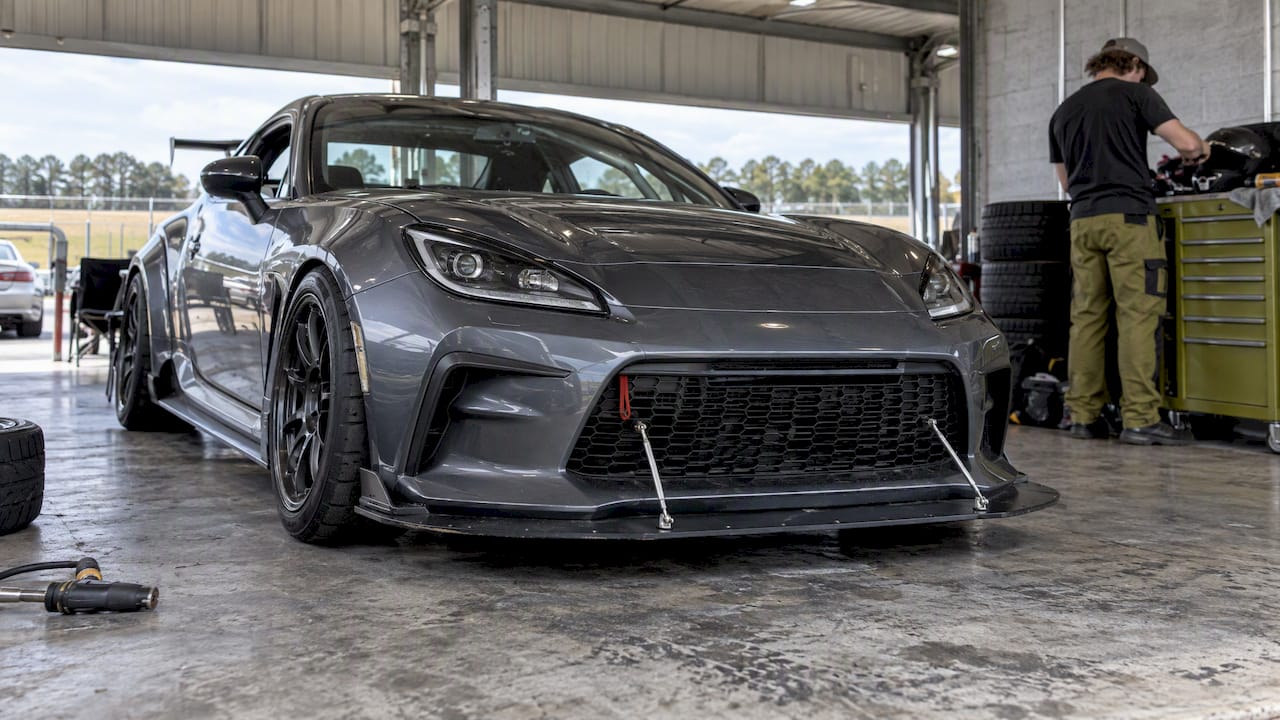
The best FR-S suspension setup for handling combines adjustable coilovers with matched spring rates and damper valving, proper alignment corrections, and geometry fixes that most builders skip. Get those three things right and the FR-S chassis rewards you with a level of feedback and cornering precision that genuinely surprises people who have only driven it stock.
Here is what a solid baseline setup looks like:
- Adjustable coilovers with independently adjustable ride height and spring preload, paired with a monotube damper design for faster heat dissipation and response
- Camber correction targeting significant front negative camber to reduce understeer and improve turn-in, achievable with camber bolts or adjustable top hats
- Sway bar upgrades front and rear to control body roll without sacrificing independent suspension travel
- Urethane bushings throughout to sharpen suspension response and reduce deflection under load
- Roll center and bump steer correction kits whenever you lower the car, to restore the geometry the factory intended
- Corner balancing after any significant suspension change to equalize weight across all four corners
- Tire upgrade as the single highest-return modification on this chassis, before or alongside any suspension work
Each of these elements builds on the last. Skip one and the others underperform.
Table of Contents
- What suspension components actually move the needle on FR-S handling?
- What alignment settings work best for spirited driving and track use?
- Common suspension setup mistakes on the FR-S and how to fix them
- Why lowering the FR-S changes everything about suspension geometry
- Progressive vs. linear spring rates: which one fits your FR-S build?
- Tools and resources you actually need for DIY suspension setup
- Undergrounddynamics has the suspension parts your FR-S build needs
- FAQ
- Key Takeaways
What suspension components actually move the needle on FR-S handling?
The FR-S runs a MacPherson strut front and double-wishbone rear from the factory. It is a well-sorted platform, but the OEM rubber and spring rates leave real performance on the table. The good news: bolt-on suspension upgrades like adjustable dampers and matched spring rates can cut lap times significantly and increase lateral G-forces significantly over stock.
Coilovers: the foundation
Coilovers do two things at once: they set ride height and control damping. For the FR-S, a monotube design is worth the extra cost. Monotube dampers hold more fluid, dissipate heat faster, and respond quicker than twin-tube units, which matters when you are pushing the car through repeated corners on a track day. Ksport USA puts it plainly: always make the suspension faster than the engine. Matched spring rates and damping are what separate a coilover that transforms the car from one that just lowers it.
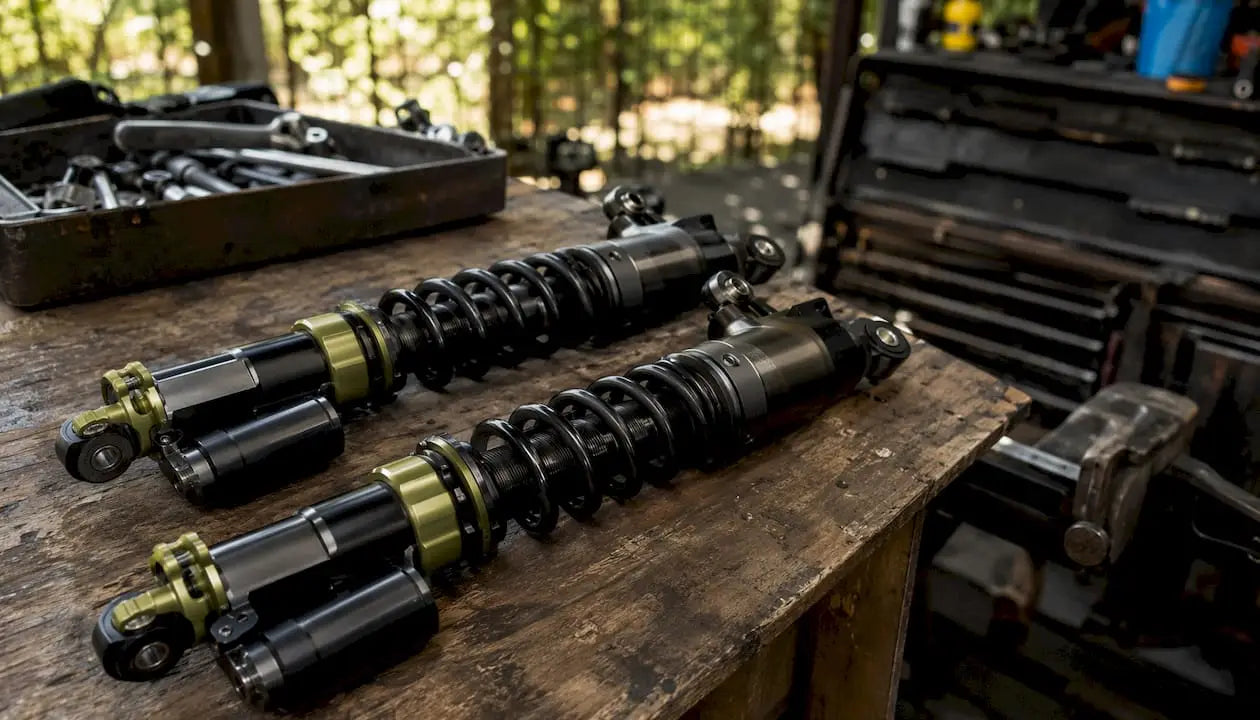
One detail that trips up a lot of builders: some coilover kits change spring preload when you adjust ride height. That forces a compromise between the height you want and the spring behavior you need. Kits with threaded shock bodies and independently adjustable lower mounts let you set height without touching preload, keeping ride and handling balance consistent.
Bushings and sway bars
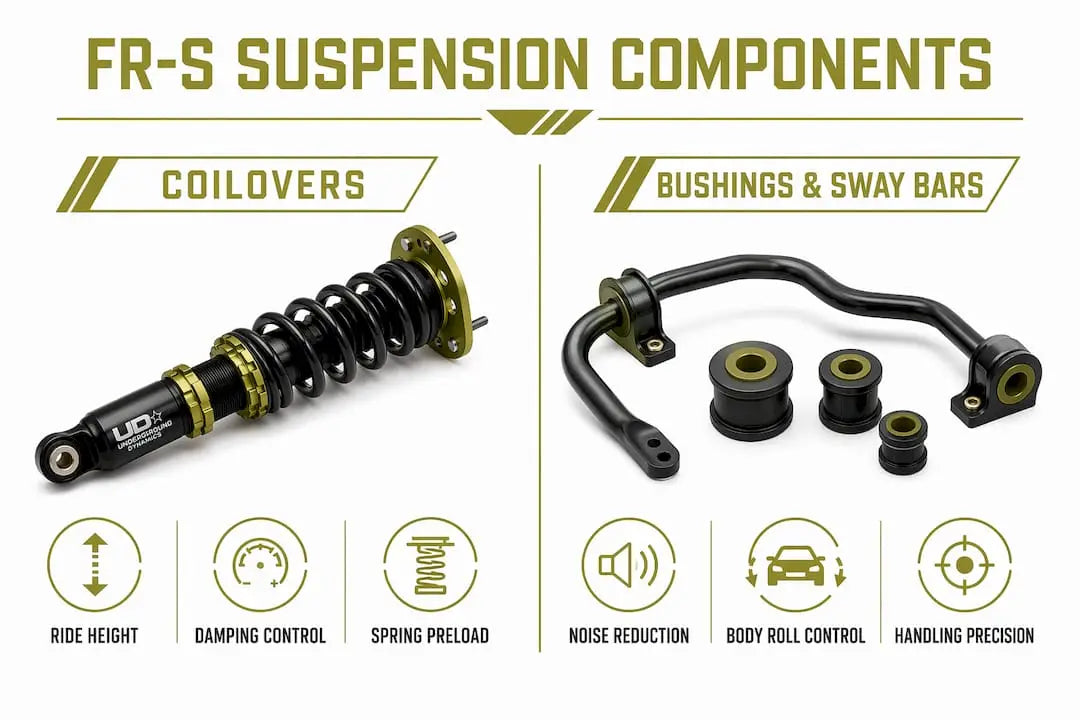
Upgrading from OEM rubber bushings to urethane tightens up the entire suspension response. Rubber deflects under cornering load; urethane does not. The installation process is labor-intensive and requires a propane torch, a Sawzall, and a hydraulic press to remove bonded OEM shells, so budget time and tools accordingly. Whiteline Performance offers a full bushing kit for the FR-S platform that covers the subframe, control arms, and sway bar mounts.
Sway bars control body roll by linking the left and right suspension. Most factory setups carry an understeer bias, so upgrading the rear bar is often the first move to bring the car toward neutral handling. Adjustable endlinks are non-negotiable when you lower the car; without them, the sway bar preloads incorrectly and handling becomes unpredictable.
-
Tires: The community at ft86club is consistent on this point. Tires make the largest single difference on this chassis. A 200-treadwear tire or a sticky performance tire like the Michelin Pilot Sport 4S transforms feedback and grip before any other mod pays off.
-
Wheels: Lighter wheels reduce unsprung weight, which lets the suspension react faster to road inputs. A 225/40/18 setup on a lightweight wheel is a proven combination for the FR-S.
Pro Tip: Never swap to a stiffer spring without re-valving or adjusting your dampers. A spring that is too stiff for the damper causes the car to bounce over bumps rather than absorb them, which actually reduces grip at the contact patch.
What alignment settings work best for spirited driving and track use?
Alignment is where most FR-S builds either come together or fall apart. The stock alignment is tuned for comfort and safety, not lap times. Dialing in camber, toe, and corner balance is what turns a suspension upgrade into a handling upgrade.
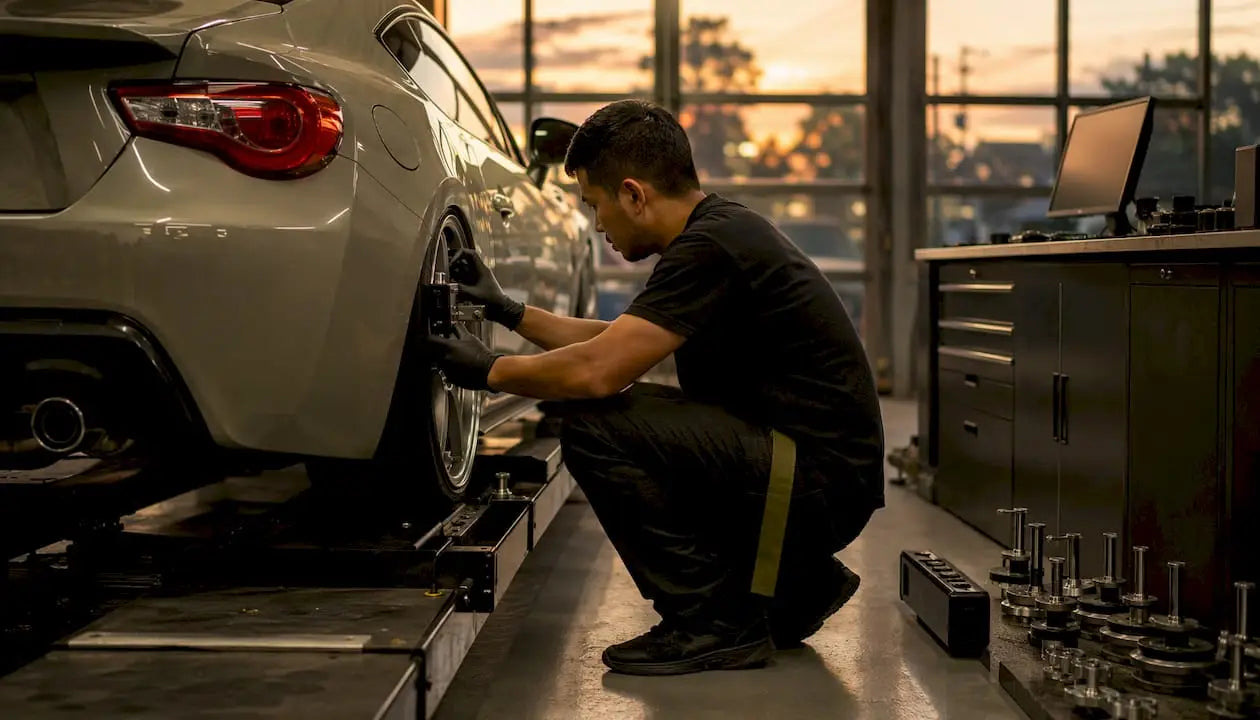
Camber correction is the highest-priority alignment change on this platform. MacPherson struts gain positive camber quickly under yaw compression, which kills front grip exactly when you need it most. Shifting front camber closer to -2 degrees using camber bolts or adjustable top hats directly reduces understeer and sharpens turn-in, and this can be achieved even at stock ride height using camber bolts. The ft86club community reports that getting more front negative camber is where the car’s handling character really opens up.
Toe settings affect stability and turn-in response. A small amount of front toe-out (around 0 to -0.1 degrees) quickens initial steering response. Rear toe-in (around +0.1 to +0.2 degrees) adds stability under braking and mid-corner. These are starting points; your specific spring rates and driving style will shift the ideal values.
Corner balancing equalizes the weight carried by each tire at static ride height. Without it, even a well-aligned car will push or rotate inconsistently because the load distribution is uneven. Corner balancing requires a set of four scales and a flat surface. It is the last step after all suspension changes are made, and it is what separates a car that handles well from one that handles predictably.
| Alignment parameter | Target range (street/track) | Effect on handling |
|---|---|---|
| Front camber | around -2 degrees | Reduces understeer, improves cornering grip |
| Rear camber | around -1 degree | Stabilizes rear under load, reduces oversteer risk |
| Front toe | 0 to -0.1 degrees (slight toe-out) | Sharpens turn-in response |
| Rear toe | +0.1 to +0.2 degrees (toe-in) | Adds stability under braking and mid-corner |
| Corner balance | Within 1–2% side-to-side | Consistent weight distribution, predictable handling |
For ECU tuning that complements your suspension work on track days, this ECU remap guide covers how power delivery interacts with chassis balance.
Common suspension setup mistakes on the FR-S and how to fix them
Most FR-S handling problems trace back to a handful of repeatable mistakes. Knowing them ahead of time saves you from chasing symptoms that have nothing to do with the actual cause.
- Mismatched spring and damper rates. Proper spring rate selection matched with damper valving is critical. A spring that is too stiff for the damper produces a bouncy, unpredictable ride that actively hurts grip. If you upgrade springs, re-evaluate your damper settings at the same time.
- Adjusting ride height without correcting geometry. Lowering the FR-S changes roll center height and bump steer characteristics. Whiteline Performance is direct about this: lowering without correction kits degrades handling rather than improving it. Roll center drops as the car lowers, increasing body roll and reducing the suspension’s ability to keep the tire flat in corners.
- Skipping corner balancing after suspension changes. Changing spring rates, ride height, or even top mounts shifts the static weight distribution. Running without a corner balance after those changes means the car is fighting itself through every corner.
- Preload confusion on budget coilovers. Many entry-level coilover kits adjust ride height by threading the lower spring perch up or down on the shock body. Moving that perch changes spring preload directly. The result is a car that sits at the right height but has a spring that is either bound up or nearly unloaded, neither of which handles well.
The suspension tuning checklist from Undergrounddynamics walks through the full sequence of checks to run after any suspension modification, which is worth bookmarking before you start wrenching.
Why lowering the FR-S changes everything about suspension geometry
Lowering the FR-S is not just a ride height change. It moves every suspension pickup point relative to the chassis, and those changes compound in ways that hurt handling if you do not address them directly.
Roll center drop is the primary issue. As the car lowers, the roll center moves toward the ground faster than the center of gravity does. The gap between them increases, which means the car generates more body roll for the same lateral force. A roll center correction kit raises the outer tie rod pickup point to restore the original geometry.
Bump steer gets worse with lowering because the steering rack and tie rod ends no longer sit at the correct angle relative to the control arms. Every time the suspension compresses or rebounds, the toe changes slightly. On a lowered car without correction, you feel this as a nervous, darty steering response over bumps.
Anti-dive geometry is the third variable. GKTech’s research on the FR-S/BRZ platform shows that lowering the front lower control arm mount by 5–15mm improves braking performance and reduces nose dive without compromising tire compliance. For a car lowered 50mm, the static anti-dive value is already higher than stock, so a smaller adjustment of 5–10mm is usually the right starting point.
- Use adjustable endlinks to correctly preload sway bars after lowering.
- Install a roll center correction kit before your first alignment appointment post-lowering.
- Address bump steer with a correction kit that repositions the tie rod end to match the new geometry.
- Re-evaluate anti-dive settings if you notice excessive nose dive under hard braking after lowering.
Pro Tip: When adjusting anti-dive by lowering the front control arm mount, make changes in 5mm increments and test between each adjustment. Too much anti-dive transfers braking load through the suspension arms rather than the spring and damper, which reduces tire compliance over bumps and can actually slow you down.
The geometry changes from lowering springs are covered in detail at Undergrounddynamics, including how roll center and bump steer interact when you drop the car.
Progressive vs. linear spring rates: which one fits your FR-S build?
Spring rate choice shapes how the FR-S feels in every driving situation, from daily commuting to a full track day. The two main options are progressive and linear rates, and they behave very differently under load.
Linear springs have a constant rate throughout their travel. A 10kg/mm linear spring requires the same force to compress the first millimeter as the last. This consistency makes handling predictable and repeatable, which is why most track-focused setups use linear springs. The tradeoff is a firmer ride on rough roads, since the spring does not soften for small bumps.
Progressive springs start softer and get stiffer as they compress. The softer initial rate absorbs small road imperfections without transmitting them to the chassis, while the stiffer rate under load resists body roll in hard cornering. For a street-driven FR-S that occasionally sees a track day, progressive springs offer a reasonable compromise. The downside is that the changing rate makes the handling feel slightly less consistent at the limit, which experienced drivers notice.
For a dedicated track car or autocross build, linear springs with a matched damper are the cleaner choice. For a daily driver that needs to survive real roads and still perform on weekends, progressive springs reduce the harshness penalty. The role of damping matters here too: whatever spring you choose, the damper valving needs to match the rate or you end up with a setup that oscillates rather than settles.
949 Racing and the ft86club community generally recommend starting with a moderate linear rate (around 8–10kg/mm front, 6–8kg/mm rear for street and light track use) and adjusting from there based on seat time feedback. The rear spring rate relative to the front is what controls oversteer and understeer balance, so small changes at the rear have an outsized effect on how the car rotates.
Tools and resources you actually need for DIY suspension setup
Getting the FR-S suspension dialed in at home is realistic, but it requires more than a floor jack and a torque wrench. Here is what the job actually demands.
Essential tools:
- Four-post alignment rack or string alignment kit: String alignment using a set of straight edges and a tape measure is accurate enough for camber and toe adjustments between professional alignments. It is not a replacement for a full alignment, but it lets you make small corrections after a track day without a shop visit.
- Camber gauge: A digital camber gauge reads camber angle directly at the wheel. Accurate to within 0.1 degrees when used correctly.
- Torque wrench: Suspension fasteners have specific torque specs. Under-torqued control arm bolts move under load and change your alignment mid-corner.
- Hydraulic press: Required for bushing replacement. A shop press in the 12-ton range handles most FR-S suspension bushings without damaging the housing.
- Propane torch and Sawzall: Needed to remove OEM rubber bushings that are bonded into their shells. This is the step most people underestimate.
- Four corner scales: Corner balancing requires a set of four scales that read simultaneously. Longacre and Intercomp both make scales designed for this purpose.
- Coilover spanner wrenches: Adjusting spring perch height and preload on most coilovers requires the spanner wrenches that come with the kit. Improvising with a punch and hammer damages the threads.
Community resources:
The ft86club forums (gr86.org) are the most concentrated source of real-world FR-S suspension data available. Threads covering alignment specs, spring rate comparisons, and coilover reviews from actual owners with track time are searchable and current. 949 Racing has published staged suspension upgrade progressions for the FR-S platform that are worth reading before you buy anything. Whiteline Performance’s technical blog covers geometry correction in detail specific to the BRZ/FR-S/86 platform.
Pro resource: Grassroots Motorsports has documented full FR-S suspension builds including bushing replacement procedures and brake upgrade fitment notes, with enough detail to guide a first-time builder through the process.
Undergrounddynamics has the suspension parts your FR-S build needs
If you have read this far, you know the FR-S rewards builders who take suspension seriously. Coilovers, springs, geometry correction, alignment. It is a system, not a parts list.
Undergrounddynamics stocks coilovers, air ride, and lowering springs for the FR-S platform, sourced from established suppliers with real fitment data attached. No guessing whether a part fits. Every listing includes the technical specs you need to match spring rates to your damper setup and confirm compatibility before you buy. The catalog covers the full range from street-oriented setups to track-focused builds, priced from $100 to $2,500, so you can build in stages without committing to a full race setup on day one.
Browse the full performance catalog at Undergrounddynamics to find the right components for your current build stage, or go straight to the suspension category and filter by your specific application.
FAQ
What is the best suspension setup for track use on the FR-S?
Adjustable coilovers with a monotube damper design, matched linear spring rates, and a full geometry correction kit (roll center, bump steer) give the best track performance. Corner balancing after installation is what makes the setup consistent lap after lap.
What suspension gives the smoothest ride on a lowered FR-S?
Progressive springs with a quality twin-tube or monotube damper set to a softer damping setting give the best ride compliance on a lowered car. A coilover kit with independently adjustable ride height and preload lets you lower the car without binding the spring.
Do you want soft or stiff springs for the FR-S on track?
Linear springs in the 8–10kg/mm front range are the standard starting point for track use. Stiffer springs reduce body roll and improve response, but they require matched damper valving or the car bounces rather than grips.
How do I make my FR-S handle more predictably?
Corner balancing, bump steer correction, and proper camber alignment (targeting around -2 degrees front) address the three most common sources of unpredictable handling. Tires are the highest-return single change on this chassis.
Does Undergrounddynamics carry FR-S suspension parts?
Yes. Undergrounddynamics stocks coilovers, lowering springs, and air suspension options for the FR-S platform with full fitment specs. The suspension catalog covers street and track applications.
Key Takeaways
Bolt-on suspension upgrades with matched spring rates and damper valving, combined with geometry correction and proper alignment, deliver the most consistent handling gains on the Scion FR-S.
| Point | Details |
|---|---|
| Coilovers with matched damping | Spring rate and damper valving must match; mismatched setups cause bouncy, unpredictable handling that hurts grip. |
| Geometry correction after lowering | Roll center and bump steer correction kits are required when lowering; skipping them degrades handling rather than improving it. |
| Camber and corner balance | Front camber near -2 degrees reduces understeer; corner balancing after any suspension change equalizes weight distribution. |
| Spring rate choice | Linear springs suit track use for consistent response; progressive springs suit street-driven builds that need ride compliance. |
| Undergrounddynamics suspension catalog | Stocks coilovers, lowering springs, and air ride for the FR-S with fitment specs, covering street to track builds from $100 to $2,500. |