FREE SHIPPING ON ORDERS OVER $150

Cart
0
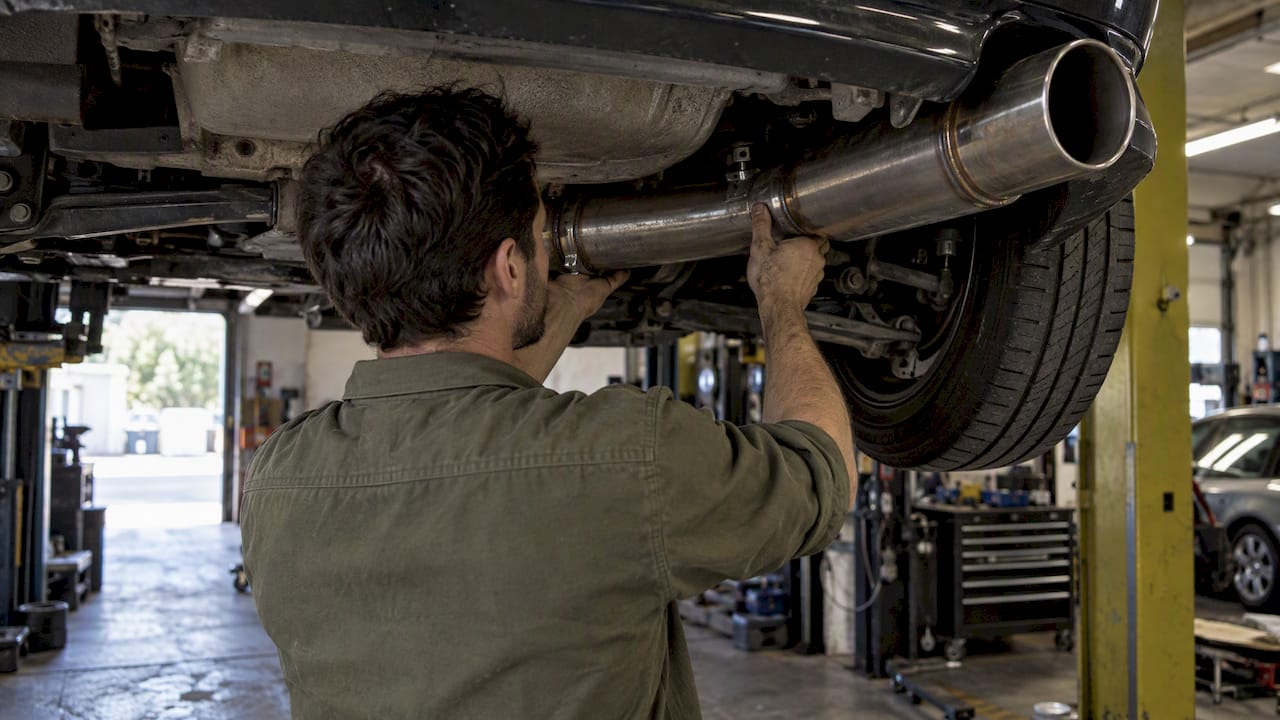
Engines don’t need backpressure. Any resistance in the exhaust means the piston has to push harder to clear the cylinder, and that costs power. What people feel when a bigger exhaust “kills torque” is a loss of exhaust gas velocity, which weakens scavenging. Those are two different things, and mixing them up is how builders end up with an oversized pipe and a flatter powerband.
This guide separates the two, shows where the myth came from, gives you real numbers for what’s healthy and what’s a restriction, and walks through how to size an exhaust for your platform.
TL;DR
- Backpressure is a pumping loss. Less restriction is better, never more.
- The “power loss from a bigger pipe” people report is usually lost velocity and weaker scavenging, not lost backpressure.
- Turbo cars care most about what happens after the turbine. NA cat-backs are mostly about sound and weight unless the rest of the engine breathes better too.
- A clogged cat or collapsed pipe is the real backpressure problem. A gauge at the upstream O2 sensor port tells you in minutes.
- Match the exhaust to your platform and power goals. Don’t just buy the biggest diameter.
Table of Contents
- Where the backpressure myth comes from
- What backpressure actually does to the engine
- Scavenging explained
- Backpressure vs. velocity vs. flow
- How much power can you expect?
- Why turbo cars are different
- Real backpressure problems: clogged cats and crushed pipes
- Our perspective: stop chasing a number
- How to choose an exhaust without falling for the myth
- Shop chassis-specific exhaust parts
- Common mistakes to avoid
- FAQ
- Sources
Where the backpressure myth comes from
The story usually goes like this. A builder swaps a stock exhaust for a much larger pipe on a naturally aspirated car. The car sounds great, but low-end and midrange feel weaker. The conclusion: “I lost backpressure, so I lost torque.”
The observation is real. The conclusion is wrong. A mechanic-trade write-up on the topic makes the same point: simply bolting on the largest pipes available often reduces power, because gas velocity drops too low at mid-range rpm and the scavenging effect goes with it. The goal isn’t zero backpressure at any cost. It’s the right velocity and flow for your engine’s rpm range.
So the pipe didn’t fail because it let gas out too easily. It failed because it was the wrong size for the engine’s airflow.
Two older beliefs ride along with this one:
- “Engines need backpressure to protect the valves.” No. Valve damage from a free-flowing exhaust isn’t a thing you should plan around. Burned valves on built engines usually trace back to lean fueling or heat, which is a tuning issue.
- “Backpressure builds torque.” Backpressure only adds work for the piston. What builds torque at low rpm is velocity and pulse timing.
What backpressure actually does to the engine
At the bottom of the power stroke, the cylinder is still full of exhaust gas. On the exhaust stroke, the piston pushes it out. As On All Cylinders explains, any backpressure or restriction means the piston has to push harder, which wastes energy that would otherwise go to the crank.

That’s a pumping loss. The engine spends some of its own output just to empty itself. Too much of it also has side effects. Manufacturer guidance for large engines, such as Scania’s exhaust system manual, says exceeding the specified backpressure limit leads to higher fuel consumption, higher combustion temperatures, overheating and lost power. That document covers industrial engines, so treat it as an illustration of the mechanism, not a spec for your Civic. It cites a limit around 100 mbar (about 1.45 psi) for those engines.
The takeaway for builders: backpressure never helps. It’s only a question of how much restriction your system has and whether you can reduce it without wrecking velocity.
Scavenging explained
If backpressure is always bad, why does exhaust tuning matter at all? Because of scavenging.
Exhaust gas leaves the cylinder in pulses. A fast-moving pulse leaves a low-pressure zone behind it. That low pressure helps pull the remaining spent gas out and, during valve overlap, helps draw fresh air and fuel into the cylinder. Properly designed headers use this to improve volumetric efficiency.
A few practical points follow:
- Scavenging depends on velocity. Gas speed is set by pipe diameter against the volume of gas the engine moves. Too big a pipe, gas slows, scavenging weakens.
- It improves with rpm. Higher rpm means higher gas velocities and a stronger vacuum effect, which is why a large pipe can feel dead down low and fine up top.
- Header design matters more than the muffler. Primary length, collector design and pulse timing are where scavenging is won or lost. This guide on the scavenging effect frames it as a balance of scavenging, backpressure and velocity.
So yes, an exhaust can “help” an engine. It does that by lowering restriction and by keeping gas moving at the right speed. Neither is backpressure.
Backpressure vs. velocity vs. flow
| Term | What it is | What you want |
|---|---|---|
| Backpressure | Resistance the piston must push against | As low as practical |
| Velocity | How fast exhaust gas moves through the pipe | High enough at your torque rpm to keep scavenging working |
| Flow capacity | How much gas the system can move at peak power | Enough for your airflow without a bottleneck |
The tension is between velocity and flow. A small pipe keeps velocity high but chokes at the top end. A big pipe flows freely at peak but can lag down low. That’s the balance a good system design is solving, and it’s why CarReformer’s breakdown says the engine wants good flow with stable gas velocity and minimal restriction.
How much power can you expect?
Here’s where honesty saves you money. According to the same CarReformer guide, reducing exhaust restriction on stock naturally aspirated engines typically gains about 2 to 5% at the wheels. Turbocharged engines paired with ECU tuning can see 5 to 15% in peak power.
That’s a range, not a promise. Results depend on how restrictive your stock system was, how the car is tuned and what else you’ve changed.
In practice that means:
- NA street car, cat-back only: small gains. You’ll mostly get sound, weight savings and a cleaner look. A cat-back on a stock NA engine is mainly about sound and weight, unless you support it with cams, headers or a tune.
- NA car with headers, cams and a tune: the exhaust is now part of a system, and a bigger pipe starts making sense.
- Turbo car: restriction matters much more.
Why turbo cars are different
On a turbo platform, restriction after the turbine raises the pressure ratio across it. The turbo and engine have to work harder to expel exhaust. That’s why a high-flow downpipe is foundational on turbo builds, per CarReformer.
If you’re on a turbo Civic, Accord 1.5T, or a turbo Camaro, the order of priority is usually downpipe or turbo-back first, then cat-back, then tune to take advantage of both. On an NA Miata, 350Z, G35 or BRZ, the headers and tune carry more of the weight, and a cat-back is the finishing piece.
Real backpressure problems: clogged cats and crushed pipes
The myth is harmless until it keeps you from diagnosing a real restriction. A clogged catalytic converter is one of the main causes of mysterious power loss on modern cars. The Motor Guy notes it’s rarely the first thing owners check, and that skipping the test leads to swapping spark plugs and injectors for no reason.
How to test it
Shops use a pressure gauge threaded into the upstream oxygen sensor port. Here’s the process:
- Warm the engine and let it idle in a safe, ventilated space.
- Remove the upstream O2 sensor (let the exhaust cool enough to avoid burns) and thread in the gauge with the correct adapter.
- Read at idle, then hold about 2,500 rpm.
- Compare to the numbers below.
According to the diagnostic figures the Motor Guy cites, a healthy engine generally shows less than 1.5 psi at idle and less than 2.5 to 3 psi at 2,500 rpm. Sustained readings above 3 to 5 psi point to a severe restriction like a collapsed pipe or clogged cat. A separate repair-advice page describes the same method and the same under-1.5-psi idle benchmark.
If you’re not comfortable pulling an O2 sensor or reading the result, take the car to a qualified technician. A high reading means stop driving it hard, since the restriction can cause damage.
One more caution on the fix: on a street car in the US, removing or gutting a catalytic converter can put you on the wrong side of emissions rules and inspection. Our post on straight pipe vs. cat-back covers fitting an exhaust without inspection trouble.

Our perspective: stop chasing a number
We see the same pattern in the questions builders ask: “How much backpressure do I need?” or “Will this be too loud and too free-flowing?” Those are the wrong questions.
We sell parts for specific chassis, and the thing we care about is fitment and function. On exhaust, that means we think about it like this:
- Start with the platform and the goal. A turbo 1.5L Civic and an NA FA20 BRZ don’t want the same pipe, even if both come in 3-inch options.
- Ask what else is changing. If you’re adding cams, a tune or headers, the exhaust can be sized to that airflow. If you’re stock, a modest cat-back is fine.
- Match diameter to airflow, not to bragging rights. Bigger is not a spec. Plenty of the best street cat-backs are in the 2.5 to 3 inch range for a reason.
- Material and weight are real benefits. Cutting weight off the rear of the car is measurable even when horsepower isn’t. Our titanium vs. stainless comparison goes into what to check on welds and finish.
- Test, don’t guess. If a car feels down on power, put a gauge on it before you throw parts at it.
None of that is hype. It’s a repeatable system: diagnose, define the goal, match the parts, verify.
— Ismael
How to choose an exhaust without falling for the myth
Use this checklist when you’re shopping:
- Confirm your engine type. Turbo or NA changes everything about where to spend first.
- Pick the section. Downpipe, cat-back or full system. Cat-back is the easiest bolt-on. Turbo cars see the most from the part nearest the turbine.
- Choose diameter for your airflow. Stock-ish power rarely needs much more than stock-ish diameter plus a smoother path. Higher-power builds can use larger piping.
- Look for mandrel-bent, smooth routing. Fewer sharp bends and less length mean less restriction, as manufacturers like Scania note in their exhaust manual.
- Check material. Stainless is the durable standard. Titanium trades cost for weight.
- Check legal fit. Know your state’s noise and emissions rules before you buy.
- Plan the tune. On turbo cars especially, tuning is how the gains show up.
A quick example
Take a stock 2016 to 2020 Civic 1.5T. The restriction behind the turbine is the real limit, so the best results come from a free-flowing exhaust paired with a tune. A 63mm stainless cat-back like the Injen cat-back for the 1.5L turbo Civic sedan is a straightforward, chassis-specific option for the back half of the system. Combine it with the rest of your plan and you have a setup, not a guess.
Shop chassis-specific exhaust parts
If you’re ready to pick parts, browse our exhaust systems collection. Each listing is built around fitment detail and technical specs for your platform, so you can buy with confidence instead of crossing your fingers. We also carry intakes, suspension and aero, which you can find from the Underground Dynamics home page.
Common mistakes to avoid
- Buying the biggest pipe on the shelf. Bigger isn’t automatically better and often costs midrange.
- Blaming the exhaust for a tuning problem. If fueling is off, neither a big nor a small pipe fixes it.
- Ignoring the cat. A restricted converter can cancel out everything your new parts do.
- Expecting a cat-back to transform an NA engine. Plan for sound and weight first, power second.
- Skipping the tune on a turbo car. The gains in the 5 to 15% range come with tuning support, not the pipe alone.
FAQ
How much exhaust back pressure is acceptable?
As little as you can get. On a healthy car, shop diagnostics generally put it under 1.5 psi at idle and under 2.5 to 3 psi at 2,500 rpm, per The Motor Guy. Consistent readings above 3 to 5 psi suggest a serious restriction. Your engine’s manufacturer spec, if published, is the one to follow.
Is exhaust back pressure good or bad for my engine?
It’s bad for performance, because it adds pumping loss and makes the piston work harder. What helps is exhaust velocity and scavenging, which come from good design. Engine Labs walks through why the opposite belief took hold.
How do I get rid of exhaust back pressure?
First find out if you have a real restriction by testing at the upstream O2 port. If it’s a clogged cat or crushed pipe, repair or replace it. If the system is healthy and you want less restriction, a smoother cat-back or, on turbo cars, a high-flow downpipe is the usual path. Ask a qualified technician if you’re unsure how to test.
What happens when exhaust back pressure is low?
The engine wastes less energy pushing gas out, which is good. The trouble comes only when the pipe is so large that velocity drops and scavenging weakens, usually in the low and midrange. That’s a sizing problem, not a backpressure shortage.
What is exhaust scavenging in simple terms?
Fast exhaust pulses leave a low-pressure zone behind them, which helps pull spent gas out of the cylinder and draw in fresh charge during valve overlap. On All Cylinders has a clear diagram-led explanation.
Sources
- Engine Labs: Is Exhaust Backpressure Really Beneficial?
- On All Cylinders: Exhaust Scavenging, Explained
- Mechanic trade news: Exhaust Backpressure, Do We Need It?
- Scania exhaust system manual, industrial engines
- CarReformer: Performance Exhaust Systems, Power Gains and Limits
- The Motor Guy: How To Tell If Your Catalytic Converter Is Clogged
- Ricks Free Auto Repair Advice: Diagnose a Bad Catalytic Converter
- Low Offset: The Exhaust Scavenging Effect