FREE SHIPPING ON ORDERS OVER $150

Cart
0
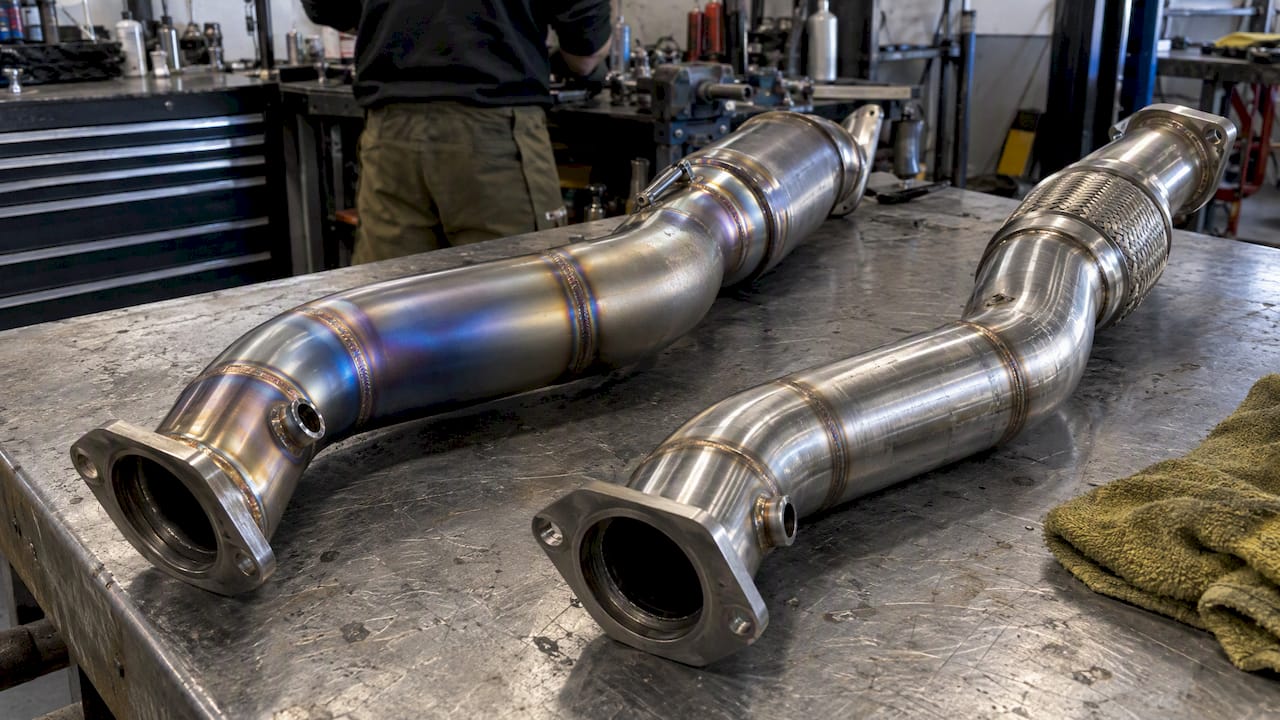
If your build chases every pound for track time, titanium wins; if you want a system that shrugs off daily driving and salt for years without drama, stainless steel is the smarter buy. The two materials trade weight and tone against cost and long-term toughness, and the right call depends on how you actually drive the car. Below, we break down the trade-offs and give you a checklist to make the call with confidence.
TL;DR:
- Titanium typically cuts exhaust weight by 30% to 40%, but handling gains are most noticeable in autocross, time attack, motorcycles, and weight restricted competition.
- On turbocharged or sustained high load builds, titanium retains exhaust heat longer, but pipe diameter and bends, not material, chiefly determine backpressure.
- Muffler, resonator, wall thickness, and pipe diameter shape exhaust tone more than material alone, so choose the sound hardware before paying titanium’s premium.
- Before buying titanium, confirm the whole system’s material, inert gas back purging, and safe joints to stainless; poor welds can oxidize or crack.
- Any catalytic converter replacement must retain a compliant certified converter under federal rules, and state inspection requirements can add further restrictions depending on location.
Table of Contents
- Titanium vs Stainless at a Glance
- How Exhaust Weight Affects Handling
- Thermal Performance and Backpressure Effects
- Why Titanium and Stainless Sound Different
- Durability, Corrosion, and Fatigue Realities
- What Drives the Cost Gap Between Materials
- Fabrication and Welding: What to Verify Before You Buy
- Emissions Rules You Need to Know Before You Swap
- How to Choose Between Titanium and Stainless
- Our Take on Matching Material to Fitment
- Build Your Setup With Fitment-Verified Parts
- FAQ
- Sources
Titanium vs Stainless at a Glance
Before you commit to a system, it helps to see how the two materials stack up across the attributes that actually affect your build.
- Weight: Titanium systems typically run 30 to 40% lighter than comparable stainless setups, according to enthusiast coverage comparing full exhaust systems.
- Sound: Titanium tends toward a higher-pitched, metallic tone; stainless leans deeper and throatier.
- Durability: Stainless grades generally outlast titanium on daily drivers exposed to road salt and moisture.
- Cost: Titanium carries a significant premium tied to material and specialized welding.
- Thermal behavior: Titanium holds heat differently in the gas stream, which matters for turbocharged and race applications.
A titanium system can shed roughly 30 to 40% of the weight of an equivalent stainless setup, per published testing and enthusiast reporting, which is the single biggest reason track builders pay the premium. Street cars built for daily use and longevity tend to do better with stainless.
How Exhaust Weight Affects Handling
Weight savings on an exhaust do more than lighten your trunk numbers. The exhaust sits low and far from the car’s center of mass, often stretching from the firewall to the rear bumper, so trimming mass there changes how the car rotates, not just how much it weighs.
- Removing weight at the vehicle’s extremities reduces polar moment of inertia, which practitioner-level technical analysis ties directly to quicker transient response.
- Faster turn-in and quicker direction changes show up most on cars that already corner hard, like autocross or time-attack builds.
- On a heavy daily driver, the same weight savings exist but you likely will not feel them in normal driving.
- Motorcycles and strict weight-class competition cars benefit the most, since every pound saved there is a bigger percentage of total vehicle weight.
Pro Tip: If you are chasing a lap time rather than a feeling, weigh your current exhaust before you buy. Knowing the actual pounds removed tells you more than any spec sheet.
Titanium earns its premium when your build lives on track days, in a weight-restricted class, or on two wheels. For a street car that sees mostly commuting and the occasional canyon run, stainless gets you most of the handling benefit without the price tag.
Thermal Performance and Backpressure Effects
Material choice changes how heat moves through your exhaust, and that affects more than comfort near the floorboards. Titanium and stainless conduct heat differently, which shapes how hot the gas stream stays as it travels toward the catalytic converter and muffler.
- Titanium tends to retain heat in the gas stream longer than stainless, which can help turbocharged setups maintain exhaust velocity and reduce lag.
- That same heat retention means components near the pipe, like wiring, heat shields, and sensors, see more thermal exposure and need proper shielding.
- Catalytic converter efficiency depends partly on reaching and holding operating temperature, so a hotter gas stream can help converter light-off on cold starts.
- Backpressure is driven mostly by pipe diameter and bends, not material, so do not expect a titanium swap alone to change flow characteristics.
- Race engines and turbocharged street builds running sustained high loads are where titanium’s thermal behavior offers the clearest advantage.
For a naturally aspirated street car with modest power goals, the thermal difference between materials is rarely the deciding factor. It matters more once you are chasing turbo response or running sustained high RPM on track.
Why Titanium and Stainless Sound Different
A lot of the tone difference people hear comes from material stiffness and how it transmits sound waves, not some mysterious property. Titanium is stiffer relative to its weight, which tends to produce a higher-frequency, almost metallic ring. Stainless flexes slightly more and tends to produce a deeper, fuller tone.
- Wall thickness changes resonance regardless of material: thinner walls ring higher, thicker walls deaden higher frequencies.
- Pipe diameter affects both volume and pitch, with larger diameters generally dropping tone lower.
- Muffler design and internal packing do more to shape final sound than the base pipe material in most builds.
- Resonators and mid-pipe choices let you dial in tone independent of whether you run titanium or stainless.
If you want a specific sound, pick your muffler and mid-pipe architecture first, then treat material as a secondary tuning knob rather than the main lever.
Durability, Corrosion, and Fatigue Realities
Longevity comes down to how each material handles moisture, heat cycling, and fabrication quality, and the two behave differently under real-world conditions. Stainless grades like 304 and 409 resist corrosion well, especially with adequate wall thickness, and they tend to shrug off years of road salt and weather on a street-driven car.
- Titanium resists corrosion in theory, but poorly welded joints are more vulnerable to oxidation and cracking over time.
- Fatigue cracking in titanium systems is tied closely to fabrication quality rather than the material itself failing on its own.
- Correct welding technique matters enormously, since a well-built titanium system can outlast a sloppy stainless one, and vice versa.
- Winter driving with heavy salt exposure favors stainless, since the daily thermal and chemical cycling is harder on marginal titanium welds.
Pro Tip: Ask any vendor how they weld their titanium joints before you buy. A system built without proper atmosphere control is a crack waiting to happen, no matter how light it is.
Published consumer research backs this up directly: for daily-driven cars exposed to salt and routine use, properly specified stainless systems often outlast titanium because titanium’s weak points sit right at the welds.

What Drives the Cost Gap Between Materials
Titanium costs more for reasons that go beyond raw material pricing. The metal itself is pricier than stainless, but the bigger driver is fabrication: titanium welding requires specialized equipment, shielding gas, and skilled labor, and the supply chain for aerospace-grade tubing is thinner than for common stainless alloys.
- Material cost alone can run several times higher per foot than equivalent stainless tubing.
- Specialized welding (back-purged, inert atmosphere) adds labor cost that stainless fabrication does not require.
- Limited supplier availability for high-quality titanium tubing can mean longer lead times and fewer options.
- The premium is easiest to justify on competition builds, strict weight classes, or motorcycles where every pound counts.
- For a street car with no weight restrictions, that premium often buys less practical benefit than putting the same budget into suspension or tires.
Set your budget around your actual use case. If you are not racing or weight-restricted, stainless usually delivers more value per dollar spent.
Fabrication and Welding: What to Verify Before You Buy
Not every “titanium exhaust” is actually titanium end to end, and fabrication quality determines whether the material advantage holds up.
- Confirm the welding process: titanium requires back-purging with inert gas to prevent oxidation and brittle welds.
- Understand bending limits: titanium is harder to mandrel-bend cleanly than stainless, which affects achievable pipe routing.
- Ask about dissimilar metal joints: when titanium meets stainless flanges or hangers, research on titanium-to-stainless joining confirms brittle Ti-Fe intermetallics form at the joint, so proper interlayers or joining methods matter.
- Run the magnet test: titanium is non-magnetic, so a magnet that sticks to the “titanium” piping tells you it is actually steel.
- Ask directly whether the entire system is titanium or just the tips, since mixed-material systems are common and priced to look like a full upgrade.
Pro Tip: A quick photo request of the welded joints before purchase will tell you more about build quality than any marketing copy.
Emissions Rules You Need to Know Before You Swap
Replacing or removing a catalytic converter with a noncompliant pipe, sometimes sold as a “test pipe” or converter replacement pipe, is prohibited under federal rules. EPA guidance on exhaust system repair treats this as tampering under the Clean Air Act, and it applies regardless of material choice.
- Keep converter placement and specification compliant whenever you modify exhaust routing.
- Use certified replacement converters where your original setup requires one.
- Check your state’s specific inspection and emissions rules in addition to federal guidance, since requirements vary by location.
- Ask your fabricator directly how they plan to keep the finished system emissions-compliant.
How to Choose Between Titanium and Stainless
Work through these questions in order, and the right material usually becomes obvious by the third one.
- Define your primary goal. If your build is track-focused and weight-restricted, titanium’s savings matter. If it is a street car driven year-round, durability and cost should lead.
- Check your exposure to salt and moisture. Daily drivers in winter climates favor stainless for its forgiving corrosion behavior.
- Decide how much sound tuning matters to you. Remember that muffler and mid-pipe choices shape tone more than material alone, so do not pay a titanium premium purely for pitch.
- Set a real budget. Titanium systems typically cost significantly more up front; decide if that money is better spent on weight savings or elsewhere in the build.
- Interrogate the vendor. Ask whether the entire system is titanium or just visible sections, what welding process they use, what warranty they offer, and what weight savings they can document for your specific application.
-
Match the material to your archetype:
- Track or competition builds with weight limits: titanium.
- Weekend street cars with occasional track days: stainless, unless weight is a scoring factor.
- Motorcycles: titanium, where the percentage weight savings is largest relative to total vehicle mass.
- Restored or collector cars driven occasionally: stainless, for long-term reliability without constant upkeep.
Once you know your archetype, the material choice stops being a debate and becomes a straightforward spec decision.
Our Take on Matching Material to Fitment

We spend our time thinking about fitment data because a part that is theoretically lighter or louder does not help you if it does not bolt up cleanly to your chassis. When we evaluate exhaust-compatible hardware and supporting components for popular platforms, we weigh material claims against actual fitment specs, not marketing language.
For most street-driven platforms we support, we lean toward recommending stainless-based systems paired with properly specified supporting hardware, since that combination tends to hold up best across daily use and varied climates. For track-oriented or weight-restricted builds, titanium earns its place when the fitment data and weld quality back up the claims. Either way, we think the material decision should follow your actual use case, not the other way around.
— Ismael
Build Your Setup With Fitment-Verified Parts
Once you have settled on titanium or stainless for your exhaust, the rest of your build should follow the same logic: match parts to your actual platform instead of guessing. We carry exhaust systems and the suspension, intake, and chassis hardware that round out a performance build, each listed with the fitment detail and technical specs we think you need to buy with confidence.
If you are unsure whether a given component fits your specific year, trim, or modification level, check the product fitment page first or reach out to us directly for build-specific guidance. We would rather help you get the right part the first time than have you deal with a return.
FAQ
Should I get a titanium or stainless steel exhaust?
Choose titanium if your build is weight-restricted or track-focused, since it is commonly reported as much lighter than a comparable stainless system, typically by about a third or more source. Choose stainless if you drive daily, deal with road salt, or want the lower-maintenance option for long-term reliability.
What are the downsides of using titanium exhaust pipes?
Titanium costs significantly more due to material price and specialized welding, and poorly fabricated welds are more prone to cracking and oxidation over time. It also requires careful handling during joining to stainless components, since brittle intermetallics can form at dissimilar metal joints.
Which metal is best for exhaust?
There is no single best metal: titanium suits weight-sensitive track and motorcycle builds, while stainless suits daily drivers that need corrosion resistance and lower cost. The right choice depends on how the vehicle is actually used, not which material sounds more advanced.
Does a titanium exhaust sound better?
Titanium tends to produce a higher-pitched, metallic tone compared with stainless steel’s deeper sound, though neither is objectively “better”. Wall thickness, muffler design, and pipe diameter influence final tone more than material alone.
What should I check before replacing my exhaust’s catalytic converter section?
Federal guidance prohibits replacing a catalytic converter with a noncompliant pipe, so any work near that section must keep a certified converter in place. If you are scrapping an older vehicle instead of repairing it, some regional services handle vehicles missing a catalytic converter as part of standard removal, though emissions compliance rules still apply to any vehicle staying on the road.
Sources
- Why You Might Want To Think Twice About Adding A Titanium Exhaust To Your Project Car
- Exhaust System Repair: Questions and Answers, U.S. EPA
- Solid-state joining of titanium alloy to stainless steel (research thesis/report)