FREE SHIPPING ON ORDERS OVER $150

Cart
0
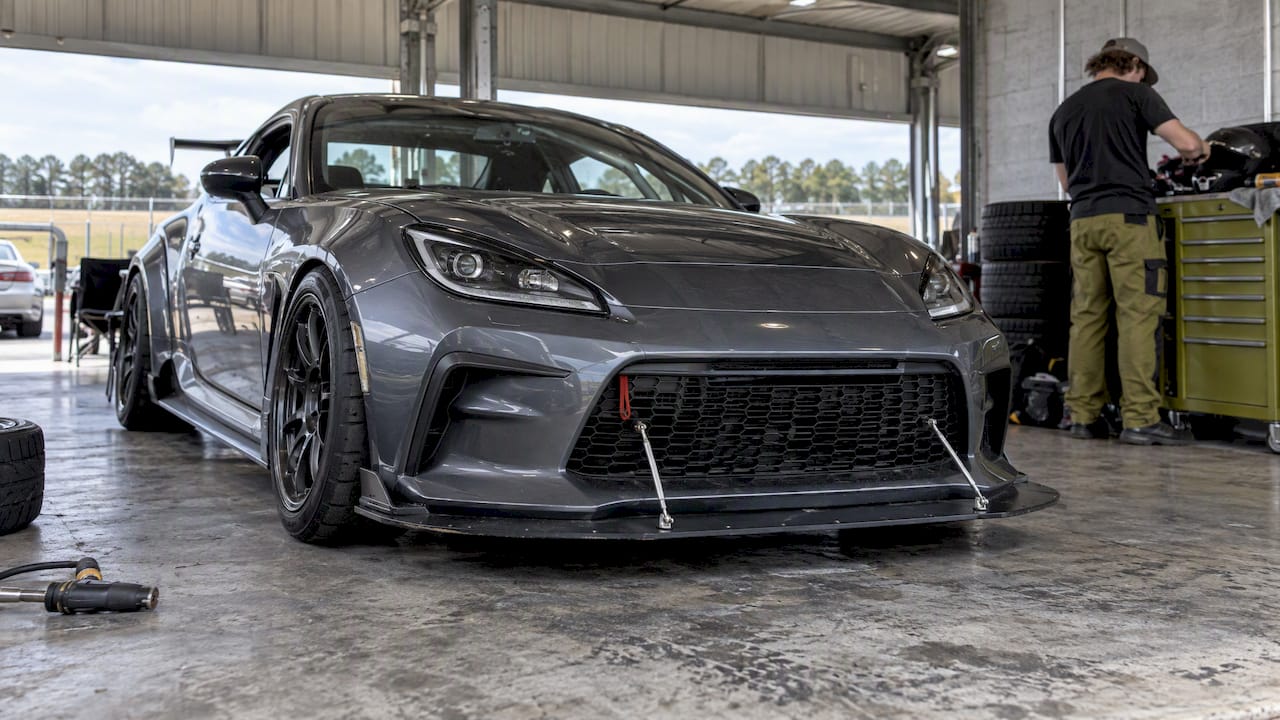
Splitter rods tie the leading edge of a front splitter back to the car, so the blade doesn’t flex, sag or crack once air starts pushing down on it. They are a brace, not a source of grip. Whether you need them depends on how far the splitter sticks out, how it’s mounted, and how fast you drive.
This guide covers what the rods do, when they earn their place, when they get in the way, and how to decide for your own build.
TL;DR
- Rods support the front edge of a splitter against downforce, bumps and vibration. They add no downforce themselves.
- They aren’t mandatory on every car. A short lip on a street car often needs none. A long blade on a track car usually does.
- External rods add drag and clutter. A properly engineered internal mount can replace them if you have the budget and fabrication skills.
- Rod angle matters. A rod set at a shallow angle braces far less than one that’s closer to vertical.
- If you track the car, build in a breakaway point so a curb strike doesn’t push force into the radiator or frame.
Table of Contents
- What a splitter does, and why it needs help
- The real purpose of splitter rods
- Are splitter rods necessary?
- Why rod angle matters more than most people think
- The downsides of external rods
- Replacing rods with internal mounting
- Mounting a splitter safely
- Our take
- Picking rods or planning around them
- Where to start if you’re building
- FAQ
- Sources
What a splitter does, and why it needs help
A splitter is a flat horizontal plane that extends forward from the bottom of the front bumper. It splits the oncoming air. Some air goes over the car, and the air that goes under is accelerated, which creates low pressure and adds front downforce. An air dam is a different part: a vertical panel that blocks high-pressure air from getting under the car. The two often work together, as laid out in this aerodynamics study on passenger-car body kits.
Here is the catch. That pressure difference pushes down on a big flat plate that is only held at one edge. The back of the blade is bolted near the bumper or chassis. The front is cantilevered out in the wind. The more it overhangs and the faster you go, the more the front edge wants to bend downward.
That is the job rods do. They run from the front of the blade up and back to a solid point on the car, turning a floppy cantilever into a braced structure.

The real purpose of splitter rods
Rods do three things, and they are worth keeping apart.
1. Resist bending under load
One builder on a Mustang forum put it plainly: rods aren’t strictly necessary but have a purpose, especially if you race. They support the splitter against the downforce pushing on it and help level it out. Without them, the blade can flex.
On a Supra forum thread about a bolt-on splitter, owners describe the rods as reinforcing the splitter against the air pushing down on it and helping prevent flexing and cracking while driving. The same thread notes that on some designs the splitter tray bolts to the underside of the car, not only the bumper, which changes how much the rods have to do.
2. Keep the blade at its intended angle
A splitter that droops at speed is no longer the shape you chose. Its angle changes, its gap to the ground changes, and the airflow under the car changes with it. Rods hold the blade where you set it, so the car behaves the same on lap 15 as on lap 1.
That consistency matters for feel. Teams at the top of the sport design front-end aero partly to give drivers confidence. Racecar Engineering’s look at the Mustang GT3 update shows a reprofiled front splitter chosen to give teams more setup options, including running higher on bumpy circuits with less aero penalty. Most of us don’t have a GT3 budget, but the lesson carries: a rigid, repeatable front end makes the car more predictable to drive hard.
3. Allow a controlled failure
A splitter is often the lowest, most forward part of the car. It meets curbs, driveway lips and trailer hitches before anything else does. Rods can be designed to bend or release instead of passing the hit straight into the car. A controlled-flex design is how some commercial rods are sold, and the Studio VRM mounting write-up covers why experienced track drivers use sacrificial hardware so a minor strike doesn’t wreck the radiator support or frame.
That same write-up explains why rods show up in time attack: the class rules there allow a splitter that extends 3 inches past the bumper, and at that overhang you need rods to stop the blade bending excessively.
Are splitter rods necessary?
Short answer: sometimes.
Use this as a rough decision filter.
| Situation | Rods needed? | Why |
|---|---|---|
| Short street lip, mostly cosmetic | Usually no | Little overhang, little load |
| Lip kit on a daily driver at highway speed | Rarely | Light load, and the part is designed as a whole |
| Bolt-on splitter with a long blade, street and occasional track | Often yes | Overhang plus speed leads to flex and cracks |
| Track or time attack, large overhang | Yes, or an equivalent internal structure | High load, repeated impacts |
| Chassis-mounted splitter with strong internal brackets | Maybe not | The brackets do the rods’ job |
Two things push the answer toward yes: overhang and speed. Two things push toward no: a stiff splitter material and a mount that already supports the blade well back from its leading edge.
The honest caveat is that a lot of cars wear rods for looks. One of the top-ranked threads asks exactly that, and plenty of replies lean toward style. If your splitter is a small, rigid lip that sees public roads only, rods are a styling choice. That’s fine. Just don’t tell yourself they are doing structural work.
Why rod angle matters more than most people think
A rod is strongest in a straight push or pull along its length. It braces best when it runs nearly in line with the load, which on a splitter is mostly vertical. Set the rod at a shallow angle, laid back toward the bumper, and most of its force goes sideways instead of up. A forum thread on rod opinions makes the same point: putting the rods at such a shallow angle reduces their effectiveness at stabilizing the splitter.
Practical rules of thumb:
- Anchor the top end to something structural, not a thin plastic bumper cover.
- Mount the lower end as close to the front edge of the blade as the design allows.
- Pick the steepest angle that clears the bumper and your ride height.
- Use adjustable ends so both sides match and you can level the blade.
- Check that the hardware doesn’t loosen. Rods that rattle are working loose.
One caution: rods braced to a bumper cover alone only move the problem. If the bumper cover is the weak link, the whole assembly flexes together.
The downsides of external rods
Rods are not free.
Drag. Anything sticking out in the airstream costs efficiency. A Miata aero forum thread from an experienced shop points out that external supports such as rods or cables increase drag, and that supports mounted behind the bumper are cleaner. The shop’s view in that thread is that there are only specific reasons to use rods at all, and that in most cases they can be designed away.
Stiff rods transfer impact. A rigid rod bolted solidly can carry a curb hit back into the front structure. That’s why breakaway points matter.
Cosmetic cost. Some people love the look. Others find it busy. That is a personal call.
Alignment and maintenance. Rods have to be matched left and right and checked after every hard session.
Replacing rods with internal mounting
The alternative is a splitter supported by brackets tucked behind the bumper and air dam, anchored to the chassis. Builders sometimes call these arch-mounts or give them nicknames, and the aim is the same: rigidity without exposed hardware. The Miata thread above describes this as the cleaner approach.
The trade-offs:
- Pros: less drag, cleaner look, solid support closer to the load path.
- Cons: more fabrication, more cost, and you have to engineer it correctly. A poorly designed bracket can be worse than rods.
- Fits when: you have a dedicated track build, a fabricator you trust, and the budget.
For many street-and-track builds, a good set of rods is the sensible middle ground.
Mounting a splitter safely
If you drive on track, treat the mount as a system.
- Decide on overhang first. Check your class or event rules before drilling anything. Time-attack classes can specify how far past the bumper a splitter may extend.
- Support the blade where the load is. Mount points should sit well back, not only at the leading edge.
- Use a breakaway point. Thin pins or sacrificial hardware let the splitter let go in a minor impact, not transmit force into the radiator, frame or engine bay, as the Studio VRM guide explains.
- Fit rods only after the splitter is level. Set ride height and rake first, then brace.
- Inspect after every session. Look for cracks around bolt holes, bent rods and loose jam nuts.
- Balance front and rear. A strong front splitter with no rear aero makes a car nervous at speed. Look at your whole aero package, including side skirts and rear diffusers, and match the front to what the rear can support.
Materials matter too. Carbon fiber and fiberglass both work, but they don’t flex the same way. Fiberglass tends to crack when abused, and a rigid carbon blade can transmit more of a hit. Plan your rods or mounts around the material you pick.
Our take
We sell chassis-specific aero and suspension, and we see the same mistake over and over: people buy the splitter and treat the support as an afterthought. Then the blade sags, a bolt hole cracks, and they decide the part was junk.
Our view is simple. Start from how the car is used.
If it’s a street car with a modest lip, you probably don’t need rods, and you should say no to anyone pushing them as a must-have. Spend the money on tires or seat time.
If it’s a track car, think of the splitter as a structural part. Brace it, pick fitment that matches your chassis, and give it a safe way to fail. A rod set you can adjust and replace cheaply beats a fixed bracket you’d have to cut off after one bad curb.

And don’t let the aero outrun the suspension. A splitter only works at a consistent ride height, which is why aero buyers and suspension buyers keep crossing paths. Stiff, adjustable coilovers hold the car at the height the splitter was designed for. Pairing the two is a repeatable system, and it beats guessing.
We’ve written a separate breakdown of four splitter support rod types to match before you buy if you’re at the shopping stage.
— Ismael
Picking rods or planning around them
Use this checklist before you order.
- Measure overhang. How far does the blade extend past the bumper? The longer it is, the more it needs support.
- Identify the mounting points. Where does the splitter attach? To the bumper only, or to the chassis?
- Choose rod material for your use. Aluminum and reinforced fiber options exist. Check the ends: heim joints allow angle adjustment, which helps you set both sides equally.
- Check ground clearance. Rods that sit low will scrape on the same things your splitter does.
- Confirm fitment for your chassis. Generic parts need more trial and error than chassis-specific ones.
- Think about the next step. Do you plan to add a wing, diffuser or wide-body? Rods that suit a small lip may not suit a bigger setup.
Where to start if you’re building
If you’re putting together a front end for a specific chassis, we’d start with fitment. Our body kits collection groups aero kits by vehicle, and platforms such as the BRZ, FR-S and 86 have their own page: ZN6/ZC6 aero and suspension parts. Pair that with coilovers so the ride height you set stays where you put it. Everything we list is carbon fiber or fiberglass, and we show fitment details so you can check a part against your car before you buy.
FAQ
Are splitter rods necessary?
Not always. A short, rigid lip on a street car often does fine without them. A long, bolt-on blade used at track speeds usually needs them, or an equivalent internal structure. The deciding factors are overhang, speed and how well the blade is supported near its leading edge.
Do splitter rods add downforce?
No. The splitter generates the downforce. The rods only hold it in position so it can keep doing that job without flexing or drooping. Adding rods to a splitter that is already well supported won’t change your grip.
Do splitter rods hurt aerodynamics?
External rods can add drag, because they sit in the airflow. Builders who want the cleanest result mount supports behind the bumper instead. For most street and club-level cars, the stability gain from rods outweighs the small efficiency cost.
Is a splitter the same as a front spoiler or lip?
Not quite. A splitter is a horizontal plane that extends forward to divide the air and create front downforce, while an air dam is a vertical piece that limits air going under the car. A lip or spoiler is often a smaller piece that may combine some of both. Check how far the part extends and how it is mounted before you decide whether it needs support.
Sources
- Research and Development of a Body Kit for Passenger Cars to Enhance Aerodynamic Efficiency
- splitter rods, Mustang6G forum thread
- APR Splitter need rods?, SupraMKV forum thread
- Splitter support rods, how to make them go away, Miata Turbo forum
- How to Mount a Splitter (Safely), Studio VRM
- Inside Ford’s Mustang GT3 update programme, Racecar Engineering