FREE SHIPPING ON ORDERS OVER $150

Cart
0
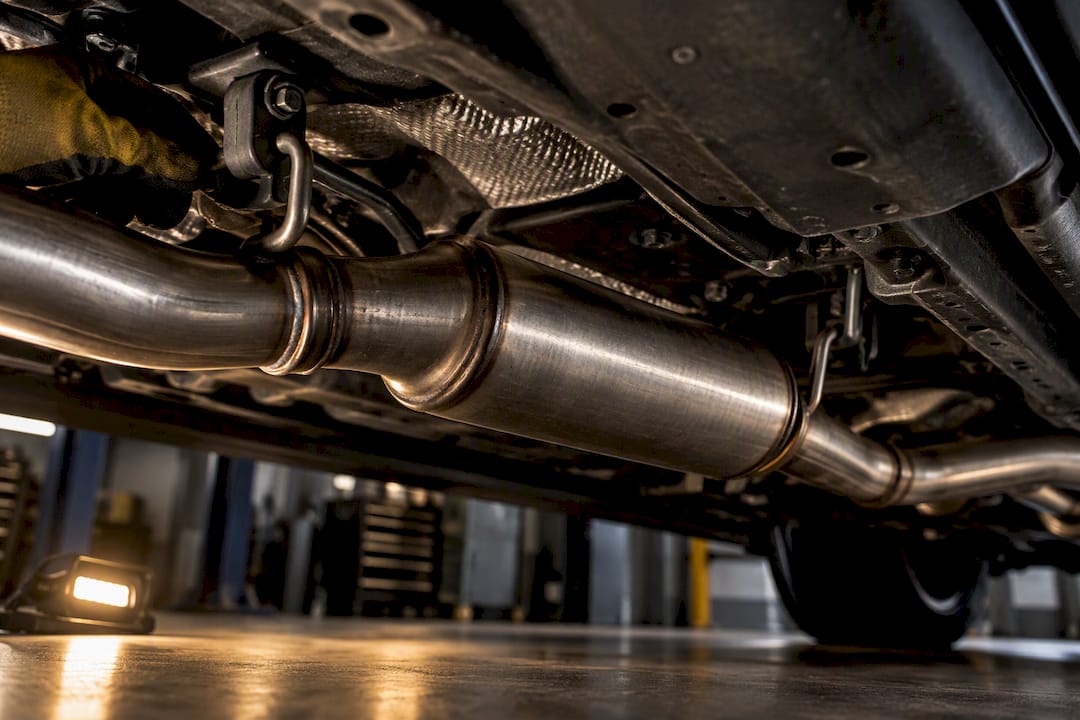
Most drone problems clear up in two steps: check and replace worn hangers or mounts first, then add or swap in a resonator, or move to a chambered muffler if the boom stays put. If the noise sticks to one narrow rpm band after that, you’re looking at a tuned Helmholtz or quarter-wave side-branch, which costs more but nails the exact frequency causing you grief.
TL;DR:
- Worn hangers and mounts are the most common cause of exhaust drone, and replacing or repositioning them can often fix the issue.
- Using a temporary strap test can confirm if mounting hardware is contributing to drone, saving repeat visits and unnecessary parts.
- Fixed hardware solutions like resonators, chambered mufflers, or side-branch tuners target specific frequencies, with side-branches offering the most precise fix.
- Placement and chamber size are crucial in tuning Helmholtz resonators or quarter-wave tubes to effectively cancel the offending frequency.
- Accurate RPM testing and recording before making modifications help ensure that the right fix is chosen and reduce trial-and-error.
Table of Contents
- How to tell if the sound is exhaust drone
- Immediate low-effort fixes to try first
- Hardware solutions that reliably fix drone
- Resonator and Helmholtz tuning explained
- Vibration isolation and chassis transmission
- DIY versus professional installation
- Practical fitment and product notes from Underground Dynamics
- The most cost-effective way to chase down drone
- How Underground Dynamics can help
- Sources
- FAQ
How to tell if the sound is exhaust drone
Drone is a low, droning hum, more of a pulse than a growl, and it usually shows up at a steady cruise rather than under acceleration. It’s the sound of your exhaust amplifying itself at a specific engine speed, not a leak or a rattle, though those can complicate the picture if they’re happening too.
The tricky part is that drone is rpm-specific. You might drive around fine at 2,000 rpm, hit 2,600 to 3,000, and suddenly the cabin turns into a subwoofer. Different cars drone at different bands depending on pipe length, engine displacement, and what’s been removed from the system, but that steady-cruise, narrow-band pattern is the signature.
Here’s how to confirm it before you spend a dollar on parts:
- Find a safe stretch of road and hold steady speeds in each gear, noting the exact rpm where the boom starts and stops.
- Repeat under light throttle and under load (slight uphill or with the AC on) to see if the band shifts.
- Listen from outside the car at idle and at the drone rpm using a phone recording, since cabin drone often sounds different from what’s happening at the tailpipe.
- Get under the car with a flashlight and check for soot trails, black streaks, or crushed hangers, which point to a leak rather than pure drone.
- Wiggle the exhaust by hand at each hanger point and listen for looseness or metal-on-metal contact against the floor or subframe.
Write down the rpm band and conditions. That detail is exactly what a shop needs to pick the right fix instead of guessing, and it’s the difference between one visit and three.
Immediate low-effort fixes to try first
Before you touch any exhaust hardware, look at the cheap stuff. Worn rubber hangers are one of the most common, easiest-to-miss causes of what feels like exhaust drone, because a stretched or torn hanger lets the pipe sag, shift, and transmit vibration straight into the floorpan instead of isolating it.
- Inspect every rubber hanger and mount along the system and replace any that are cracked, stretched, or torn loose.
- Try repositioning a hanger by one hole if the pipe is sitting at an angle that puts it closer to the chassis or heat shields.
- Add an extra hanger point on a long unsupported span, which can quiet a resonance without changing a single pipe.
- Do a temporary strap test: loop a ratchet strap or bungee around the muffler and pull it slightly off its normal hang point to see if the drone changes pitch or drops out.
- If your system is modular, swap in a resonator section before assuming you need a whole new muffler.
If a strap test kills or shifts the drone, you’ve confirmed the exhaust’s mounting geometry is part of the problem, not just the internal muffler design.
This is also where muffler-delete regret usually gets fixed. Removing a resonator or chambered section is a common cause of new drone, and reversing that by adding a resonator back or fitting a chambered muffler typically resolves it without giving up much performance.
Pro Tip: Record a short video of the strap test with audio before and after; it’s the fastest way to show a shop exactly what changes and saves you from re-explaining the problem in person.
Hardware solutions that reliably fix drone
Once hangers and quick swaps don’t finish the job, you move to purpose-built hardware. Each option targets drone differently, and picking the right one depends on how narrow your problem band is and how much fabrication you’re willing to pay for.
- Resonators cancel a narrow frequency band using an internal chamber tuned to that range, and they’re the first real hardware step because they’re modular, affordable, and don’t gut your tone.
- Chambered mufflers attenuate low frequencies more effectively than straight-through designs, trading a little flow for meaningfully less boom.
- Side-branch resonators (Helmholtz and quarter-wave designs) target the exact offending frequency by tuning chamber volume and neck or tube length, giving you the most precise fix available short of a lab.
- J-pipes function as a specialized side-branch, routed to fit tighter packaging while still tuning out a specific rpm range.
- X-pipes and H-pipes cross-connect the two banks on V6 and V8 engines, canceling out-of-phase pulses between banks, which reduces drone and reshapes exhaust tone at the same time.
Resonators work by canceling a specific frequency inside a chamber, and where you put that chamber matters as much as picking one at all. Placement close to the source of the standing wave, and volume large enough to handle your target frequency, determines whether the fix actually lands or just shifts the boom to a different rpm.
Chambered mufflers take a broader approach. Instead of canceling one frequency, they use internal baffles to break up sound waves across a wider range, which is why they handle low-end drone better than a straight-through glasspack or a muffler-delete pipe ever will. You give up a small amount of flow, but for most street builds that trade is worth it.
Helmholtz and quarter-wave side-branches are the surgical option. A Helmholtz design uses a sealed chamber connected by a neck, tuned so the trapped air mass resonates against the offending frequency and cancels it. A quarter-wave tube does something similar using a length of pipe closed at one end, sized so the reflected wave arrives out of phase with the noise you’re trying to kill. Both are narrower in bandwidth than a chambered muffler, meaning they’re excellent at killing one specific rpm band and less useful if your drone shifts around under different loads.
J-pipes and crossover pipes solve related but different problems. A J-pipe is essentially a packaged side-branch you can fit into tight factory routing without custom bending. X-pipes and H-pipes, meanwhile, are about phase cancellation between banks on V-configuration engines: they don’t just quiet drone, they change your exhaust’s whole tonal character, often making it deeper and less “buzzy” at cruise.
The trade-offs across all of these come down to three things: how wide a frequency range you need covered, how much space and weight you can spare under the car, and how much backpressure you’re willing to accept. A resonator adds minimal weight and backpressure for a narrow fix. A chambered muffler adds more weight but broader coverage. Tuned side-branches and crossovers require the most planning and often custom fabrication, but they solve problems the bolt-on options can’t touch.
Resonator and Helmholtz tuning explained
Every drone problem is really a standing wave problem. Your engine fires pulses down the exhaust at a rate tied directly to rpm, and at certain speeds those pulses line up with the pipe’s natural resonant length, reinforcing each other into the boom you hear in the cabin. Higher rpm means a higher pulse frequency; the specific rpm where that frequency matches your system’s resonant length is your drone band.
A Helmholtz resonator fights this with a sealed air volume connected to the main pipe by a short neck. The air in that chamber has its own resonant frequency, determined by the volume of the chamber and the length and diameter of the neck. Increase the chamber volume and the tuned frequency drops. A quarter-wave tube does the same job with a simpler shape, a length of pipe closed at one end, but it tends to work over a narrower band and is pickier about exact length.
Research on Helmholtz chamber design backs up the design lever that matters most: larger chamber volumes shift the tuned frequency lower and improve insertion loss across multiple load points, without pushing backpressure into a range that hurts performance.
Adaptive quarter-wave tube systems have demonstrated attenuation of roughly 15 to 26 decibels in controlled testing, which shows how much a properly tuned side-branch can achieve compared to a fixed, off-the-shelf resonator.
In practice, tuning means measuring your actual drone rpm, converting that to the offending frequency, and picking a trial chamber volume or tube length sized for that range, then testing and adjusting. Vehicle packaging limits how big a chamber you can fit, which is why fabricators often iterate with a slightly undersized unit before scaling up. One safety note that never gets skipped: any modification that adds openings or side-branches to the exhaust needs to be checked for exhaust leakage into the cabin, since carbon monoxide intrusion is a real risk with a poorly sealed joint.

Vibration isolation and chassis transmission
Not every drone complaint is actually about sound waves in the pipe. A lot of it is mechanical: exhaust pulses vibrating the pipe itself, and that vibration transmitting into the floorpan through worn or badly positioned hangers. When that happens, you can feel the boom in the seat and the steering wheel as much as you hear it, and no resonator in the world fixes a vibration problem.
- Replace worn hanger bushings with fresh rubber or polyurethane isolators rated for the heat and flex your system sees.
- Reposition mounts so the pipe hangs with even clearance from the floor, heat shields, and subframe at every point.
- Add an isolation pad or extra hanger at any point where the exhaust contacts the underbody directly.
Sound-deadening material inside the cabin can dull how loud the drone feels, but it’s a last resort, not a fix. If you’re leaning on mats and foam to make the noise tolerable, you’re masking a mechanical or tuning problem instead of solving it, and it’ll likely get louder as hangers wear further.
DIY versus professional installation
Some of this you can knock out in an afternoon with a jack and a socket set. Other parts of it need a welder and a trained ear.
- Hanger and mount swaps are DIY-friendly: jack stands, basic hand tools, and 30 to 60 minutes per hanger.
- Bolt-on resonator or muffler swaps are still DIY territory on modular systems, usually an hour or two including test drives.
- Welded side-branches, custom J-pipes, and tuned Helmholtz chambers need a fabricator with exhaust experience and access to a bender and welder.
- Crossover pipe installs (X-pipe or H-pipe) usually mean cutting into an existing system, so budget for professional welding unless you already have that gear at home.
Cost bands follow the same split: hanger parts alone are the cheapest fix you’ll make all year. Bolt-on resonators or mufflers with basic labor land in the moderate range. Custom fabrication and tuned side-branch work costs the most and takes the longest, often a full day in the shop once you include test-and-adjust passes.
Practical fitment and product notes from Underground Dynamics
The catalog includes chassis-specific fitment and technical spec sheets to help buyers choose a resonator or muffler section that fits their car. The ISR Performance GT single exhaust line, for example, lists fitment for the Nissan Z (RZ34), 350Z, and Hyundai Genesis Coupe 3.8, which matters when you’re choosing a catback section that changes muffler behavior rather than just the tip.
Speaking of tips, the ISR Performance EP dual-tip exhaust for the 350Z is a good example of why a tip-only swap rarely kills drone. If the section behind the tip doesn’t change the resonator or muffler internals, the frequency causing your boom is untouched. Look for parts built to alter that internal behavior or swap as a modular section, not just the visible end piece.
The most cost-effective way to chase down drone
Measure first, then change one thing at a time. Swap a single section, drive the same rpm test, and only escalate to tuned side-branches if a resonator or chambered muffler doesn’t close the gap. If tone matters more to you than comfort, accept some drone as the cost of that sound; if daily comfort matters more, prioritize the resonator or chambered muffler path before anything louder.
Keep a simple record: before and after audio clips at the same rpm. It saves repeat shop visits and arguments about whether anything actually changed.
— Ismael
How Underground Dynamics can help

Fitment-first shopping saves you from buying a resonator or catback section that looks right and doesn’t bolt up. The store offers exhaust systems, hanger bushings, and modular catback sections with chassis-specific specifications to assist customers in finding compatible fixes.
- Browse the full catalog for exhaust systems, hangers, and supporting hardware across popular enthusiast platforms.
- Check the performance parts category for modular catback and resonator options before committing to a full system swap.
- Replace worn isolators with ISR Performance hanger bushings sized for your chassis.
Confirm modularity and exact fitment on the product page before you buy, and reach out to support if you’re not sure which section addresses your specific drone band. A quick before-and-after recording at your problem rpm makes that conversation faster on both ends.
Sources
For readers who want the engineering detail behind the fixes above:
- Journal of the Technical University of Gabrovo (2025) - Helmholtz resonator volume effects
- AP Tuning — Exhaust drone fixes: Resonators, Helmholtz, and placement (Published 22 February 2026)
- Adaptive quarter-wave tube research and experimental results (AAS 2012 conference paper)
FAQ
What does it mean when an exhaust is droning?
Exhaust drone is a low, pulsing boom that shows up at a specific, steady rpm rather than across the whole range. It happens when exhaust pulses reinforce a standing wave inside the pipe at that engine speed, and it’s most noticeable at highway cruise.
What causes an exhaust drone?
Drone is most often caused by removing a resonator or chambered section, changing pipe length or diameter, or losing the standing-wave cancellation those parts were doing. Worn or misplaced hangers can add to it by letting vibration transmit into the chassis on top of the acoustic problem.
Does muffler delete cause droning?
Yes, removing a muffler or resonator is one of the most common causes of new drone because it deletes the chambered section that was canceling a specific frequency. Reversing it by adding a resonator back or fitting a chambered muffler usually clears the boom.
What are the symptoms of exhaust drone?
The main symptom is a low, humming boom that appears at a steady cruising speed and disappears or changes when you accelerate or decelerate through that rpm band. It’s often felt as vibration in the seat or steering wheel in addition to being heard, especially when worn hangers are transmitting pulses into the floorpan.
Should I try a resonator or a Helmholtz side-branch first?
Start with a resonator or chambered muffler since they’re modular, cheaper, and fix most drone cases without fabrication. Move to a tuned Helmholtz or quarter-wave side-branch only if the drone stays locked to one narrow rpm band after that first fix, since tuned side-branches target a specific frequency more precisely but cost more to build.