FREE SHIPPING ON ORDERS OVER $150

Cart
0
For most street-driven enthusiast cars, a cat-back exhaust is the right call. It keeps your catalytic converter in place, stays closer to legal noise limits, and gives you a tuned sound without the inspection headaches. Straight pipe setups make sense only for off-road or track-only machines with documented exemptions, since running one on public roads risks failed inspections, noise citations, and tampering penalties. The real decision comes down to sound, power, cost, and legality, and we’ll walk through all four.
TL;DR:
- Straight pipes commonly reach 100 to 120 dB, while many state passenger vehicle limits fall between 80 and 95 dB, creating citation risk.
- Cabin drone often peaks around 1,800 to 2,500 RPM, and retaining a resonator can reduce resonance during steady highway cruising.
- Headers, a catback system, and an ECU tune offer a more reliable route to measurable gains than a straight pipe alone.
- Converter removal can violate federal emissions law, so reserve straight pipes for documented competition cars that never use public roads.
Table of Contents
- 1. Straight pipe vs catback across sound, power, and legality
- 2. Sound and daily driving: tone, loudness, and cabin drone
- 3. Performance effects: backpressure, exhaust tuning, and realistic gains
- 4. Cost, installation, and maintenance: what to budget and expect
- 5. Emissions, legality, and inspections you need to know
- 6. How to choose the right setup for your build
- 7. Why fitment matters more than exhaust volume
- 8. Shop exhaust systems and performance parts built for your platform
- FAQ
- Sources
1. Straight pipe vs catback across sound, power, and legality
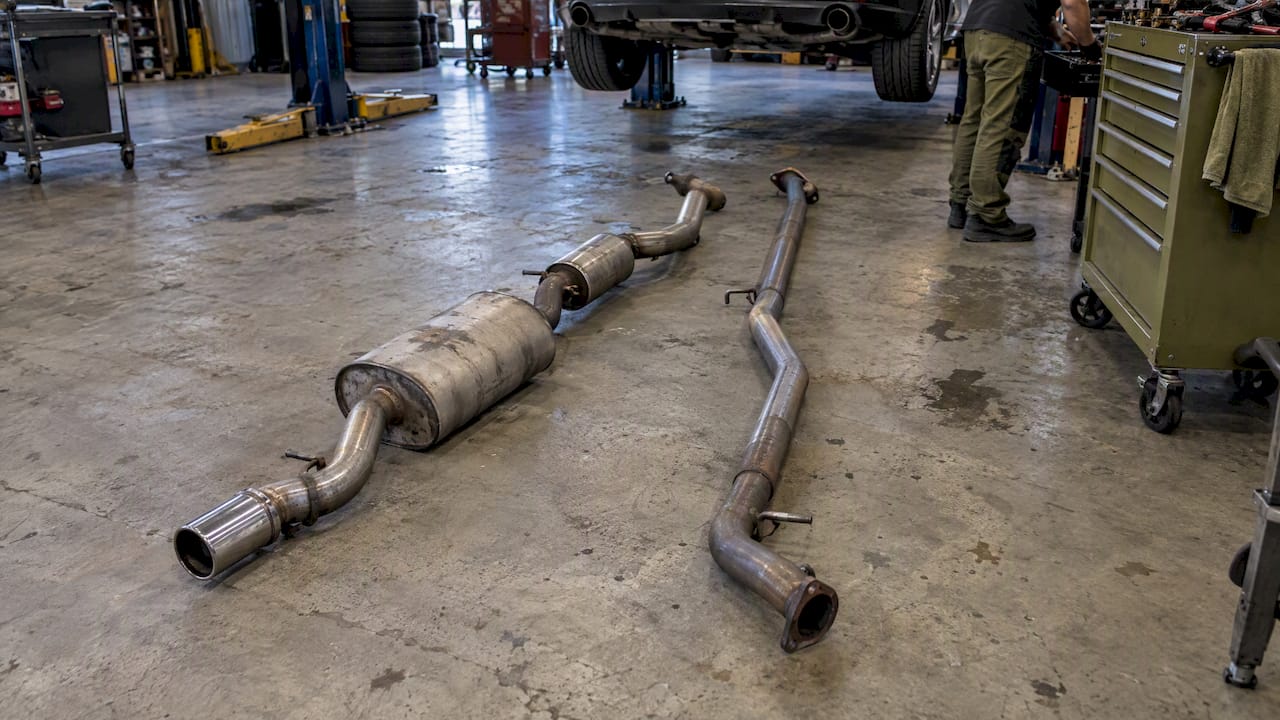
Before you pick a side, it helps to know exactly what each setup is. A cat-back exhaust replaces everything from the catalytic converter backward: mid-pipe, resonator, muffler, and tailpipe, while leaving the converter and front pipe untouched. A straight pipe strips things down to bare piping, often removing the converter, resonator, and muffler altogether so exhaust gases exit with minimal restriction.
That single difference drives everything else.
Sound. Cat-back systems are built around a muffler and often a resonator, so you get a shaped tone: deeper, louder than stock, but tuned to avoid harshness. Straight pipes skip the sound-deadening hardware entirely, which means raw, unfiltered exhaust note and a lot more volume. Community reports and enforcement cases put straight-pipe output around 100 to 120 decibels at the exhaust exit, well above what most states allow for passenger vehicles.
Performance. Both setups can improve exhaust flow versus a restrictive stock system, but the gains depend on more than just removing parts. SAE research shows pipe diameter, length, and muffler or converter placement all affect backpressure and how an engine responds across the rev range. A straight pipe reduces backpressure further than a cat-back, but without a tune to match, that change can hurt low-end torque and throttle response instead of helping.
Emissions and legality. This is where the two setups diverge hardest. A cat-back keeps your catalytic converter intact, so it doesn’t touch your emissions compliance. A straight pipe that removes or bypasses the converter is a different story: EPA guidance is direct that converter-replacement pipes and other devices built to bypass emissions controls are prohibited under the Clean Air Act, and most states layer their own noise and tampering laws on top.
Cost and installation. Cat-back kits are typically bolt-on, designed to match factory mounting points, so a shop can swap one in without custom fabrication. Straight pipe setups, especially custom ones, often require welding and fitting work, which adds labor time and cost even though the parts themselves can be simpler.
Daily drivability. This is where a lot of enthusiasts get surprised. A straight pipe sounds aggressive in the driveway, but at steady highway speeds that same system can produce a droning resonance inside the cabin that gets tiring on long drives. Cat-back systems, with their muffler and resonator tuned for a range of RPMs, usually manage that resonance better.
Here’s how the two stack up at a glance:
- Sound: cat-back stays tuned and closer to legal limits; straight pipe is louder and often drone-prone.
- Performance: cat-back offers modest, tune-friendly gains; straight pipe needs a tune to avoid hurting drivability.
- Emissions/legality: cat-back preserves converter compliance; straight pipe risks tampering violations if it removes the converter.
- Cost/installation: cat-back is usually a bolt-on job; straight pipe often means custom welding and more labor.
- Daily drivability: cat-back minimizes cabin fatigue; straight pipe can mean constant drone on long trips.
If you drive your car daily, the cat-back wins on nearly every practical measure. If your car lives on a track and never sees inspection, the calculus changes.
2. Sound and daily driving: tone, loudness, and cabin drone
The sound difference between these two setups comes down to what’s inside the pipe, not just the diameter. A muffler works by routing exhaust gas through chambers and tubes that cancel out specific sound frequencies, while a resonator smooths out drone-inducing frequencies before they reach the muffler. Pull both of those out, and you’re left with raw exhaust pulses bouncing straight through open piping.

One stat worth remembering: straight pipe systems are commonly reported in the 100 to 120 dB range at the exhaust exit, while many states set passenger vehicle noise limits closer to 80 to 95 dB, meaning a straight pipe can land well outside legal bounds in everyday driving conditions, according to EPA enforcement guidance.
Drone happens because certain engine speeds create exhaust pulses that resonate with the cabin’s natural frequency, usually somewhere in the 1,800 to 2,500 RPM cruising range. A straight pipe has nothing to break up that resonance, so it often shows up louder and more consistent at highway speeds. Cat-back systems with a resonator in the mix tend to cancel out more of that frequency before it ever reaches your ears.
A few practical ways to manage sound if you’re leaning toward an aggressive setup:
- Test drive before you commit: many shops can let you hear a demo car with the exact system you’re considering.
- Choose a cat-back with a resonator, not just a muffler, if drone at cruising speed worries you.
- Ask about chambered versus straight-through mufflers, since chambered designs tend to cut more drone at the cost of slightly more backpressure.
- Check community forums for your specific platform, since drone frequency varies by chassis and wheelbase.
If you’re building a car you’ll actually drive to work, this is the section that matters most. The loudest setup in the shop parking lot isn’t always the one you’ll want after a two-hour highway commute.
3. Performance effects: backpressure, exhaust tuning, and realistic gains
Backpressure gets blamed for a lot, but it’s not as simple as “more backpressure bad, less backpressure good.” Engines rely on a certain amount of exhaust pulse timing, called scavenging, to help pull fresh air into the cylinder on the next intake stroke. SAE testing shows that exhaust geometry, including pipe diameter, length, and the location of mufflers or catalytic converters, directly affects how well that scavenging process works across the rev range. Change one piece without accounting for the rest, and you can lose torque even while gaining peak horsepower.
That’s the trap with a straight pipe. Removing the catalytic converter cuts backpressure more aggressively than a cat-back swap, and it also removes the converter’s role in emissions control. Without a matching tune, that drop in backpressure can actually hurt low-end response and throttle feel, because the engine’s fuel and timing maps were calibrated around the stock exhaust’s flow characteristics.
For most enthusiasts chasing real gains, the more reliable path is a cat-back paired with a set of headers and an ECU tune, rather than a straight pipe alone. That combination lets you open up exhaust flow at both ends of the system while giving the engine computer a chance to adjust fuel and timing to match the new airflow. Stock systems are engineered to balance noise, emissions, and drivability all at once, and SAE research notes that aftermarket changes shift that balance, which is exactly why a tune matters once you start swapping parts.
A few things worth keeping in mind if power is your goal:
- Backpressure and scavenging work together, so removing all restriction isn’t automatically a performance win.
- Catalytic converter removal changes emissions behavior and can hurt low-end drivability without a tune.
- Headers plus a cat-back plus a tune typically deliver more consistent, measurable gains than a straight pipe by itself.
- Dyno testing before and after is the only reliable way to confirm whether a given change actually helped your specific engine.
If you’re serious about chasing numbers, book dyno time. It’s the difference between guessing and knowing what your setup actually does.
4. Cost, installation, and maintenance: what to budget and expect
Parts cost varies a lot depending on what you’re after. OEM-style cat-back kits sit at the lower end of the spectrum, while higher-end performance cat-backs with mandrel-bent piping and premium mufflers cost more but typically bolt in without modification. Custom straight-pipe fabrication tends to fall somewhere in between on parts, but the labor side changes the math.
Installation time reflects that difference. A bolt-on cat-back is usually a same-day job for most shops, since it’s designed to mount at factory hanger points with minimal cutting. A custom straight pipe, especially one built from scratch to fit your specific chassis, often means a welder is involved, which adds both labor hours and cost even when the parts list looks shorter.
Maintenance and ownership considerations matter just as much as the initial build:
- Tampering with emissions equipment can affect your warranty, since manufacturers can deny coverage on related components if they trace an issue back to a removed catalytic converter.
- Insurance claims can get complicated if an aftermarket exhaust is tied to a failed inspection or a documented tampering violation.
- Bolt-on cat-backs are easier to service and replace down the line, since they’re built to standard fitment points.
- Custom straight pipes can be harder to revert, especially if factory hardware was cut or discarded during the install.
Before any work starts, get written fitment specs and a firm estimate from your installer, and ask directly whether they can restore stock components if you ever need to pass an inspection. That one conversation can save you from a surprise bill later.
5. Emissions, legality, and inspections you need to know
This is the part of the decision that carries real financial risk, not just a judgment call about sound. EPA guidance is clear that aftermarket parts intended to bypass or remove emissions controls, including converter-replacement pipes, are prohibited under the Clean Air Act, and that tampering can make a vehicle noncompliant with federal emissions law. A related EPA fact sheet spells out that replacing a catalytic converter with a straight pipe can violate section 203(a)(3) of the act and may carry civil penalties, with the only narrow exception being vehicles intended for export.
The practical fallout is real: a straight pipe without a catalytic converter will very likely fail an emissions inspection in any state that requires one, on top of the noise citation risk if your local jurisdiction enforces a decibel limit, and many U.S. states set that limit somewhere between 80 and 95 dB for passenger vehicles.
If you want aggressive sound and flow without that exposure, a few compliant routes exist:
- Look for CARB or EPA executive-order-approved parts, which are tested and certified to meet emissions standards.
- Keep your catalytic converter in place and build your sound and performance goals around a cat-back instead.
- Reserve a true straight pipe for a documented track-only or off-road vehicle, since enforcement discretion generally applies only to permanently converted competition cars, not daily drivers.
- Verify your state and local inspection requirements before you buy, since rules vary and change.
Keep documentation for any part that claims compliance. If you ever get pulled over or face an inspection dispute, that paperwork is what backs you up. For more on how aftermarket changes intersect with inspections, our post on avoiding tickets and failed inspections covers similar ground for body modifications.
6. How to choose the right setup for your build
Your use case should drive this decision more than anything else. Walk through this checklist before you buy:
- How often is this your daily driver? If it’s your primary transportation, prioritize cat-back.
- Does your state require emissions or safety inspections? If yes, keep your catalytic converter.
- How much noise can you tolerate on a two-hour drive? Drone fatigue is real and underrated.
- What’s your budget for parts and labor? Bolt-on cat-backs are typically more predictable to price out.
- Is this car ever going to see a track, and is it documented as track-only? That changes what’s actually legal for you.
For most builds, a cat-back paired with a proper tune covers the goal of sound, modest power, and street legality in one package. Save the straight pipe for a car that never touches public roads.
Before you commit, ask your installer three things: will the catalytic converter stay in place, does this exhaust require a supporting tune, and can they restore stock parts if you need to pass inspection later.
Pro Tip: Bring your VIN and trim details when you call a shop, since fitment and emissions equipment can vary even within the same model year.
7. Why fitment matters more than exhaust volume
The loudest exhaust on the market means nothing if it doesn’t fit your chassis correctly or forces you into custom fabrication you didn’t budget for. We built our catalog around chassis-specific fitment data because platform-specific compatibility, not generic aesthetics, is what actually determines whether a part performs the way it’s supposed to.
— Ismael
8. Shop exhaust systems and performance parts built for your platform
If you’re ready to move forward with a cat-back, headers, or supporting components like a matched air intake, parts with chassis-specific fitment detail can help so you’re not guessing at compatibility.
Browse our full catalog for exhaust systems and complementary performance parts selected for platform fit, not just volume.
FAQ
What is the difference between cat-back and straight pipe?
A cat-back exhaust replaces everything behind the catalytic converter, including the muffler and resonator, while keeping the converter in place. A straight pipe strips out the muffler, resonator, and often the converter itself, leaving open piping with far less sound control and emissions compliance.
Why is it called a catback exhaust?
The name describes exactly what the system covers: everything from the catalytic converter backward to the tailpipe. It leaves the factory converter and front pipe untouched, which is why it doesn’t affect emissions compliance the way a straight pipe can.
Can a straight pipe damage an engine?
A straight pipe itself won’t damage an engine, but removing backpressure without a matching tune can hurt low-end torque and throttle response, since factory fuel and timing maps are calibrated around stock exhaust flow. SAE testing confirms that exhaust geometry changes affect performance across the rev range, which is why tuning matters after a major exhaust change.
Is straight pipe better than muffler?
A straight pipe is louder and flows more freely than a muffled system, but it trades away sound control, emissions compliance, and often legal street use. For most daily-driven cars, a cat-back with a muffler and resonator delivers a better balance of sound, drivability, and legality under federal guidance.
Sources
- FACT SHEET: Clean Air Act – Vehicle Aftermarket Defeat Devices and Tampering (March 2020) — Clean Air Northeast / EPA excerpts
- SAE technical paper on improving engine efficiency by reducing backpressure (2023)