FREE SHIPPING ON ORDERS OVER $150

Cart
0
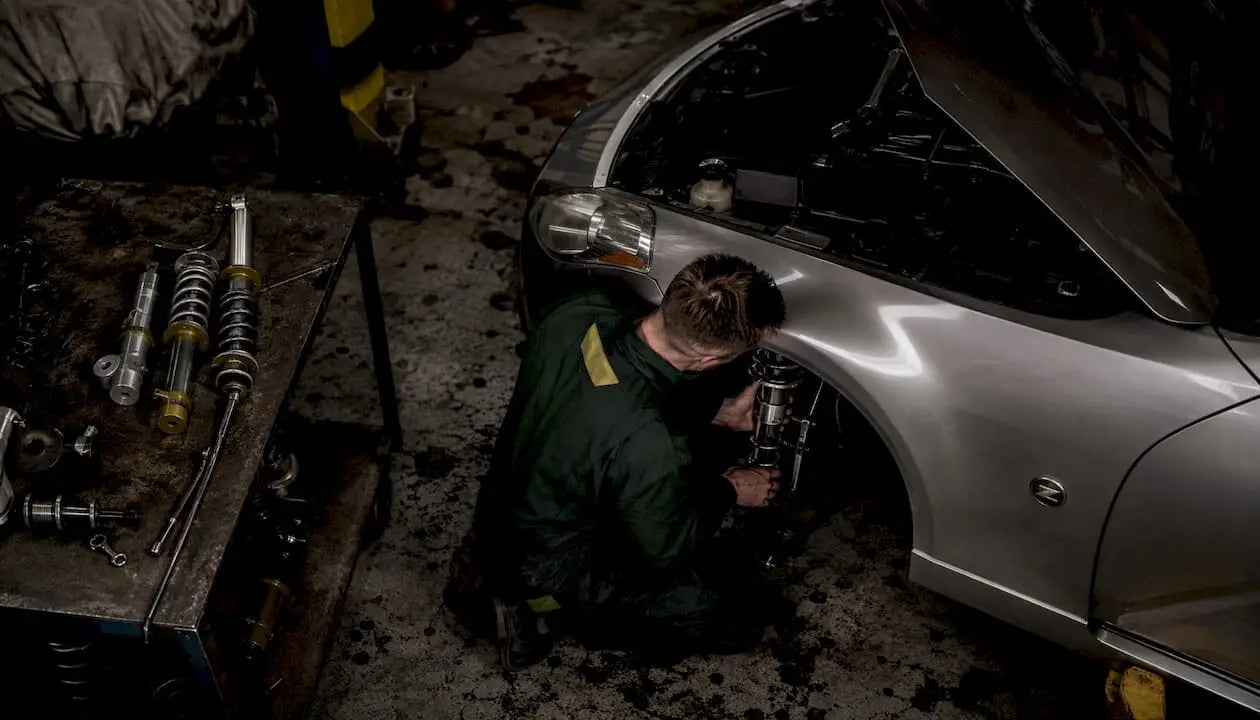
For a dedicated 350Z track setup, the short answer is to use balanced moderate spring rates front and rear, adjustable dampers with external reservoirs, and a full geometry correction with camber arms and toe links. That combination gives you a car that rotates predictably, holds its line under braking, and doesn’t punish you for pushing hard into a late apex.
Here’s the quick-reference breakdown before we get into the details:
- Spring rates: moderate spring rates front and rear for general track use; aggressive road race setups use significantly stiffer front springs and somewhat stiffer rears
- Dampers: Adjustable compression and rebound with external reservoirs for consistent performance under heat
- Alignment: Adjustable front upper camber arms and rear toe/camber arms are non-negotiable after lowering
- Sway bars: Stiffer front and rear bars reduce body roll and sharpen turn-in response
- Chassis maintenance: Re-torque all suspension bolts after your first track session and recheck alignment every few events
The 350Z’s factory suspension isn’t terrible, but it was tuned for a balance of street comfort and light sport driving. Once you’re running track days, that compromise costs you lap time and driver confidence. The right coilovers fix both.
Table of Contents
- Why coilovers are the most important upgrade for 350Z track use
- How to choose coilovers based on your driving style and track goals
- What spring rates and damping settings actually work on track
- Tuning tips to get the most out of your 350Z coilovers on track
- Complementary chassis upgrades that make your coilovers actually work
- Undergrounddynamics has the parts to back up this build
- FAQ
- Key Takeaways
Why coilovers are the most important upgrade for 350Z track use
The stock struts on the Z33 have a fixed spring rate and no meaningful damping adjustment. You can’t tune out understeer, you can’t control weight transfer timing, and you can’t lower the car without sacrificing suspension travel. Coilovers solve all three problems in one package.
A coilover combines the spring and damper into a single adjustable unit. That means you control ride height independently of spring preload, dial in compression and rebound damping for the specific track you’re running, and choose spring rates that match your driving style. The result is a car that responds to your inputs instead of fighting them.
Lowering the center of gravity is a real, measurable benefit on a front-engine, rear-drive platform like the 350Z. Less body roll means more consistent tire contact patch through corners, which translates directly to grip and lap time. Adjustable damping lets you fine-tune how quickly the chassis responds to direction changes, which is where track driving separates itself from street driving.
Core advantages of coilovers over factory suspension:
- Adjustable ride height without sacrificing suspension travel
- Tunable compression and rebound damping for different track conditions
- Spring rate selection matched to your driving goals
- Reduced body roll and improved weight transfer control
- Better driver feedback and mid-corner predictability
- Corner-balancing capability for even tire loading
How to choose coilovers based on your driving style and track goals
Not every coilover is built for the same job. A setup that works brilliantly at an autocross event will feel punishing on a high-speed road course, and a dedicated race coilover will rattle your fillings out on the drive to the track. Know what you’re building before you spend money.
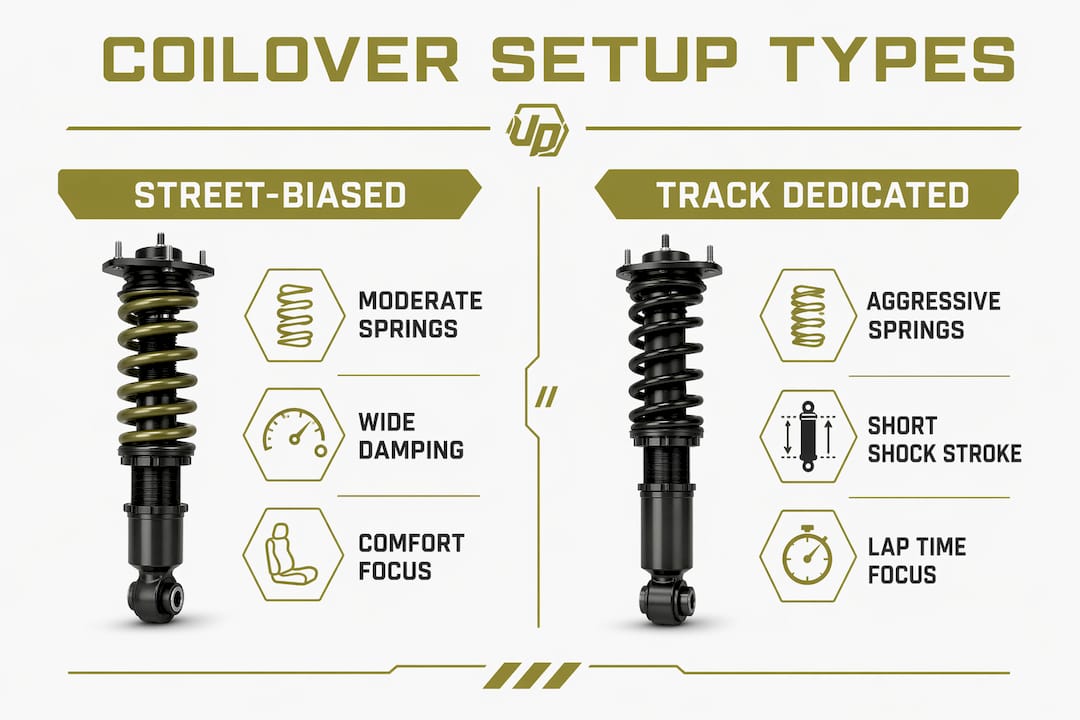
Street-biased track use calls for a coilover with a wide damping range, moderate spring rates, and a design that tolerates daily driving. You want something you can soften for the commute and firm up for track days without rebuilding the car. Separate compression and rebound adjustment gives you that flexibility.
Dedicated track or road race use is a different animal. Here, you want aggressive spring rates, shorter shock strokes for faster response, and dampers that stay consistent under repeated heavy use. The Ksport Version RR runs 20kg/mm front and 12kg/mm rear with 36-way damping adjustment and is explicitly built for track-only use. It is not comfortable on the street, and it’s not meant to be.
Mixed-use builds land somewhere in between. A coilover with 8–10kg/mm spring rates and independent compression/rebound adjustment covers most track day scenarios while remaining drivable on the road.
Key selection criteria:
- Monotube vs. twin-tube: Monotube designs dissipate heat more effectively under sustained track use and deliver more consistent damping performance. Twin-tube units are generally less expensive but can fade under repeated hard use.
- Damper quality over brand: Damper quality matters more than height adjustability or brand name. A high-quality damper like the KW Variant 3 outperforms a cheaper coilover with more adjustment knobs.
- Spring rate range: Confirm the kit supports your target spring rates, or that custom rates are available.
- Complementary parts: Coilovers alone won’t fix the geometry. Budget for camber arms and toe links from the start.
What spring rates and damping settings actually work on track
Getting the numbers right is where most 350Z owners either nail the setup or spend months chasing a handling problem they created themselves. Spring rates and damping are not independent variables. They work together, and the wrong combination in either direction costs you.
For general track use, balanced moderate spring rates front and rear are the community-proven starting point. This range controls body motion without making the car nervous over track surface imperfections. Dedicated road racing setups use much stiffer springs up front and moderately stiffer springs at the rear, paired with shorter shock strokes for faster chassis response.
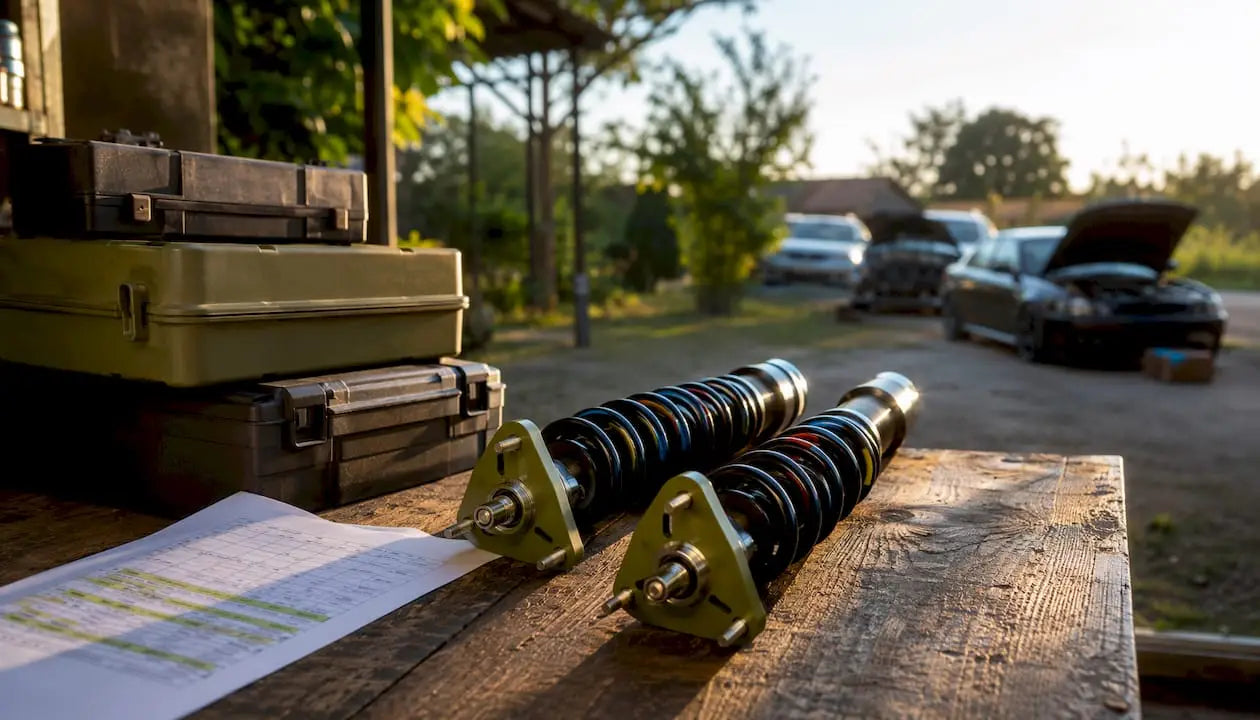
| Setup Type | Front Spring Rate | Rear Spring Rate | Damping Adjustment | Best For |
|---|---|---|---|---|
| General track | moderate spring rate | moderate spring rate | Independent comp/rebound | Track days, mixed use |
| Road race | significantly stiffer front spring | moderately stiffer rear spring | Multi-way simultaneous | Dedicated circuit racing |
| Aggressive street/track | moderately stiff front spring | moderately soft rear spring | Multi-way simultaneous | Intermediate track, spirited street |
| Road and track balance | moderate front spring | moderate rear spring | Single adjuster comp/rebound | Road and track dual use |
Damping adjustment works on two axes: compression controls how quickly the suspension compresses over a bump or during weight transfer, and rebound controls how quickly it returns. For track use, start with the manufacturer’s recommended baseline, then firm up compression to reduce dive under braking and body roll in corners. Too much rebound stiffness will cause the tire to skip over surface irregularities rather than follow them.
Practical tips for dialing in spring rates and damping:
- Start at the manufacturer’s baseline setting before making any changes
- Firm up front compression first if the car understeers mid-corner
- Increase rear rebound if the rear steps out too quickly on corner exit
- Set ride height using preload collars rather than lowering the spring perch, to maintain proper spring dynamics and avoid binding
- Corrosion-resistant materials (like SAE9254 spring steel and 6061 aluminum bodies) extend coilover lifespan under track conditions
Tuning tips to get the most out of your 350Z coilovers on track
Seat time reveals what the data can’t. Once you’re on track, the real tuning work begins, and the difference between a driver who improves and one who spins in circles is usually documentation.
Document every damper change you make, one or two clicks at a time. Write down the click count, the track condition, and what the car felt like before and after. Without that record, you’ll lose your baseline after three sessions and spend the rest of the day chasing a ghost. This is the single habit that separates systematic tuners from people who just turn knobs and hope.
Pro Tip: Before your first session of the day, photograph your damper click positions on all four corners. If something goes sideways on track, you can return to your last known-good setup in under two minutes.
Balancing front and rear damping is how you tune handling character. Stiffening the front relative to the rear increases understeer. Stiffening the rear increases oversteer tendency. The 350Z’s natural balance leans toward understeer at the limit, so most track setups run slightly more front stiffness than rear to sharpen turn-in without making the rear unpredictable.
Adapting to different track layouts:
- Tight, technical tracks with lots of direction changes favor softer rebound for quicker weight transfer
- High-speed tracks with long sweepers reward stiffer compression to reduce body motion
- Bumpy surfaces need slightly softer compression to keep tires planted
- After every track session, re-torque all suspension bolts and recheck ride height before the next event
Complementary chassis upgrades that make your coilovers actually work
Coilovers on a stock geometry 350Z are like putting race tires on a car with bent wheels. The hardware is there, but the geometry is fighting you. These supporting upgrades are what turn a coilover install into a complete track setup.
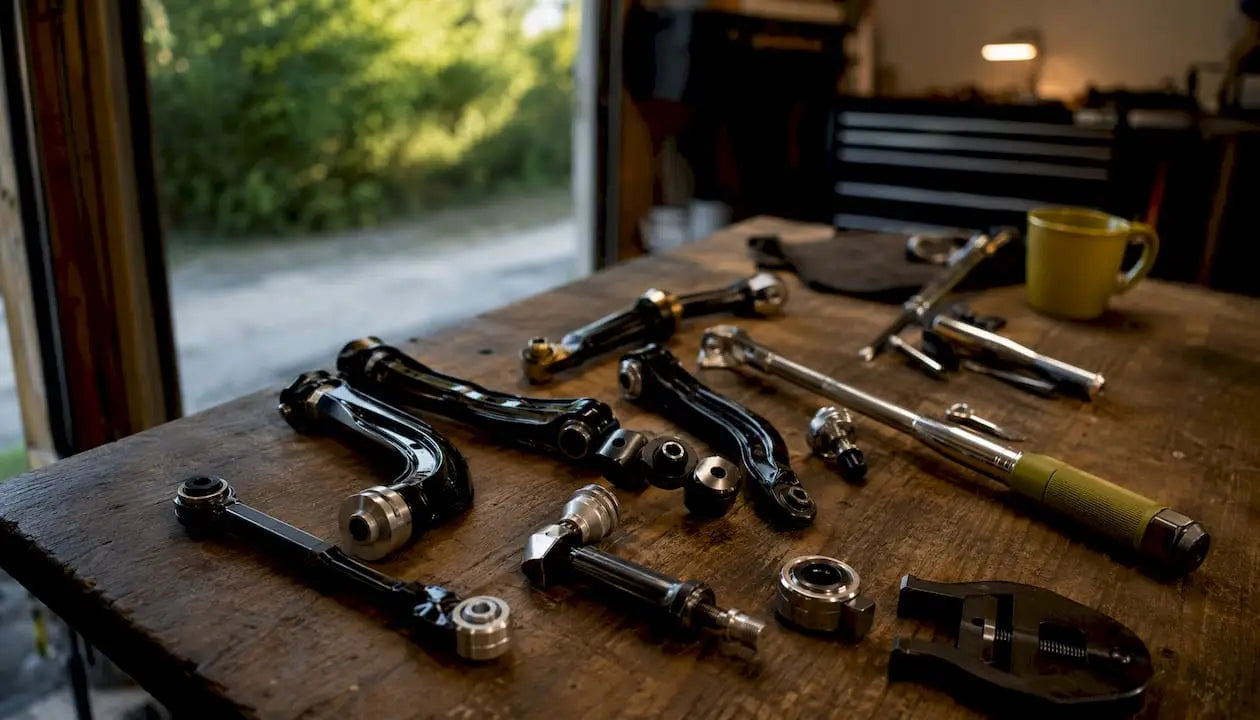
Adjustable front upper camber arms are the first thing to add. Lowering the car on coilovers pulls the front camber positive, which kills tire contact patch and scrubs the outer edge of your front tires. ISR Performance front upper camber arms for the Z33 let you dial in the negative camber needed for track use, typically 2–3 degrees front. Without them, your alignment shop is working with one hand tied behind their back.
Rear toe and camber arms complete the geometry picture. The 350Z’s rear suspension is sensitive to ride height changes, and lowering without correcting rear toe introduces instability under braking and mid-corner. Adjustable rear camber arms let you run the negative camber that keeps the rear planted, while toe arms let you set the slight toe-in that stabilizes the rear at speed.
Sway bars work with your spring rates, not instead of them. Stiffer front and rear bars reduce body roll without adding spring rate, which means you keep compliance over bumps while sharpening corner entry. The front bar has the bigger effect on understeer balance; the rear bar controls oversteer tendency.
Bushings are where the details matter. Solid bushings in critical suspension locations give you accurate, repeatable geometry with no deflection under load. The tradeoff is increased noise and vibration. For the differential specifically, avoid polyurethane bushings in heat-prone areas. Poly diff bushings have a documented failure rate under track heat. Solid bushings are the right call there, despite the added NVH.
Key chassis upgrades checklist:
- Adjustable front upper camber arms (ISR Performance Z33 units are a proven fitment)
- Rear toe arms and rear camber arms for full geometry correction
- Front and rear sway bars, adjustable if budget allows
- Solid differential bushings, polyurethane subframe bushings
- Full performance alignment after every major suspension change
- Corner-balancing after coilover installation for even tire loading
Proper alignment after installation is not optional. The 350Z needs adjustable control arms to correct camber, caster, and toe after lowering. Skipping this step destabilizes track handling and accelerates tire wear faster than almost any other mistake you can make.
Undergrounddynamics has the parts to back up this build
If you’ve read this far, you know the 350Z track setup isn’t just about picking a coilover brand. It’s about building a system: the right spring rates, quality dampers, corrected geometry, and the chassis parts that hold it all together under load.
Undergrounddynamics stocks the suspension components that make this build work, including ISR Performance camber kits for the Z33 with real fitment specs, not guesswork. The catalog covers coilovers, suspension upgrades, and chassis-specific parts selected for enthusiasts who are actually building cars, not just browsing. Every listing includes the technical detail you need to buy with confidence. Browse the full suspension catalog to find what fits your build stage and budget, then get the alignment done right the first time.
FAQ
What is the best coilover for a 350Z track setup?
For general track days, a coilover with 8–10kg/mm balanced spring rates and independent compression/rebound adjustment covers most scenarios. For dedicated road racing, the Ksport Version RR runs 20kg/mm front and 12kg/mm rear with 36-way damping and is built strictly for circuit use.
Do track cars use coilovers?
Yes. Coilovers are the standard suspension choice for track-prepped cars because they allow precise control over ride height, spring rate, and damping, none of which are adjustable on factory struts.
What year 350Z should you avoid?
Some early model years had production quality issues and less refined engine tunes compared to later revisions. Most 350Z owners building for track use prefer models from the mid-2000s onward for their updated engine calibration and revised suspension geometry.
Is the 350Z increasing in value?
Yes. The Z33 has been appreciating steadily as the enthusiast market recognizes it as a modern classic. Clean, low-mileage examples and well-built track cars have both seen price increases over the past few years.
Key Takeaways
For a 350Z track setup, coilover quality and geometry correction matter more than brand name alone.
| Point | Details |
|---|---|
| Spring rates for track | 8–10kg/mm balanced front and rear covers general track use; road race setups run 20kg/mm front, 12kg/mm rear. |
| Damper quality first | High-quality dampers with external reservoirs outperform cheaper coilovers with more adjustment options. |
| Geometry correction required | Adjustable front camber arms and rear toe/camber arms are necessary after lowering to prevent tire wear and instability. |
| Document every adjustment | Record damper click positions before each session to maintain your baseline and tune systematically. |
| Undergrounddynamics for parts | Stocks ISR Performance camber kits and suspension components for the Z33 with chassis-specific fitment detail. |
Recommended
- Honda Civic Coilover Setup: A Complete DIY Guide – Underground Dynamics
- Dialing in Coilover Alignment Settings: A Builder’s Guide – Underground Dynamics
- Why G35 Coilovers Improve Balance and Handling – Underground Dynamics
- ISR Performance Billet Engine Mount Set with Solid Bushings - Nissan 3 – Underground Dynamics