FREE SHIPPING ON ORDERS OVER $150

Cart
0
G35 coilovers improve balance by replacing the factory spring and shock assembly with a single, adjustable unit that lowers the center of gravity and lets you tune damping and spring rates to match your driving style. The industry term for this process is suspension tuning, and on the Infiniti G35, it produces measurable gains in cornering stability, braking composure, and turn-in sharpness. Ride height adjustments typically range from 1.0 to 2.2 inches, which directly reduces body roll and pitch. This article breaks down the physics, the hardware, and the setup steps that make coilovers the most effective single suspension upgrade for the G35.
Why G35 coilovers improve balance through ride height adjustment
The center of gravity is the single biggest factor in how a car handles lateral forces. Lowering ride height reduces body roll, sharpens turn-in, and improves high-speed stability by moving that center of gravity closer to the ground. On the G35, the factory ride height leaves meaningful room for improvement, and coilovers give you the control to exploit it.
Here is what adjustable ride height actually changes on your G35:
- Body roll: Less distance between the center of gravity and the road means less leverage for lateral forces to tip the car during cornering.
- Pitch under braking: A lower stance reduces the forward dive you feel when you get on the brakes hard.
- Aerodynamic stability: Reduced ground clearance at speed lowers the amount of air passing under the car, which improves high-speed composure.
- Road adaptability: Coilovers let you raise the car for uneven roads or urban driving, then drop it back down for track days.
The practical range of 1.0 to 2.2 inches of drop covers both street and track needs without requiring a separate setup for each. Most G35 drivers running a street-focused build settle around 1.2 to 1.5 inches of drop. That range keeps the car drivable on imperfect pavement while delivering a noticeable improvement in cornering feel.
Pro Tip: Do not chase the lowest possible ride height. Dropping too far compresses suspension travel and can cause the car to bottom out on bumps, which actually destabilizes the chassis mid-corner. Find the height that gives you the handling gain without sacrificing travel.
How does adjustable damping control weight transfer on the G35?
Damping controls how fast the suspension moves, not how stiff it feels at rest. That distinction matters because weight transfer during acceleration, braking, and cornering happens through suspension movement. Advanced coilover systems offer 3-way adjustable damping that controls rebound, low-speed compression, and high-speed compression independently. Each setting targets a different phase of chassis behavior.
Here is how each damping circuit affects G35 balance:
- Rebound damping controls how fast the suspension extends after compression. Too little rebound and the car bounces off bumps. Too much and the wheel stays compressed, reducing grip.
- Low-speed compression damping manages body movement during cornering, braking, and acceleration. This is the setting most directly tied to chassis balance and roll control.
- High-speed compression damping handles sharp impacts like curbs and potholes. Getting this wrong makes the car feel harsh without actually improving lap times.
Adjusting damping one variable at a time and recording each change is the only reliable way to understand what each setting does to your specific setup. Changing two settings at once makes it impossible to know which one caused the difference you feel. This is not optional advice. It is the difference between dialing in a car and chasing your tail for three track sessions.
Softer damping improves comfort and lets the suspension absorb road texture, but it allows more body movement. Firmer settings reduce that movement and sharpen response, but the ride gets harsh fast. Balancing comfort with control is the core challenge of G35 suspension tuning, and most drivers running mixed street and track use land somewhere in the middle of the damping range.
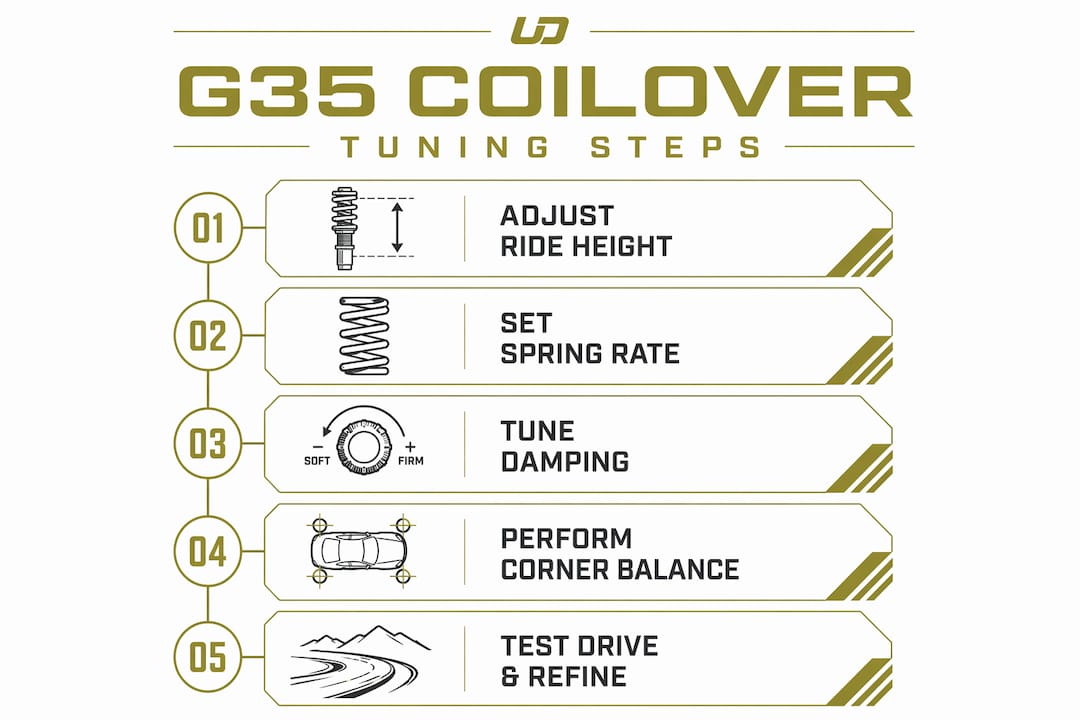
Pro Tip: Start with all damping settings at the midpoint. Drive the car on your normal roads for a week before making any adjustments. That baseline gives you a reference point so every change you make has a clear before-and-after comparison. Read more on damping and lap times before you start.
What spring rates and sway bars do for G35 suspension balance
Spring rate determines how much the suspension compresses under a given load. Recommended street spring rates for the G35 run 6–9 kg/mm front and 5–8 kg/mm rear, which balances handling responsiveness with enough compliance for daily driving. Going outside that range without a matching change to damping and sway bar stiffness creates an unbalanced setup that handles worse than stock.
| Setup goal | Front spring rate | Rear spring rate | Trade-off |
|---|---|---|---|
| Street comfort | 6 kg/mm | 5 kg/mm | More body roll, better ride |
| Mixed street/track | 8 kg/mm | 7 kg/mm | Balanced handling and comfort |
| Track focused | 9+ kg/mm | 8+ kg/mm | Harsh on street, sharp on track |
Sway bars work alongside springs to control roll stiffness. Adjustable sway bars and endlinks let you tune the front-to-rear roll balance independently of spring rate. That matters because the G35 is a rear-wheel-drive platform. Running too much front roll stiffness relative to the rear pushes the car toward understeer. Softening the front bar or stiffening the rear bar brings the balance back toward neutral.
Key points for getting spring and sway bar tuning right:
- Match spring rate changes with damping adjustments. Stiffer springs need more rebound damping to control the faster energy return.
- Stiffer springs reduce body roll but increase the load transferred to the tires on rough surfaces, which can reduce grip.
- Treat the suspension as a system. Changing one component without adjusting the others produces unpredictable results.
Does proper coilover setup actually matter for G35 balance?
Setup is where most G35 coilover installs fall short. The hardware can be excellent, but without proper corner balancing and alignment, the car will not handle as well as it should. True rear coilovers place springs and dampers together at the rear wheels, improving the motion ratio and giving the rear suspension more direct control over wheel movement. Divorced setups, where the spring and shock are separate, are less efficient and harder to tune.
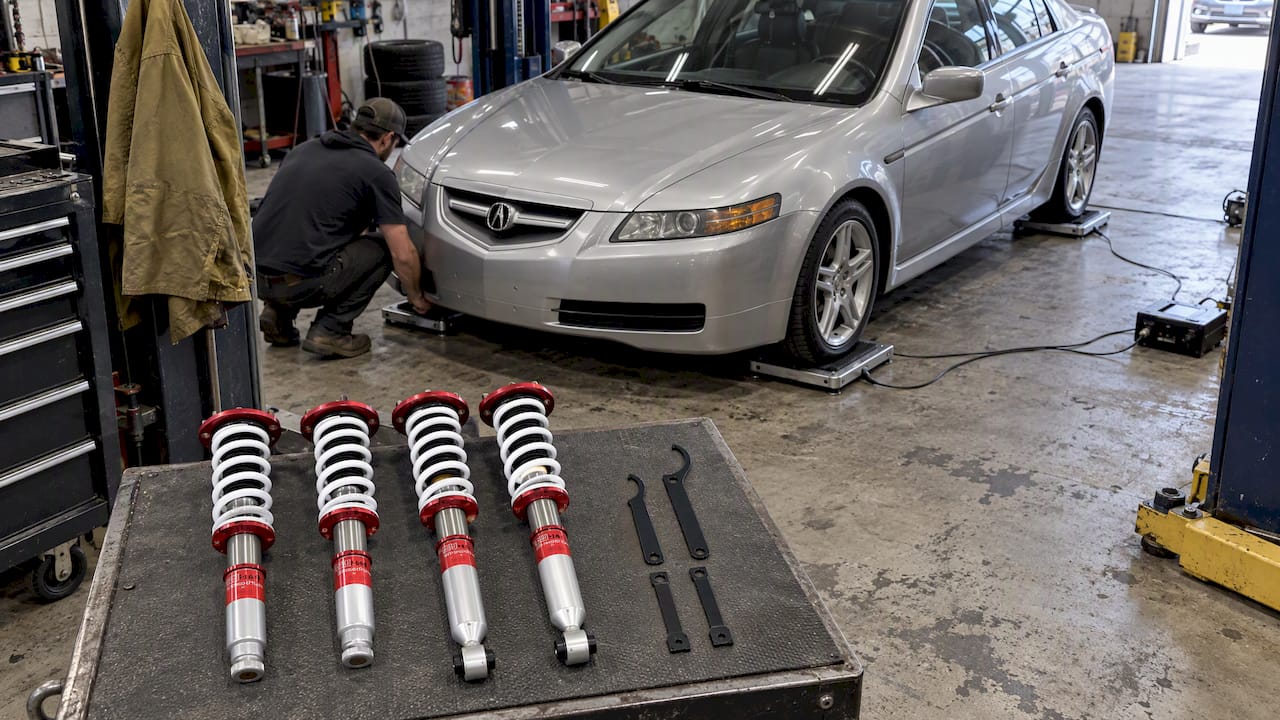
Corner balancing equalizes the weight on all four contact patches. Failing to corner balance after installation is the most common mistake G35 owners make. An unbalanced car will push or oversteer unpredictably because one axle is carrying more load than the other. A corner balance session on a set of scales takes about an hour and fixes that immediately.
Alignment is the other half of the equation. Increased negative camber improves track grip by keeping more of the tire contact patch on the road during cornering. Neutral camber preserves tire wear for daily driving. Most G35 drivers running a mixed setup run around 1.5 to 2 degrees of negative camber front and 1 to 1.5 degrees rear. The G35 alignment tool from Undergrounddynamics makes camber adjustment accessible without a full shop setup.
Common setup mistakes to avoid:
- Installing coilovers without adjusting alignment afterward.
- Setting ride height before corner balancing, which changes the height again anyway.
- Ignoring toe settings, which affect straight-line stability and turn-in equally.
- Skipping a re-check after the first 500 miles, when components settle into position.
For a full breakdown of alignment best practices, the coilover alignment guide at Undergrounddynamics covers every step in detail.
How coilovers change the G35 driving experience on street and track
The practical payoff of proper G35 suspension tuning shows up immediately in two places: turn-in and mid-corner composure. Coilovers provide sharper steering response and more predictable handling under aggressive cornering by reducing chassis squat and improving suspension geometry. The car goes where you point it, without the delay and vagueness that comes from excessive body movement.

Tire contact also improves. When the chassis stays flatter through a corner, the tire sits more squarely on the road surface. That means more grip, not because the tire changed, but because the suspension is keeping it in the right position. On a rear-wheel-drive car like the G35, that rear grip translates directly into confidence when you get on the throttle mid-corner.
The adjustability of a quality coilover setup also means you are not locked into one compromise. Soften the damping for a long highway drive, stiffen it back up for a track day. That flexibility is something stock suspension cannot offer at any price. For drivers who want to understand how the same principles apply across platforms, the coilover handling guide at Undergrounddynamics covers the core concepts clearly.
Pro Tip: After any suspension change, give yourself at least two full driving sessions before evaluating the result. Your brain adapts to new handling characteristics, and what feels strange on day one often feels natural and fast by day three.
Key Takeaways
G35 coilovers improve balance by lowering the center of gravity, enabling adjustable damping and spring rates, and requiring proper corner balancing and alignment to deliver predictable, confidence-inspiring handling.
| Point | Details |
|---|---|
| Center of gravity | Ride height drops of 1.0–2.2 inches reduce body roll and sharpen cornering response. |
| Adjustable damping | 3-way damping controls rebound, low-speed, and high-speed compression for precise weight transfer management. |
| Spring rate matching | Street setups run 6–9 kg/mm front and 5–8 kg/mm rear, balanced with sway bar adjustments. |
| Corner balancing | Equalizing weight on all four wheels is required after installation for predictable handling. |
| Alignment strategy | Negative camber improves track grip; neutral camber preserves tire wear for daily driving. |
What I have learned tuning G35 coilovers over multiple builds
By Ismael
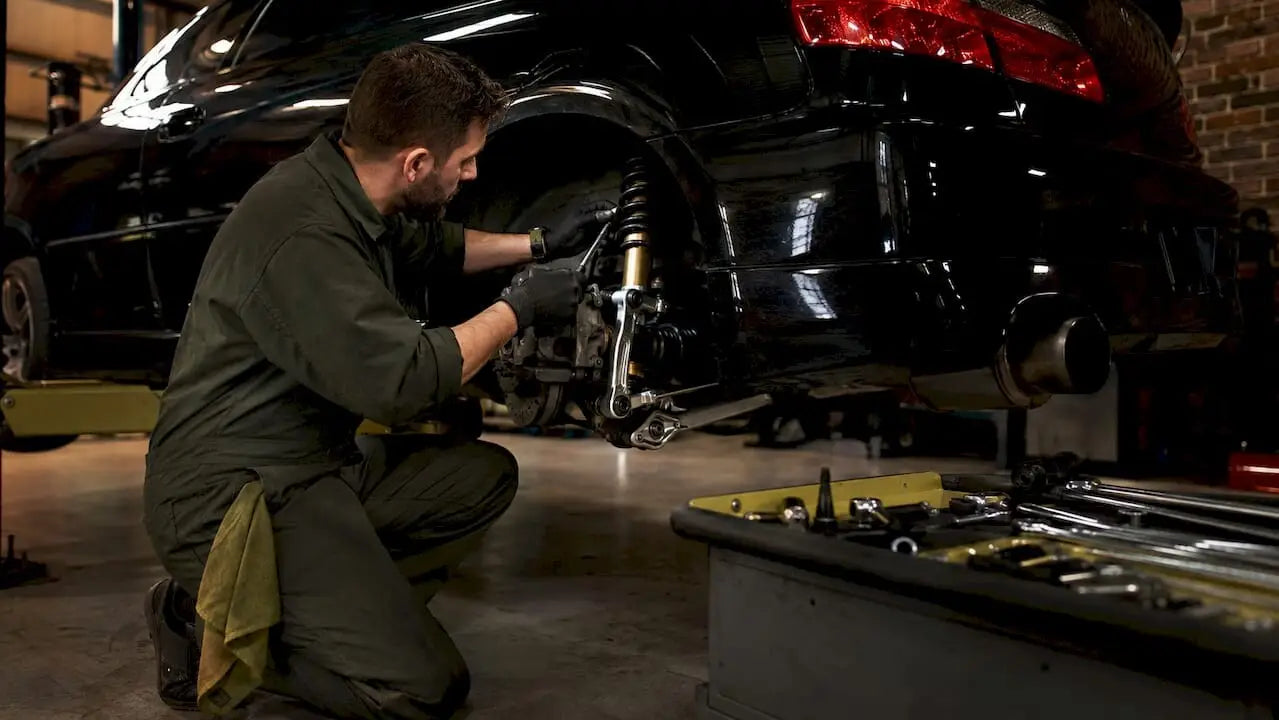
The biggest mistake I see is treating coilover installation as the finish line. Bolt them on, drop the car, done. That approach leaves most of the performance on the table. The hardware is just the starting point. The real work is in the setup: corner balancing, alignment, and methodical damping adjustment.
I have also seen drivers go too stiff too fast. They read that track setups run high spring rates and immediately go to 10 kg/mm front. Then they wonder why the car feels nervous and skittish on anything but a smooth track surface. The G35 responds well to a progressive approach. Start in the middle of the recommended range, get seat time, then adjust based on what you actually feel.
The other thing worth saying plainly: alignment signs you should not ignore after a coilover install are real. Uneven tire wear, pulling to one side, and vague steering are all symptoms of an alignment that did not get updated after the ride height changed. Do not skip that step. It costs less than a set of tires.
Check your settings after the first 500 miles. Components settle, preload shifts, and what was corner-balanced on day one may be slightly off by week three. A quick re-check keeps the setup honest and the handling predictable.
— Ismael
G35 suspension upgrades at Undergrounddynamics
Undergrounddynamics carries a selection of G35 coilover kits built for drivers who want real fitment data and technical specs before they buy. Every kit in the catalog is listed with spring rates, damping adjustment counts, and ride height ranges so you know exactly what you are getting.

The suspension catalog covers coilovers, lowering springs, and air suspension options for the G35, with components sourced from established suppliers. If you are also looking at alignment tools to complete your setup, the Undergrounddynamics performance parts catalog includes the ACT G35 alignment tool alongside other chassis-specific hardware. No guesswork on fitment. No vague product descriptions. Just parts that work.
FAQ
What do G35 coilovers actually do for balance?
G35 coilovers lower the center of gravity and allow independent adjustment of ride height, spring rate, and damping. That combination reduces body roll and improves handling stability during cornering and braking.
How much should I lower my G35 for best handling?
A drop of 1.0 to 1.5 inches delivers the best balance of handling improvement and suspension travel for street use. Going beyond 2.2 inches typically compromises ride quality and suspension geometry.
Do I need corner balancing after installing coilovers?
Yes. Corner balancing equalizes weight across all four wheels and is required to achieve predictable handling. Skipping it leaves the chassis unbalanced, which causes unpredictable push or oversteer.
What spring rates work best for a street G35?
Street-focused G35 setups run 6–9 kg/mm front and 5–8 kg/mm rear. That range handles daily driving conditions while delivering a clear improvement over factory suspension response.
How does alignment affect G35 coilover performance?
Alignment directly controls how the tire sits on the road. Negative camber increases grip during cornering, while neutral camber preserves even tire wear for daily driving. Always update alignment after changing ride height.