FREE SHIPPING ON ORDERS OVER $150

Cart
0
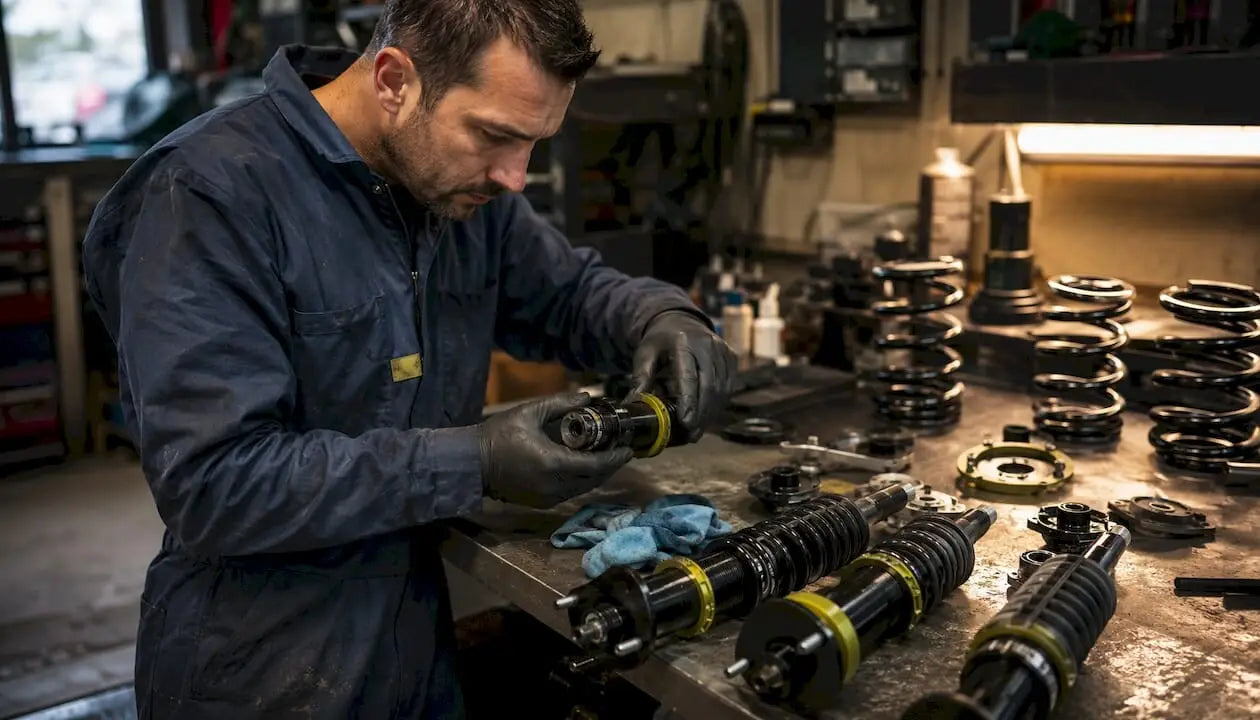
A full coilover kit is a matched assembly of springs, dampers, mounts, and hardware engineered to replace your factory suspension as a complete system. Every component is calibrated to work with the others, which is exactly what separates a true coilover setup from bolting on random aftermarket parts. If you’re shopping for your first kit or building out a dedicated track car, knowing what’s actually in the box prevents expensive surprises.
What does a full coilover kit include?
Most full coilover kits ship with the following core components:
- Four damper/shock assemblies with integrated coil springs
- Threaded shock bodies for ride height adjustment via collar rotation
- Spring perches (upper and lower) to seat the coil spring correctly
- Locking collars to lock the spring perch at your chosen ride height
- Bump stops to limit suspension travel and protect the damper at full compression
- Dust boots to shield the shock shaft from road debris and moisture
- Mounting hardware including nuts, bolts, washers, and sometimes brackets
Advanced track kits go further. High-end setups often add remote reservoirs, tender springs with thrust plates, spherical bearings, and quick-connect hose fittings for the reservoir lines. Some kits, like MCS two-way setups, include separate front and rear spring hats plus main/tender spring spacers as standard.
Typically not included are upper mounts (top hats), strut bearings, and installation wear parts, which may require separate purchase or reuse of factory components.
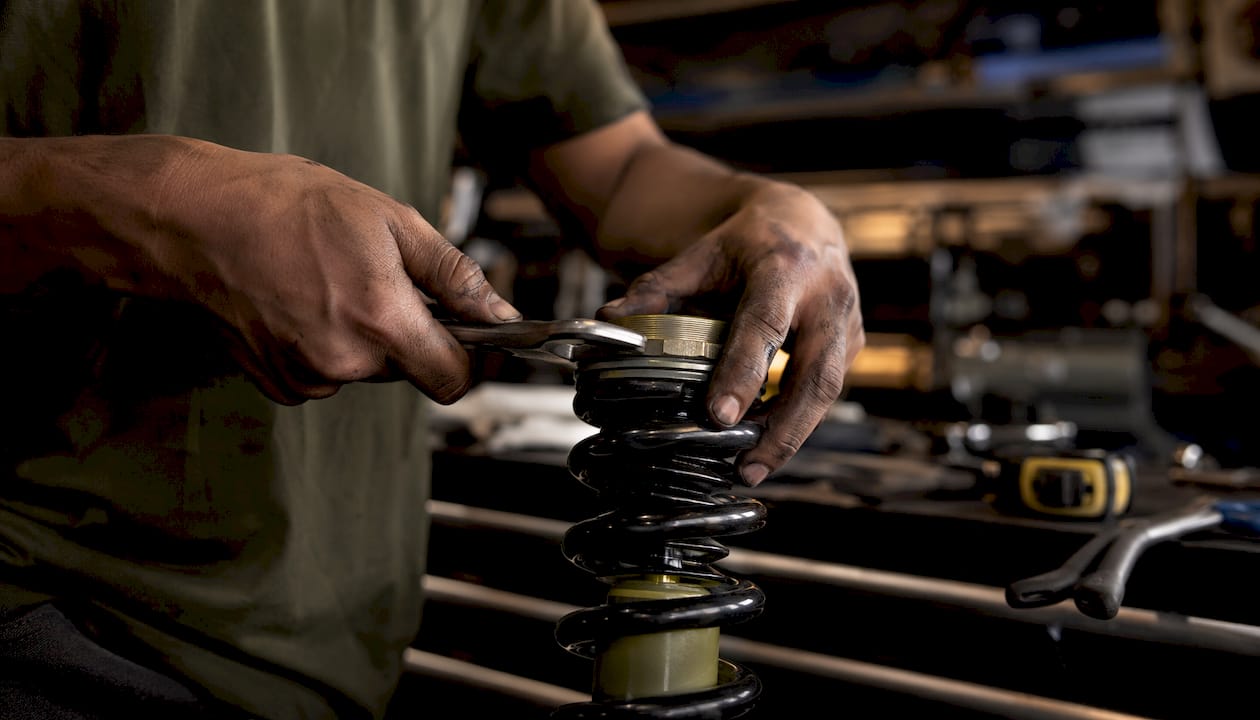
Pro Tip: Before you order, pull up the manufacturer’s parts list and cross-reference it against your vehicle’s factory suspension. Upper mounts are the most commonly missed item, and failing to verify this can stall your install entirely.
Why matched springs and dampers make or break your setup
The real value of a full coilover kit isn’t any single part. It’s the fact that the spring rate and damper valving are calibrated together from the factory to complement each other. When you mix factory dampers with aftermarket springs, or vice versa, you’re guessing at a pairing that engineers spent real time dialing in.
That matched system lets you tune ride height, spring stiffness, and rebound independently without fighting the suspension’s own geometry. Fitment Industries describes this as the bridge between street comfort and track precision, and that framing holds up. A well-matched kit gives you a repeatable baseline to tune from, whether you’re adjusting for a weekend track day or daily street driving. The role of damping in that equation is where most builders leave time on the table.
How to choose the right coilover kit type for your build
Not all coilover kits are built for the same job. The two main designs are mono-tube and twin-tube, and the difference matters depending on how you use the car.
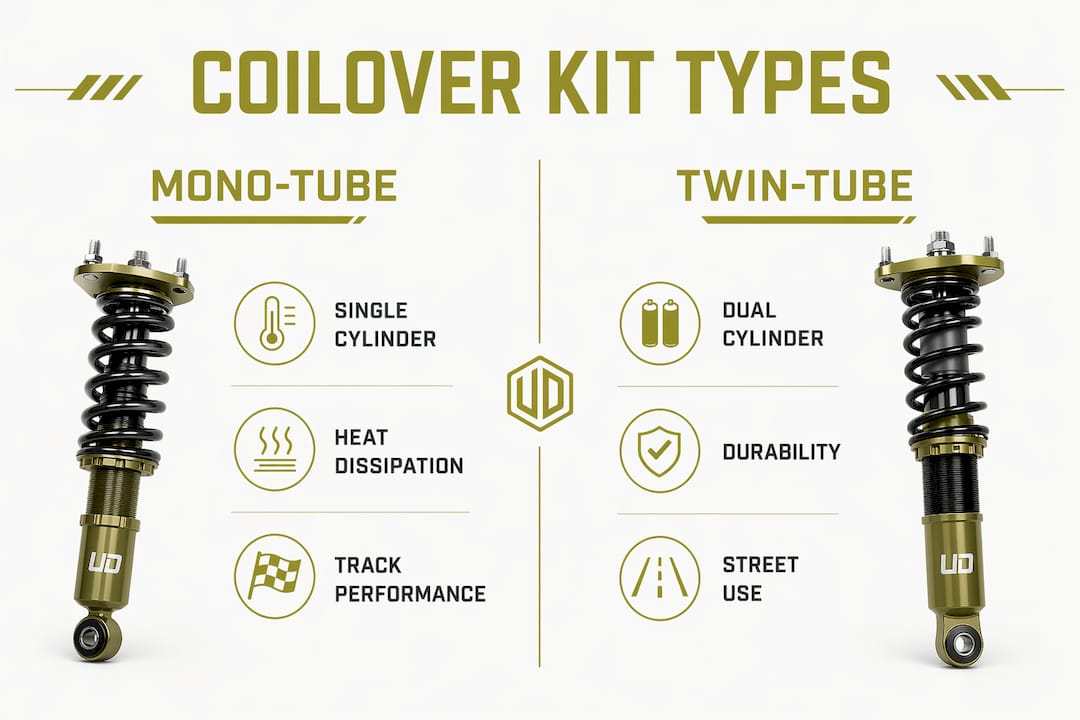
Mono-tube kits use a single cylinder housing both the piston and oil. They offer better heat dissipation and damping control, which is why they dominate track-oriented builds. The larger oil capacity keeps fluid temps lower under repeated hard braking and cornering.
Twin-tube kits run a secondary outer chamber around the main damper. This design reduces pressure on the seals, extends piston stroke, and absorbs road imperfections more smoothly. Street builds benefit from this, especially on rough American roads where ride quality matters as much as handling.
Key factors to weigh when choosing:
- Intended use: daily driver, weekend track, or dedicated competition
- Adjustability range: how many clicks of damping and how much ride height travel
- Reservoir type: internal vs. external, and whether fluid cooling matters for your use case
- Spring rate range: does the kit’s spring rate match your car’s weight and chassis stiffness
- Compatibility: does the kit list your specific chassis code, not just the model name
Pro Tip: If you’re splitting time between street and occasional track days, a twin-tube kit with a wide range of damping adjustment gives you enough range to cover both without buying two setups. Mono-tube is the call only when track performance is the clear priority.
Why modularity and serviceability matter for long-term builds
A coilover kit isn’t a one-time purchase if you’re serious about the car. Seals wear, collars corrode, and springs can fatigue over years of hard use. The question before you buy is whether the kit is rebuildable or disposable.
Rebuildable kits let you order individual components like seals, spring perches, locking collars, and dust boots without replacing the entire assembly. That matters for total cost of ownership. Replacing a worn seal on a rebuildable kit costs a fraction of buying a new set of dampers.
Modularity benefits worth confirming before purchase:
- Individual replacement parts available directly from the manufacturer
- Rebuild services offered or supported with documented procedures
- Replacement springs available in multiple rates for the same damper body
- Dust boots and bump stops sold separately for routine maintenance
Function and Form, for example, makes every coilover component available individually so builders can replace worn parts with basic hand tools without sending the kit out for service. That kind of parts availability is worth factoring into your budget alongside the initial kit price. Staying on top of regular maintenance extends the life of any suspension system significantly.
Pro Tip: Search the manufacturer’s website for a replacement parts page before you buy. If they don’t sell individual components, you’re buying a disposable kit, and that changes the math on price.
What to verify before buying a full coilover kit
Getting the kit home and realizing you’re missing parts is a frustrating way to spend a weekend. Run through this checklist before you confirm the order.
- Upper mounts included? Many kits, including high-end competition setups, omit upper mounts by default. Verify whether you need to reuse factory top hats or buy new ones.
- Wear parts covered? Strut mounts, strut bearings, and specific bolts often need replacement during installation and are rarely included in the kit itself.
- Installation hardware complete? Some kits ship with all necessary nuts and bolts; others assume you’ll source them separately.
- Sway bar end links compatible? Lowering your ride height often requires longer end links to maintain proper suspension geometry. These are almost never included.
- Tools required: A torque wrench, jack stands, and a socket set are the minimum. A spring compressor may be needed depending on the design.
Checking the manufacturer’s documentation is the fastest way to get a complete picture. If the spec sheet isn’t clear, contact the seller directly before ordering. Undergrounddynamics lists fitment details and component specs on product pages so you know exactly what’s in the box before checkout.
Pro Tip: Budget for upper mounts, end links, and a fresh set of strut bearings when you price out a kit. These parts add up, and buying them at the same time saves a second trip to the parts store mid-install.
How material quality affects coilover performance and durability
The components inside a coilover kit are only as good as the materials used to build them. Damper bodies made from anodized aluminum resist corrosion better than bare steel, which matters if the car sees rain or salt. Spring steel grade directly affects fatigue life. A spring that loses rate after a season of hard use throws off the entire suspension tune you worked to dial in.
Spherical bearings in upper mounts, when included, eliminate the compliance of rubber bushings and give you more direct feedback from the road. That’s a meaningful difference on a track car, though it does add noise and harshness on the street. Pillow ball mounts, like the rubber-coated versions used in some Ksport kits, split the difference with a hardened rubber coating that reduces noise while maintaining more precision than a stock rubber mount.
Hardware quality matters too. Zinc-plated or stainless fasteners hold up far better than bare steel in the wheel well environment. If a kit ships with hardware that shows surface rust in the bag, that’s a signal about the rest of the build quality.
Key Takeaways
A full coilover kit is a matched suspension system where every component is engineered to work together, covering dampers, springs, hardware, and adjustability features in one package.
| Point | Details |
|---|---|
| Core components | Every kit includes dampers, springs, spring perches, locking collars, bump stops, dust boots, and mounting hardware. |
| Upper mounts often excluded | Many kits omit top hats by default; verify before ordering to avoid install delays. |
| Matched system advantage | Spring rate and damper valving are calibrated together for tunable, repeatable performance. |
| Mono-tube vs. twin-tube | Mono-tube suits track use with better heat control; twin-tube fits street builds with smoother compliance. |
| Modularity saves money | Rebuildable kits with available individual parts reduce long-term cost versus disposable assemblies. |
FAQ
What parts come in a full coilover kit?
A full coilover kit typically includes damper and spring assemblies, threaded shock bodies, spring perches, locking collars, bump stops, dust boots, and mounting hardware. Advanced kits may also include remote reservoirs, tender springs, and spherical bearings.
Do full coilover kits include upper mounts?
Not always. Many kits, including competition-grade setups, omit upper mounts and require you to reuse factory components or purchase them separately.
What is the difference between mono-tube and twin-tube coilovers?
Mono-tube designs offer better damping control and heat dissipation for track use, while twin-tube designs prioritize durability and ride comfort for street applications.
Are installation tools included with a coilover kit?
No. You’ll need a torque wrench, jack stands, and a socket set at minimum. A spring compressor may also be required depending on the kit design.
Can you replace individual parts in a coilover kit?
Yes, if the kit is rebuildable. Manufacturers like Function and Form sell individual components including seals, collars, and dust boots so you can service the kit without replacing the full assembly.
Ready to spec out your suspension? Browse coilover kits and suspension upgrades at Undergrounddynamics, where every listing includes full fitment details and component specs. No guessing, no missing parts lists.