FREE SHIPPING ON ORDERS OVER $150

Cart
0
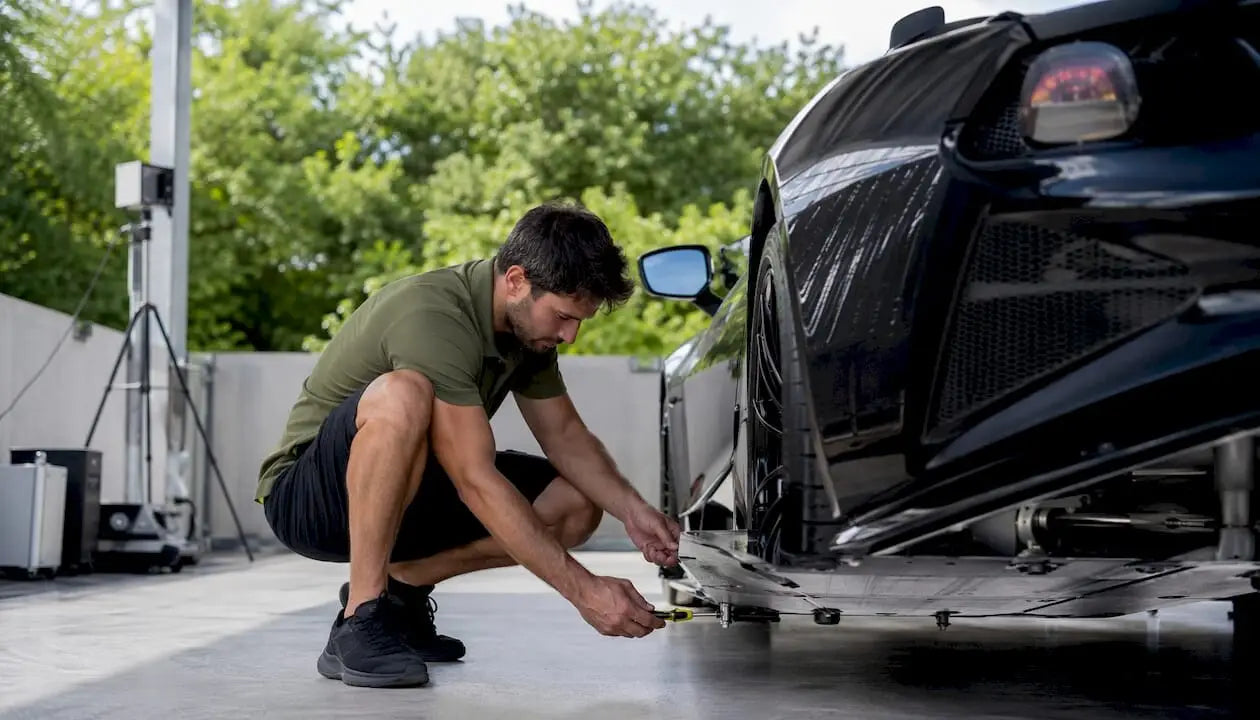
Underbody aero panels primarily reduce aerodynamic drag and protect drivetrain components — downforce requires a proper diffuser, not just flat coverage. Here’s what that means in practice:
- Drag reduction: Broad underbody coverage can cut total vehicle Cd by a small margin, translating to noticeable real-world fuel or range savings at highway speeds.
- Protection: Panels shield the engine bay, transmission, and floor from road debris, salt, and moisture — replacing heavier PVC seals in the process.
- Noise reduction: Correctly fitted panels reduce cabin wind noise, with some independent tests reporting 3–5 dB improvements.
Who benefits most: high-mileage highway drivers chasing MPG gains, EV owners managing range at speed, and performance builders integrating diffusers for genuine downforce. City commuters see smaller returns since drag forces scale with the square of velocity.
Table of Contents
- How do underbody panels actually reduce drag?
- How placement and diffuser integration change the outcome
- What materials should you use for underbody panels?
- Cooling, service access, and the tradeoffs you need to plan for
- What do studies and OEM data say about fuel economy and EV range gains?
- What does installation actually involve, and what does it cost?
- Who actually benefits most from underbody panels?
- Buyer’s checklist and the right questions to ask vendors
- Undergrounddynamics’ real-world build observations
- Key Takeaways
- The part most builders get backwards
- Undergrounddynamics carries the parts for this kind of build
- Useful sources
- FAQ
How do underbody panels actually reduce drag?
The short answer: panels smooth chaotic underbody airflow into a controlled, low-turbulence stream, cutting both form drag and interference drag simultaneously.
Air entering beneath a vehicle hits the engine bay first — a dense tangle of oil pans, subframes, exhaust pipes, and suspension arms. That geometry creates a high-pressure stagnation zone at the front, then a turbulent, separated flow through the center, and finally a large, low-pressure wake at the rear. Each transition costs energy and adds drag. According to Audi’s underbody aerodynamics technical notes, underbody refinement reduced Cd by a measurable amount on production models, with improvements to combined fuel consumption. That figure aligns with the finding that 40–50% of total aerodynamic drag originates from the underbody, wheels, and wheel arches combined.
The physical effects panels produce, in order of impact:
- Reduced turbulence in the engine bay and center floor, shrinking the separated flow region
- Smaller wake size at the rear, which directly lowers base pressure drag
- Reduced wheel-arch pumping when panels seal around the wheel openings
- Lower interference drag by eliminating exposed fasteners, pipes, and brackets from the freestream
Visualize it this way: undisturbed freestream air hits the front undertray, accelerates along a flat center floor, then either exits cleanly at the rear or enters a diffuser for pressure recovery. Researchers at TU Delft used 3D Lagrangian Particle Tracking to document exactly how diffuser angle and ride height shift the vortex structures that govern this recovery. Get the geometry wrong and those vortices detach — drag goes up, not down.
How placement and diffuser integration change the outcome
Where you put the panels matters as much as whether you use them at all. Front engine-bay trays, mid-floor panels, and diffuser-integrated systems each target a different part of the problem.
- Front engine-bay tray: Intercepts largely undisturbed air before it hits the mechanical clutter. Captures the largest share of available underbody drag reduction at the lowest cost and complexity.
- Partial mid-floor panel: Extends the smooth floor rearward, reducing turbulence in the center section. Useful on longer-wheelbase vehicles where the engine tray alone leaves a large exposed gap.
- Near-full-floor system: Covers front to rear with minimal gaps. Produces the best drag numbers but demands careful management of cooling exits and service access.
- Diffuser-integrated system: Adds a shaped rear section that converts the low-pressure underfloor flow into a pressure recovery zone. This is where downforce becomes measurable — a flat panel alone rarely generates it.
Wake management is the piece most builders overlook. Chalmers research on underbody and diffuser flows shows that rear-end pressure recovery and wake symmetry often determine net drag reduction more than the flat-floor coverage itself. Flattening the floor without addressing what happens at the tail can leave significant drag on the table — or worse, create asymmetric lift.
Pro Tip: The most common fitment mistake is mounting a front tray too low relative to the bumper’s lower lip, which creates a pressure build-up that increases front lift. Always check the tray’s leading edge sits flush with or slightly above the bumper’s lowest point, and seal the lateral gaps with rubber skirts to prevent high-pressure air from leaking under the panel’s sides. Read more on integrating panels into a full aero package before committing to a layout.

What materials should you use for underbody panels?
The short answer: thermoformed plastics for budget builds, fiberglass for custom shapes, carbon fiber for weight-critical performance work, and aluminum when you need impact resistance near the exhaust.

| Material | Pros | Cons | Typical Price Band | Best Use Case |
|---|---|---|---|---|
| Thermoformed plastic (HDPE/PP) | Cheap, flexible, corrosion-proof | Cracks under sharp impacts, limited heat tolerance | $50–$250 | Daily driver engine trays |
| Fiberglass | Shapeable, moderate weight, paintable | Heavier than carbon, can delaminate if wet layup is poor | $200–$600 | Custom mid-floor panels, street builds |
| Carbon fiber | Lightest, stiffest, premium look | Expensive, brittle on sharp impacts | $800–$2,000+ | Full-floor race/track builds |
| Aluminum | Impact-resistant, heat-tolerant | Heavier than composites, can corrode without coating | $200–$800 | Exhaust-adjacent panels, off-road exposure |
Common failure modes to watch for:
- Impact cracking at unsupported panel edges, especially on plastic trays near the front splitter
- Fastener fatigue where panels flex repeatedly over rough roads, elongating mounting holes
- Heat damage on panels routed too close to catalytic converters or turbo downpipes
- Abrasion wear on the leading edge from road debris at highway speeds
For low-clearance builds, aluminum backing plates at high-impact zones extend panel life significantly. Fiberglass hits the sweet spot for most street performance builds — shapeable enough for complex underbody geometry, durable enough for daily use, and priced within reach.
Cooling, service access, and the tradeoffs you need to plan for
Panels change where cooling air goes. That’s not a problem if you plan for it — it becomes one if you don’t.
The most common mistake is sealing the engine bay floor without providing alternative cooling exits, which can push radiator outlet temperatures up enough to trigger thermal management intervention on modern ECUs. Here’s how to mitigate the main tradeoffs:
- Map existing cooling paths before cutting or mounting anything. Identify where radiator, transmission, and differential cooling air currently exits.
- Add NACA ducts to the panel surface where targeted airflow is needed. OEMs like Audi use this approach on near-full underbody panels to maintain component cooling while preserving aero gains.
- Design removable sections over the oil drain, transmission pan, and filter locations. Rivnuts and quarter-turn fasteners make this practical without compromising sealing elsewhere.
- Install heat shielding between any panel surface and exhaust components within 4 inches. Aluminized mylar or ceramic-coated steel both work; the goal is preventing panel deformation and protecting wiring looms.
- Check temperatures after installation — at least one highway run and one low-speed urban cycle — before considering the job done.
Panels that seal correctly at the front but leave the rear open create a venturi effect that can pull more air through the engine bay than the baseline condition — useful for cooling, but it also reduces the pressure differential the diffuser needs to work. Seal progressively from front to rear and test at each stage.
Ground clearance is the other variable. For street builds, a minimum of 4 inches of clearance under the panel’s lowest point keeps you safe over speed bumps and parking lot lips. Use sacrificial skid pads on the leading edge rather than relying on the panel material itself to absorb contact. Stainless steel button-head fasteners resist corrosion and sit flush enough to avoid snagging on debris.
What do studies and OEM data say about fuel economy and EV range gains?
Published work and OEM technical notes consistently show measurable Cd reductions for broad underbody coverage, with corresponding improvements in real-world fuel consumption concentrated at sustained highway speeds.
| Coverage Level | Expected Cd Reduction | Estimated Fuel/Range Gain | Speed Sensitivity |
|---|---|---|---|
| Engine-bay tray only | small reduction | modest gain | Moderate (above highway speeds) |
| Partial mid-floor added | moderate reduction | moderate gain | High (65+ mph) |
| Near-full-floor | larger reduction | larger gain | High (65+ mph) |
| Full-floor + diffuser | largest reduction | significant gain | Very high (above highway speeds) |
An SAE technical paper on a compact hatchback found that adding belly pans reduced the underbody’s local drag coefficient by 28.4% and the complete vehicle Cd from 0.34 to 0.296 — a 13% total reduction. That’s a best-case result on an unoptimized baseline, but it illustrates the ceiling available when the starting condition is rough.
For EVs, the math is particularly compelling. Aerodynamic drag is the dominant energy consumer at highway speeds, so even a small Cd reduction translates to a noticeable range extension on a long interstate run. Audi’s underbody notes confirm that as EVs become more prevalent, underbody panels are increasingly central to range strategy. City driving returns are smaller — drag forces scale with velocity squared, so low-speed stop-and-go sees minimal benefit.
Variability sources worth understanding: your baseline Cd, tire width and profile, ride height, and how well cooling flow is managed all shift where your actual result lands within these ranges.
What does installation actually involve, and what does it cost?
Installation ranges from a straightforward bolt-on job to a multi-day project depending on coverage level and vehicle complexity.
Typical cost bands:
- DIY plastic engine tray: $80–$250 in parts, 1–2 hours, basic hand tools
- Fiberglass custom mid-floor panel: $200–$600 in parts, 3–6 hours including trimming and sealing
- Carbon fiber full-floor + diffuser kit: $800–$2,000+ in parts, 1–3 days including suspension clearance checks, exhaust rerouting if needed, and sealing
Installation checklist:
- Vehicle-specific fit confirmed against chassis measurements before ordering
- Correct fastener type (stainless button-head or nylon-insert bolts) and thread size matched to factory mounting points
- Seam sealer or closed-cell foam tape applied at all panel-to-body junctions
- Heat shields in place before any panel surface runs within 4 inches of exhaust
- Post-install ground clearance measured at ride height, not on a lift
Timeline from order to shakedown:
- Order and confirm fitment with the supplier (allow 3–10 business days for shipping)
- Dry-fit the panel without fasteners to check clearances and mark any trimming needed
- Trim, level, and test-fit again
- Apply sealing and heat shielding
- Final torque on all fasteners
- Highway shakedown run with temperature monitoring
For diffuser-level work, budget time for a suspension ride-height check — diffuser performance is sensitive to rake angle, and a panel that performs well at stock ride height may underperform or create lift if the car is subsequently lowered.
Who actually benefits most from underbody panels?
High-mileage highway drivers and EV owners get the most measurable return. Performance builds benefit when panels are paired with a proper diffuser and undertray integration.
Use-case breakdown:
- Commuter MPG improvement: Consistent highway miles above 65 mph are where the 3.5–7% fuel savings show up on a tank-to-tank basis.
- EV range extension: Even a 0.02 Cd reduction adds meaningful miles on a long highway run where aero drag dominates energy consumption.
- High-speed stability: A smooth underbody reduces the lift that develops at speed on vehicles with exposed underbody geometry — relevant for spirited canyon or track-day driving.
- Track-focused diffuser builds: The full payoff on downforce requires a complete undertray and diffuser system, not just flat panels. This is where aero on small sports cars becomes a genuine handling tool.
Quick decision guide:
- Do you drive more than 50% of your miles at highway speeds? If yes, panels pay back quickly.
- Is your vehicle an EV or hybrid? Range gains at speed make panels a strong investment.
- Are you building for track use? Plan for a full diffuser system, not panels alone.
- Is your ride height under 4 inches? Factor in ground clearance and debris risk before committing.
- Can you tolerate reduced service access? If not, plan removable sections from the start.
Buyer’s checklist and the right questions to ask vendors
Prioritize fitment accuracy, material choice, and diffuser/skirt compatibility before price.
Pre-purchase checklist:
- Vehicle-specific fit confirmed (year, make, model, trim, and any prior suspension modifications)
- Coverage area mapped against your use case (engine tray only vs. full-floor)
- Fastener and installation method documented — blind-nut, factory hole, or custom bracket?
- Service cutouts included or available for oil drain, filter, and transmission pan
- Warranty and impact/damage replacement policy stated in writing
Questions to ask any supplier:
- What is the panel’s heat tolerance rating, and has it been tested near exhaust routing?
- Do you offer matching skirts or side seals for this panel?
- Is the Cd or range improvement claim from CFD simulation, wind tunnel testing, or real-world track data?
- What baseline Cd and ride height were used in any published test results?
- Has the panel been tested for lift at speeds above 80 mph?
Treat simulation-only Cd claims with appropriate skepticism. CFD is a useful design tool, but real-world results depend on your specific vehicle’s baseline condition, ride height, and tire setup. Ask for test conditions, not just the headline number. The body kits and aero parts category at Undergrounddynamics includes fitment detail and material specs so you can evaluate options against your actual build.
Undergrounddynamics’ real-world build observations
Undergrounddynamics has applied underbody panels across a range of street and performance builds, and the patterns across those projects are consistent enough to be worth sharing directly.
Build observations:
- Street-focused hatchback with engine-bay tray and partial mid-floor: Measured highway fuel consumption improved noticeably on back-to-back tank comparisons. Secondary benefit was a clear reduction in road noise at speed, consistent with the 3–5 dB range reported in independent testing.
- Performance coupe with near-full-floor and rear diffuser: Stability at speed improved measurably — less steering correction needed above 80 mph. Cooling required NACA duct additions to the mid-floor section after the first shakedown showed elevated transmission temperatures.
- EV-adjacent hybrid build with full-floor coverage: Range per charge on highway cycles extended by a margin that matched the lower end of the 3.5–7% published range. The panel also eliminated a persistent stone-strike noise that had been reaching the cabin floor.
What the team consistently observes: noise reduction shows up on every correctly sealed build. Cooling issues show up on every build where the installer skipped the post-install temperature check. Those two outcomes are almost perfectly predictable.
The biggest mistake builders make is treating underbody panels as a cosmetic add-on rather than a system component. Sealing strategy, cooling management, and rear-end integration are what separate a panel that helps from one that creates new problems. Get the front tray right first, then expand coverage rearward — and always check temps before you call it done.
Explore the full range of build projects on the Undergrounddynamics site for complete before-and-after documentation on specific chassis.
Key Takeaways
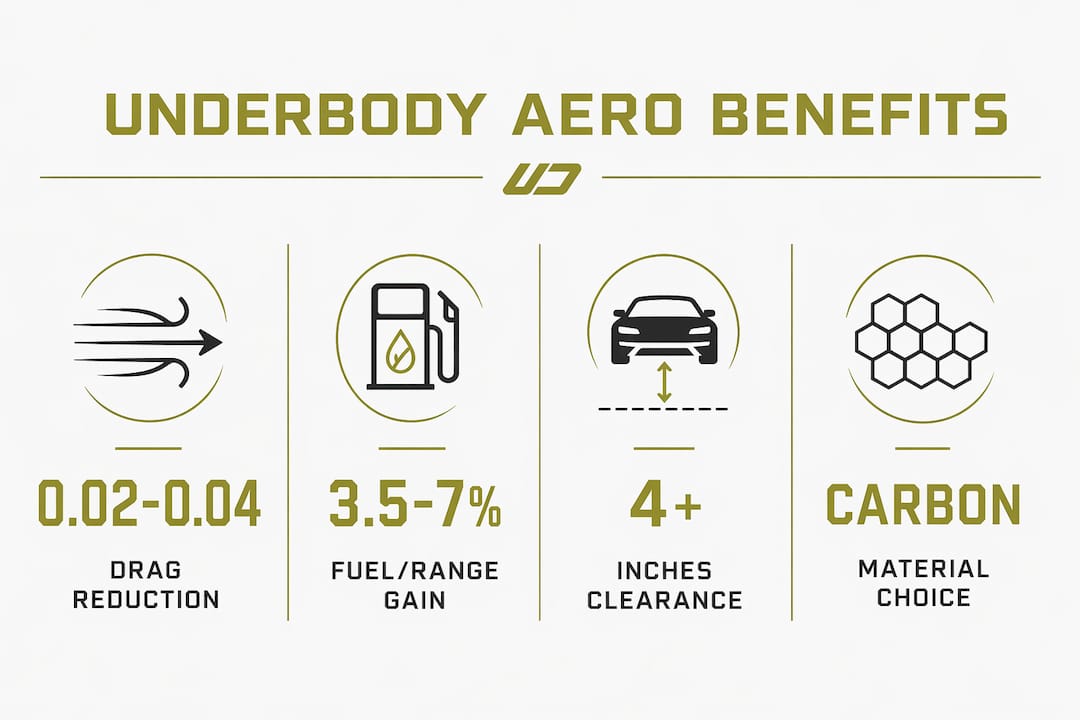
Underbody aero panels reduce drag by 0.02–0.04 Cd and deliver 3.5–7% fuel or range gains at highway speeds — but only when placement, sealing, and cooling integration are handled correctly.
| Point | Details |
|---|---|
| Primary function | Panels reduce drag and protect components; downforce requires a proper diffuser, not flat coverage alone. |
| Realistic performance range | Broad coverage cuts Cd by 0.02–0.04 (typically 0.044 in best cases on an unoptimized baseline) and improves fuel or EV range by 3.5–7% at sustained highway speeds. |
| Critical integration point | Rear-end pressure recovery and wake symmetry often determine net drag reduction more than flat-floor area. |
| Top tradeoff to plan for | Panels alter cooling flow paths; always add NACA ducts or service cutouts and verify temperatures after installation. |
| Undergrounddynamics | Offers carbon fiber and fiberglass underbody panels with chassis-specific fitment detail and build support for street and performance applications. |
The part most builders get backwards
Most of the conversation around underbody aero focuses on drag numbers and range percentages. Those matter, but they’re downstream of a more fundamental question: what is this build actually for?
The reason that question matters is that the correct panel layout for a highway commuter is almost the opposite of the correct layout for a track build. A commuter wants maximum flat-floor coverage with minimal service disruption — engine tray, mid-floor, sealed edges, done. A track builder needs the rear-end geometry to work: diffuser angle, skirt sealing, and rake all have to be dialed in together, or the downforce numbers from the simulation never show up on the car. Bolt-on panels rarely produce meaningful downforce alone, and treating them as if they do leads to expensive disappointment.
The other thing that gets underestimated is the front-first principle. The engine bay area intercepts largely undisturbed air — it’s the highest-value real estate on the underbody. Start there, measure the result, then expand rearward. Skipping straight to a full-floor kit without validating the front section first means you’re spending more money for gains you can’t isolate or verify.
Undergrounddynamics carries the parts for this kind of build
Skip the guesswork on material selection and fitment. Undergrounddynamics stocks carbon fiber and fiberglass aero components — including engine undertrays, full-floor panels, and diffuser kits — with chassis-specific fitment data attached to every listing. The catalog is built for builders who want to know exactly what they’re buying before it ships, not after it arrives.

If you’re working through a full underbody build or need help matching coverage to your specific chassis and use case, the body kits and aero parts page is the right starting point. For performance-focused builds that pair underbody work with suspension changes, the performance parts category covers coilovers and ride-height solutions that affect diffuser rake directly. Undergrounddynamics sells parts and provides build support — reach out through the site with your chassis details and build goals.
Useful sources
- SAE Technical Paper 2018-36-0291 — CFD study on a compact hatchback showing a 13% total Cd reduction and 28.4% underbody local drag reduction with belly pans added.
- Audi Technology Portal — Underbody Aerodynamics — OEM technical notes on near-full underbody panels, NACA duct cooling integration, and measured Cd improvements on production vehicles.
- Chalmers University — Under-body and diffuser flows of passenger vehicles — Academic research mapping wake behavior, body-shape interaction, and the role of rear pressure recovery in net drag reduction.
- TU Delft — On-site LPT for underbody aerodynamics — Experimental measurement work using 3D Lagrangian Particle Tracking; documents diffuser pumping effects and separation at high diffuser angles.
- MDPI Applied Sciences — Underbody/diffuser effects — Research on venturi-style diffuser downforce coefficients and the drag tradeoffs of diffuser integration.
- Nashville Performance — Benefits of underbody panels — Independent summary of real-world Cd and fuel-economy ranges; primary support for the 0.02–0.04 Cd and 3.5–7% efficiency figures.
- AutoSpeed — Modifying under-car airflow, Part 1 — Practitioner analysis of how incorrect front spoiler or tray placement can increase drag or lift; supports design integration and tradeoff sections.
FAQ
What are the panels on the underside of a car called?
They’re called undertrays, underbody panels, or belly pans — all terms for the same category of flat or shaped covers that smooth airflow beneath the vehicle and protect mechanical components from debris and moisture.
What is the purpose of an undertray on a car?
An undertray primarily reduces aerodynamic drag by smoothing chaotic underbody airflow, and secondarily protects the engine, transmission, and floor from road debris, salt, and water. Broad coverage can cut total Cd by 0.02–0.04 (with best-case improvement on an unoptimized baseline typically around 0.044) and improve highway fuel economy or EV range by roughly 3.5–7%.
Are undercarriage covers necessary for road legality?
No — undercarriage covers are not required for road legality in the United States, but they provide measurable aerodynamic and protective benefits that factory-equipped vehicles increasingly rely on. Aftermarket panels from suppliers like Undergrounddynamics can replicate or improve on OEM coverage for vehicles that lack it.
Is underbody coating the same as underbody panels?
No. Underbody coating is a spray-applied corrosion and noise barrier applied to the chassis metal itself. Underbody panels are structural covers that smooth airflow and protect components — they serve an aerodynamic function that coating alone cannot replicate.