FREE SHIPPING ON ORDERS OVER $150

Cart
0

Aerodynamics is defined as the science of managing airflow around a vehicle to control the forces of downforce, drag, and lift. The role of aero on small sports cars is more consequential than on heavier, high-powered machines because lightweight chassis respond sharply to every aerodynamic input. A small car with 1,500 lbs of curb weight feels a 100 lb downforce change far more than a 3,500 lb grand tourer does. Geometrical optimizations on concept small sports cars can produce significant downforce of around 560 N while maintaining drag coefficients near 0.3. That combination of numbers tells you something real: you can have meaningful grip without killing top speed. The key is knowing which components do what, and why the balance between them matters so much on a light car.
How do aerodynamic components impact small sports car performance?
Front splitters, rear wings, and diffusers are the three primary tools for managing aerodynamic effects on sports cars. Each one targets a different part of the airflow picture, and together they define how the car behaves at speed.
Front splitters
A front splitter extends the nose of the car horizontally, forcing high-pressure air upward and allowing lower-pressure air to pass beneath the car. That pressure difference pushes the front end down. Splitters, spoilers, and diffusers manipulate airflow to enhance tire contact with the road and improve grip during cornering and braking. On a small car, even a modest front splitter adds measurable front axle load. More front axle load means the front tires bite harder under braking and turn-in.

Rear wings and spoilers
A rear wing generates downforce by acting as an inverted airfoil. Air moves faster over the flat underside and slower over the curved top, creating a net downward force on the rear axle. Rear wing integration can yield drag coefficients as low as 0.2532, with geometry modifications reducing drag by roughly 3.4%. That means a well-designed wing does not have to be a drag anchor. The angle of attack controls the balance between downforce generated and drag added.
Diffusers
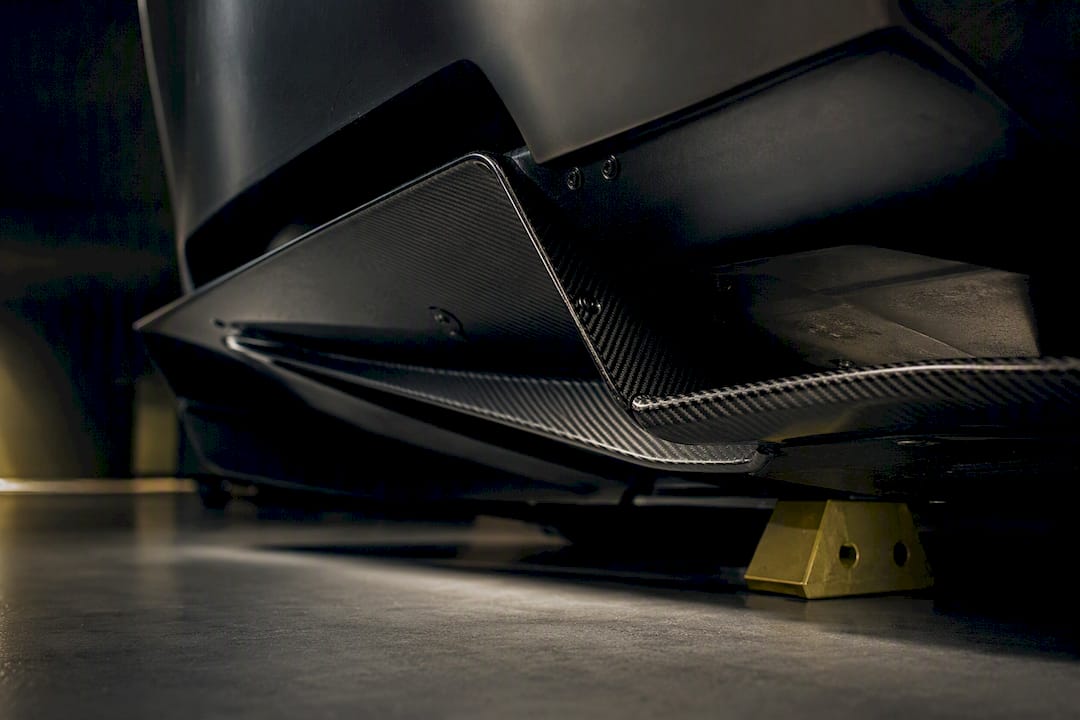
A diffuser sits at the rear underside of the car and expands the airflow exiting beneath the floor. As the channel widens, air velocity drops and pressure rises, which accelerates the air under the car ahead of it. That acceleration creates a low-pressure zone under the floor, pulling the car down. Diffusers are one of the most efficient downforce sources available because they generate grip with relatively little drag penalty.
- Front splitter: Adds front axle load, improves braking bite and turn-in grip
- Rear wing: Adds rear axle load, stabilizes the car at speed and through fast corners
- Diffuser: Generates underbody downforce efficiently with a low drag cost
- Side skirts: Seal the underbody from high-pressure side air, protecting diffuser effectiveness
Pro Tip: Start with a front splitter before adding a rear wing. On a light car, front downforce gives you braking gains immediately. Adding rear downforce first without matching the front creates understeer and can actually make the car slower in the real world.
What is the trade-off between drag and downforce in small sports car aerodynamics?
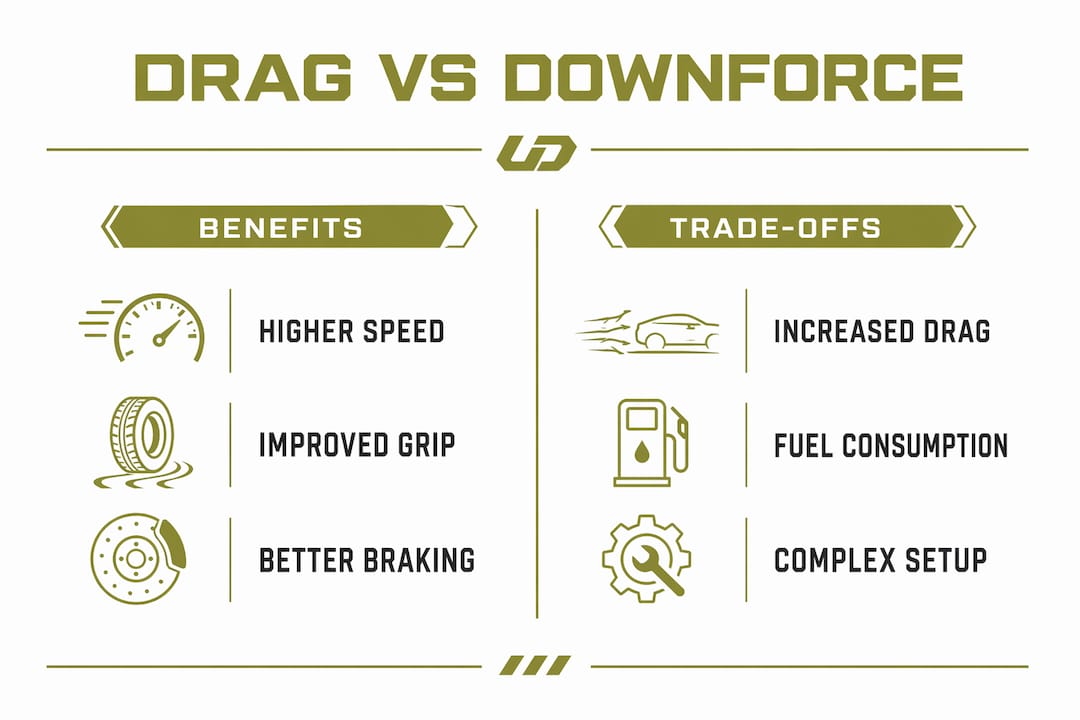
Balancing drag reduction for top speed versus downforce for braking and cornering stability is the fundamental aerodynamic trade-off in sports car design. Every aero component you add shifts this balance. Understanding where you want to land on that spectrum depends entirely on how you use the car.
Drag reduction raises top speed and reduces fuel consumption. A lower drag coefficient means the engine spends less energy pushing through air at highway speeds. On a track with long straights, that matters. On a tight autocross course, it barely registers.
Downforce does the opposite job. It loads the tires, which increases the maximum cornering force they can generate. More cornering force means faster corner speeds and shorter braking distances. The cost is drag. Every wing angle that adds downforce also adds resistance.
| Aero priority | Benefit | Trade-off |
|---|---|---|
| Low drag (flat setup) | Higher top speed, better fuel efficiency | Less cornering grip, longer braking distances |
| High downforce (aggressive setup) | Faster corners, shorter stops | More drag, lower top speed |
| Balanced setup | Competitive in both areas | Requires careful component selection |
| Active aero | Adapts to speed and conditions dynamically | Higher cost and complexity |
Active aerodynamic devices provide superior adaptability over passive systems by adjusting wing angles or flap positions in real time. A passive wing is fixed at one angle. An active system can flatten out on a straight for less drag and steepen in a corner for more grip. For most builders working with a fixed budget, a well-chosen passive setup tuned to the primary use case delivers the best return.
Pro Tip: CFD simulations and wind tunnel data show that combined roof and wing geometry changes can achieve a 1.13% drag reduction alongside a 2.23% downforce increase simultaneously. Small gains compound. Do not dismiss incremental changes.
How does aerodynamic balance affect handling and safety on lightweight cars?
Aerodynamic balance refers to the front-to-rear distribution of downforce. On a lightweight, short-wheelbase car, this balance is far more sensitive than on a heavier platform. A shift of even 10% in aero balance changes how the car rotates, brakes, and responds to steering inputs.
Passive rearward stability in many lightweight sports cars comes from the location of aerodynamic forces, not from usable front tire load. This creates a deceptive feeling of calm at high speed. The car feels planted, but the front tires are not being loaded. Under hard braking, that front grip disappears fast.
“Front aero downforce provides braking authority improvements by keeping front tires planted. Rear downforce alone can worsen front axle unloading, increasing braking issues.” — Applying Aerodynamics to Lotus Seven-Shaped Objects
The practical consequences of getting this wrong are real:
- Rear-only downforce: Loads the rear axle, pushes the front axle relatively lighter, creates understeer at corner entry
- Front-only downforce: Loads the front axle, improves braking and turn-in, but can make the rear feel loose at corner exit
- Balanced front and rear downforce: Maintains the car’s natural handling balance at speed, closest to the baseline setup
- No downforce at all: The car handles the same at 30 mph as at 100 mph, which is fine until you need to stop or turn hard at speed
Lightweight, short-wheelbase cars exhibit heightened sensitivity to aero balance changes. Adding a rear wing alone to a Lotus Seven-style car can cause understeer by unloading the front axle. That is the opposite of what most builders expect when they bolt on a wing.
What are the best practices for aero design on small sports cars?
Effective aero design for small cars follows a clear sequence. Skipping steps creates problems that are hard to diagnose once the car is built.
-
Establish a baseline. Drive the car and document its handling balance before adding any aero. Know whether it understeers or oversteers at the limit. Aero will amplify whatever tendency already exists.
-
Add front downforce first. A front splitter or front lip is the highest-value first modification on a lightweight car. Front downforce primarily improves braking authority on ultra-light small sports cars, providing the most immediate safety benefit from aero modifications.
-
Match rear downforce to front. Once the front is sorted, add rear downforce to restore balance. A rear wing or spoiler brings the rear axle load back up to match the front. The goal is to maintain the same understeer-oversteer balance you had at low speed, but now at high speed too.
-
Seal the underbody. Side skirts and a flat undertray protect the low-pressure zone under the car. Without them, high-pressure air from the sides bleeds under the floor and kills diffuser efficiency. This step is often skipped and it costs real grip.
-
Validate with data. Experimental lift coefficients agree within 4% of numerical simulations across Reynolds number ranges, confirming that CFD tools give reliable predictions before you cut any carbon fiber. Use free or low-cost CFD software to check your geometry before committing to parts.
-
Weigh every component. On a 1,500 lb car, a 15 lb wing is 1% of total vehicle weight. That matters. Carbon fiber components cost more but preserve the weight advantage that makes small sports cars fast in the first place.
Wind tunnel and CFD testing confirm that modifying roof design and integrating rear wings can optimize flow attachment and reduce lift while slightly decreasing drag. You do not need a factory wind tunnel. University CFD labs, open-source tools like OpenFOAM, and scale model testing all give usable data for a builder’s budget.
Key takeaways
Aerodynamic balance on small sports cars is more sensitive than on heavier platforms, making front downforce the highest-priority first modification for braking performance and safety.
| Point | Details |
|---|---|
| Front downforce first | Add a front splitter before a rear wing to gain immediate braking and turn-in benefits. |
| Balance front and rear | Match rear downforce to front to preserve the car’s natural handling balance at speed. |
| Drag vs. downforce trade-off | A flat setup favors top speed; an aggressive setup favors cornering and braking. |
| Lightweight sensitivity | Short-wheelbase cars respond sharply to aero balance shifts; small changes have large effects. |
| Validate before building | CFD tools predict lift and drag within 4% of experimental results, saving costly mistakes. |
Aero balance on small cars: what I’ve learned the hard way
By Ismael
The counterintuitive part of small sports car aerodynamics is that rear downforce feels like the obvious first move. You see a wing, you think grip, you bolt it on. What actually happens on a light car is that the rear gets planted and the front gets relatively lighter. The car feels stable at speed but then refuses to rotate at corner entry and takes longer to stop. That is not a win.
What I have found is that front downforce improves braking more than it improves cornering speed on a truly light car. The first time you brake hard into a corner with a proper front splitter fitted and feel the front tires stay planted instead of washing wide, it changes how you think about aero entirely. It is a safety upgrade before it is a performance upgrade.
The other thing builders underestimate is how much a short wheelbase amplifies every aero input. A car with a 90-inch wheelbase reacts to a 50 lb aero balance shift the way a 120-inch wheelbase car reacts to 150 lbs. You have less mechanical leverage to absorb the change. That means you need to be more deliberate, not less, when choosing components. Start small, test, and add incrementally. The cars that end up with the best setups are the ones where the builder took their time.
— Ismael
Performance parts that complement your aero setup
Getting the aero right is only part of the picture. The drivetrain and suspension underneath need to handle the increased loads that downforce creates.

Undergrounddynamics carries chassis-specific aero components including front lip kits, body kits, and wide-body fenders in carbon fiber and fiberglass, all listed with real fitment specs so you know what you are buying before it ships. The catalog also covers the suspension side: coilovers, air suspension, and lowering springs that work with your new aero loads rather than against them. When you add downforce, you want the suspension geometry to stay in its working range. A set of performance coilovers lets you dial in ride height and damping to match the aero balance you have built. Browse the full catalog at Undergrounddynamics and filter by chassis to find parts that actually fit your build.
FAQ
What does aero actually do on a small sports car?
Aero manages airflow to generate downforce and reduce drag, which increases tire grip and top speed respectively. On a lightweight car, even modest downforce levels produce noticeable handling improvements.
Should I add a rear wing or a front splitter first?
Add a front splitter first. Front downforce improves braking authority immediately on lightweight cars, and adding rear downforce without matching the front creates understeer.
What is a good drag coefficient for a small sports car?
A drag coefficient around 0.25–0.30 is achievable on a small sports car with proper aero geometry, balancing low drag with meaningful downforce generation.
Does more downforce always mean faster lap times?
Not always. Downforce adds drag, which costs top speed on long straights. The fastest setup matches downforce level to the track layout and the car’s power output.
How do I know if my aero balance is correct?
The car should handle with the same understeer-oversteer balance at high speed as it does at low speed. If it understeers more at speed, the front needs more downforce or the rear needs less.