FREE SHIPPING ON ORDERS OVER $150

Cart
0

For most G35 owners, a matched monotube coilover kit with adjustable spring perch, true-rear compatibility, and at least 16-way damping adjustment is the right call. Daily drivers who want better handling without sacrificing ride quality should target mid-tier kits in a moderate price range. Track-focused builds need monotube dampers, matched spring rates, and a true rear coilover conversion.
Before you order anything, do these two things:
- Confirm your exact year and body style (2003–2006 sedan, 2003–2007 coupe, or 2007–2008 sedan) because fitment splits hard between generations.
- Decide whether you want OEM-style rear (separate spring and shock) or a true rear coilover, since the latter changes your kinematics and may require additional parts.
High Performance Academy’s setup guidance recommends targeting roughly 45% bump travel and 55% droop travel as a starting baseline for street and mixed-use performance cars. That ratio keeps the car from bottoming out while maintaining traction over dips and crests.
Table of Contents
- What do G35 coilover specs actually mean?
- Which G35 years and body styles actually fit?
- How to choose the right kit for your driving goals
- What does a G35 coilover install actually cost?
- G35-specific technical setup: true rear conversion and spring-rate baselines
- Key Takeaways
- The mistake most G35 owners make when buying coilovers
- Undergrounddynamics carries chassis-specific G35 suspension kits
- Useful sources
- FAQ
What do G35 coilover specs actually mean?
Every product listing throws numbers at you. Here is what each one actually tells you about real-world performance.
Core specs to compare
- Drop range / ride-height adjustment: Most G35 kits offer a modest amount of drop via spring perch adjustment. True coilovers adjust through both the perch and lower mount, giving more range.
- Spring rates (front/rear): Measured in kg/mm. A street-oriented kit typically has softer spring rates suitable for daily driving. Track setups push higher on both ends and need matched damping.
- Damping adjustability: Entry kits offer 16-way single-knob adjustment (compression and rebound simultaneously). Premium kits separate compression and rebound for independent tuning.
- Shock design: Monotube dampers hold more fluid and use a floating piston to separate gas, which improves heat management and response consistency over twin-tube designs.
- Top-mount type: Rubber mounts absorb noise and suit daily driving. Pillowball mounts sharpen steering feedback and suit track use but transmit more NVH into the cabin.
- Rear design: OEM-style kits keep the separate spring and shock arrangement. True rear coilovers mount the spring directly to the shock body.
Price ranges and what drives them
| Tier | Typical Price Range | What You Get |
|---|---|---|
| Entry-level kits are typically priced affordably | Basic perch adjustment, twin-tube, limited damping steps | |
| Mid-tier kits are in a mid-price range | Monotube or quality twin-tube, 16–36-way damping, true rear option | |
| Premium kits are priced at the higher end | Remote reservoirs, separate compression/rebound, hand-built valving |
Remote-reservoir kits add separate oil capacity and independent compression/rebound circuits, which matters when you’re running long heat cycles on track. For street use, that extra cost rarely pays off.
Trust signals to check on any listing: warranty length and terms (look for at least 12 months covering manufacturer defects), vehicle-specific fitment confirmation with year and body style, a published spec sheet showing spring rates and travel, documented installation instructions, and customer installation photos or reports.
Which G35 years and body styles actually fit?
The G35 ran from 2003 to 2008, but fitment is not universal across that span.
- 2003–2006 sedan: Fits most G35-specific coilover kits. AWD models are almost always excluded.
- 2003–2007 coupe: Shares the Z33 platform with the 350Z, so some kits cover both.
- 2007–2008 sedan (V36): Different chassis. Kits for this generation also fit the G37, G25, Q60, and 370Z in some configurations, but you must verify the exact SKU.
The single most common purchase mistake on the G35 is ordering a coupe kit for a sedan, or a V35 kit for a V36. The chassis dimensions differ enough that the wrong kit simply won’t mount correctly. Always match the product page’s fitment table to your exact year, body style, and drivetrain before adding to cart.
AWD exclusions are standard across nearly every coilover brand. If you’re running an AWD G35 sedan, your options narrow significantly, and you’ll need to confirm compatibility directly with the seller.
OEM-style rear vs. true rear coilover
The stock G35 rear suspension uses a separate spring and shock. OEM-style coilover kits preserve that arrangement, which means easier installation and no additional parts. True rear coilover conversions mount the spring directly to the shock body, which changes the suspension’s motion ratio and static geometry. That conversion may require reinforced mounts, different control arms, or revised camber and toe settings to restore proper tire contact during cornering.
How to choose the right kit for your driving goals
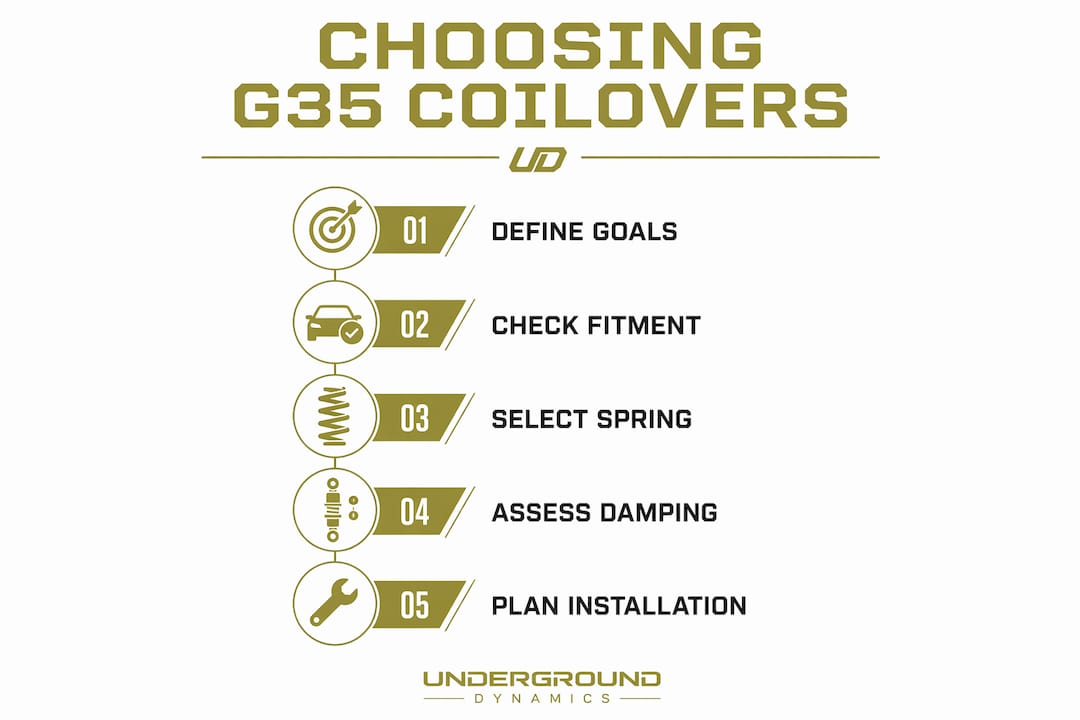
Match your intended use to the specs before you spend a dollar.
Step-by-step buyer checklist:
- Write down your exact year, body style, and drivetrain (RWD vs. AWD).
- Decide your primary use: daily commuting, spirited street driving, occasional track days, or stance.
- Set a realistic budget including installation labor ($200–$500 at most shops) and a four-wheel alignment ($100–$200).
- Ask the seller to confirm: spring rates front and rear, total shock travel, top-mount type, rear design (OEM-style or true coilover), warranty terms, and return shipping policy.
- Cross-reference the product’s fitment table against your exact vehicle.
Red flags on any listing:
- Spring rates are missing or listed only as “sport” or “performance” with no kg/mm figure
- Fitment claim says “fits G35” with no year or body-style breakdown
- No published shock travel or top-mount specification
- Warranty terms are absent or limited to “30 days”
- No documented installation instructions or fit photos from real installs
For daily driving, prioritize a kit with softer spring rates, rubber top mounts, and at least 16-way damping so you can dial back stiffness for commuting. For track use, go monotube, match spring rates to your damper valving, and plan for the true rear conversion. Stance builds need the widest drop range, but understand that extreme lowering sacrifices usable travel and can create clearance problems with wheels, tires, and exhaust routing.
What does a G35 coilover install actually cost?

Installation is not just bolting on new shocks. Budget for the full picture.
What the install typically requires:
- Jack, jack stands, torque wrench, spring compressor, and penetrating oil for corroded hardware
- New hardware (bolts and nuts) if the originals show rust
- Bump stops and dust boots if not included with the kit
- Camber arms if you’re dropping more than 1.5 inches, since stock camber arms won’t correct the geometry change
- Helper springs if running very low spring rates with significant drop
Professional installation at a shop typically costs a few hundred dollars depending on your region and parts involved. A four-wheel alignment after installation is non-negotiable. Skipping it means uneven tire wear and handling that feels off from day one. Target alignment specs after lowering include modest negative camber for stability, with toe set appropriately.
Post-install checklist:
- Clearance check through full compression with wheels turned to full lock
- Measure ride height at all four corners and match left/right within 3mm
- Verify brake lines and ABS wiring have no contact points with the shock body
- Re-torque all fasteners after 50–100 miles of driving
- Book a follow-up alignment check after the first 500 miles
Pro Tip: Before you finalize the install, cycle the suspension through full travel with the wheel installed and turned to full lock. This reveals brake line and ABS wiring interference before anything is permanently assembled, saving you from a nasty surprise on the road.
G35-specific technical setup: true rear conversion and spring-rate baselines
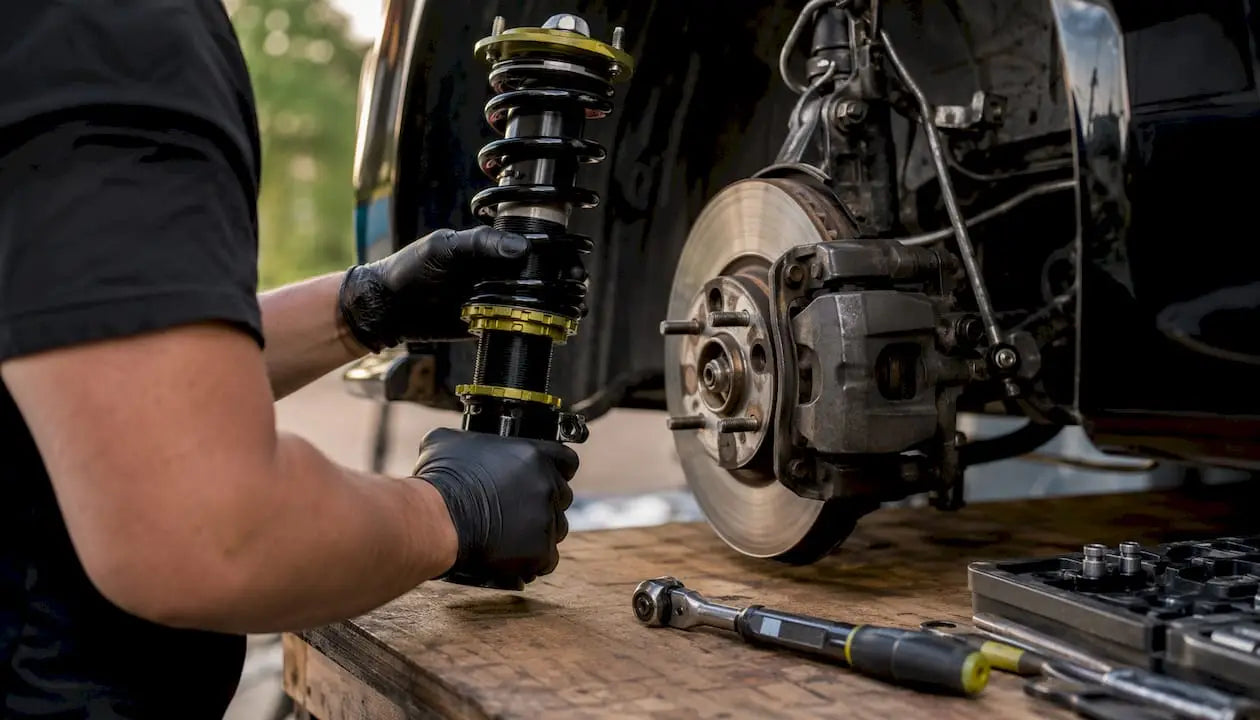
The G35’s rear suspension deserves its own section because the true-coilover conversion is where most builds go wrong.
True rear coilover conversion checklist:
- Confirm the kit is explicitly listed as “true rear coilover” for your G35 year and body style.
- Inspect the rear shock towers for adequate strength. Some conversions require reinforcement plates.
- Check whether your existing control arms allow the new motion ratio. Adjustable upper control arms often become necessary to restore proper camber gain during cornering.
- After installation, re-tune camber and toe. The change in spring perch height alters static and dynamic geometry, and stock settings won’t hold.
- Verify the new shock body clears the inner wheelhouse at full compression with the wheel at full lock.
Spring-rate baselines for the G35 platform
The G35 sedan weighs roughly 3,400–3,600 lbs depending on trim. That weight informs where spring rates should start:
- Street/daily: ~8–10 kg/mm rear, ~12 kg/mm front. Softer rates keep the ride livable and work with stock or lightly modified damping.
- Spirited street: ~10–12 kg/mm rear, ~14–16 kg/mm front. Requires matched damping increases to avoid a bouncy, unsettled feel. Spring-rate and damper valving must be matched; stiffer springs with stock-valved dampers create more problems than they solve.
- Track-focused: Higher rates on both ends, monotube dampers, and separate compression/rebound adjustment to manage the added stiffness through varied corner types.
These are starting baselines, not universal targets. Your final setup depends on tire compound, wheel weight, and how you actually drive.
Pro Tip: Do a dry-run installation without the springs. Bolt the shock body in place, cycle the suspension through full travel, and check for brake line, ABS wiring, and inner wheelhouse clearance before you ever compress a spring. This one step catches most interference problems before they become safety issues. Target a 45% bump / 55% droop split as your ride-travel starting point.
Key Takeaways
A matched monotube coilover kit with confirmed true-rear compatibility and documented spring rates is the right starting point for any G35 suspension upgrade.
| Point | Details |
|---|---|
| Confirm fitment before ordering | Match your exact year, body style, and drivetrain (AWD excluded on most kits). |
| Rear design changes everything | True rear coilover conversions alter kinematics and may require camber arms and reinforced mounts. |
| Spring rates must match damping | Running stiffer springs without adjusting damper valving creates a bouncy, unsettled ride. |
| Budget beyond the kit price | Add $200–$500 for installation and $100–$200 for a four-wheel alignment to your total cost. |
| Undergrounddynamics for G35 suspension | The suspension category lists chassis-specific coilover kits with fitment tables and spec details for the G35. |
The mistake most G35 owners make when buying coilovers
The most common error is chasing the lowest stance number on the spec sheet and ignoring everything else. A 3-inch drop sounds aggressive, but if it kills your usable suspension travel, you’ve built a car that bottoms out on every highway expansion joint and handles worse than stock.
The second mistake is skipping spring-rate verification. A listing that says “sport-tuned” without publishing actual kg/mm figures is asking you to buy blind. Spring rates that don’t match the damper valving produce a ride that feels harsh over small bumps and wallowy through fast corners simultaneously. That’s the worst of both worlds.
The third mistake is skipping the dry-run clearance check. It takes 20 minutes and catches interference problems that would otherwise show up as a rubbing brake line at 60 mph.
For most G35 owners who want a real improvement without turning the car into a track-only machine, a mid-tier monotube kit with 16–36-way damping, matched spring rates around 12 kg/mm front and 8–10 kg/mm rear, and a proper alignment afterward is the practical answer. The suspension upgrade almost always delivers more handling benefit per dollar than the next engine modification. Prioritize it accordingly.
Undergrounddynamics carries chassis-specific G35 suspension kits
Sorting through fitment tables and spring-rate specs across a dozen listings is where most buyers lose time and occasionally money. Undergrounddynamics publishes chassis-specific fitment details alongside real spec data so you can verify compatibility before you order, not after.

The G35 suspension category at Undergrounddynamics covers coilover kits with documented spring rates, drop ranges, and rear-design notes. If you’re planning a true rear conversion or need to pair your coilovers with front upper camber arms for geometry correction, the product pages include the fitment and compatibility details to make that call confidently. Check your year and body style against the fitment table, and contact support with your exact build specs if you need confirmation before ordering.
Useful sources
These are the primary references used to build the recommendations in this guide. Check them directly to verify specs and installation procedures for your specific kit.
- High Performance Academy: How to Install Coilovers & Adjust Ride Height — Step-by-step install procedures, the dry-run clearance method, and the 45/55 bump/droop ride-travel target. The most thorough free installation reference available.
- BC Racing true rear coilover product page for G35/350Z — Fitment notes for the true rear conversion on 2003–2006 sedan, 2003–2007 coupe, and 2003–2008 350Z. Confirms which additional components the conversion may require.
- Ksport Kontrol Pro G35 product page — Published spring rates (12 kg/mm front, 6.3 kg/mm rear), 36-way damping specs, true rear coilover designation, and AWD exclusion note. A good benchmark for mid-tier kit specs.
- Ksport Kontrol Plus 2-Way G35 product page — Example of a premium kit with separate compression and rebound adjustment, remote reservoir option, and documented warranty terms.
- Undergrounddynamics suspension category — Chassis-specific coilover listings with fitment tables and spec details for the G35. Use to verify fitment and compare kit options before ordering.
FAQ
What years does a G35 coilover kit typically fit?
Most kits split into two fitment groups: 2003–2007 (V35 platform, coupe and sedan) and 2007–2008 (V36 sedan). Always verify the exact year and body style on the product’s fitment table, since coupe and sedan kits are not interchangeable.
Do G35 coilovers fit AWD models?
No. Nearly every aftermarket coilover kit for the G35 explicitly excludes AWD sedan variants. If you’re running AWD, confirm compatibility directly with the seller before ordering.
What is a true rear coilover conversion on the G35?
A true rear coilover mounts the spring directly to the shock body instead of using the stock separate-spring arrangement. The conversion changes suspension kinematics and often requires adjustable control arms and a realignment to restore proper camber and toe.
How much does a G35 coilover install cost in total?
Budget the kit price plus $200–$500 for professional installation and $100–$200 for a four-wheel alignment. Camber arms and new hardware can add to that total depending on your drop target.
What spring rates should I run on a G35 for street use?
A street-focused setup on the G35’s 3,400–3,600 lb platform typically starts around 12 kg/mm front and 8–10 kg/mm rear. Those rates need to be matched to the damper valving; stiffer springs with unmatched damping produce a bouncy, unsettled ride.