FREE SHIPPING ON ORDERS OVER $150

Cart
0

For most track-day and club racing use, pick a 320 to 340mm aftermarket wheel. Go smaller, down toward 300mm, only for single-seaters, karts, or tight autocross setups where quick hands matter more than leverage. Stick closer to 350mm if the car still does daily street duty and you want a sportier feel without wrecking low-speed comfort. Rim shape, dish depth, and grip material all shift the final call from there.
TL;DR:
- A 320mm wheel is ideal for dedicated track and autocross cars, while a 340mm wheel offers a balance for street and track use.
- Smaller wheels increase steering sensitivity and effort, requiring torque adjustments or EPS tuning, especially on quick-ratio electric steering systems.
- Rim shape, dish depth, and grip material significantly influence handling feel and comfort, with specific shapes suited for different driving styles.
- Compatibility checks for hub pattern, quick-release, visibility, and glove clearance are essential before purchasing to avoid fitment issues.
- Aftermarket paddle shifters and buttons depend on car electronics and may require additional adapters or wiring for full functionality.
Table of Contents
- What Steering Wheel Diameter Works Best for Track Use?
- Why Does Steering Wheel Diameter Affect Handling and Feel?
- Does Rim Shape and Grip Material Matter as Much as Size?
- What Fitment Checks Should You Run Before Buying?
- How Do You Pick the Right Wheel and Confirm It Works?
- Hands-On Fitment Notes From Underground Dynamics
- Will Aftermarket Buttons and Paddle Shifters Still Work?
- Can You Customize or Adjust the Wheel After Installing It?
- What Safety Checks Matter Most With Wheel Size?
- Author Perspective: Chasing Precision Without Losing the Plot
- How Underground Dynamics Helps You Get the Fit Right
- Sources
- FAQ
What Steering Wheel Diameter Works Best for Track Use?
Diameter is the first decision, but it’s not the only one. Here’s how the common sizes break down by use case, based on aftermarket buyer guidance and category standards from sim and GT hardware makers.
- 320mm — the go-to for dedicated track builds and autocross cars. Quick, light, and rewarding on cars with fast steering ratios. Downside: less leverage means more effort at low speed, and tight cockpits can make big hands feel cramped against the rim.
- 330mm — the sweet spot most track regulars land on. It balances quick input speed with enough leverage to keep parking lots and paddock maneuvers manageable.
- 340mm — built for cars doing both commuting and track days. You keep most of the responsiveness of a smaller wheel while easing the low-speed muscle work.
- 350mm — best for daily-driven sports cars that still want a sportier rim than stock without the steering effort penalty smaller wheels bring.
Formula-style and open-wheel setups often run even smaller, in the 26 to 28cm range, according to Fanatec’s sim-racing wheel size guidance, since those cockpits prioritize rapid corrections over comfort. If your car already has a quick steering ratio or a cramped cockpit, size down. If low-speed maneuvering already feels like a workout, don’t go smaller just because it looks aggressive.
Why Does Steering Wheel Diameter Affect Handling and Feel?
Diameter changes three things at once: leverage, rotational inertia, and how far your hands travel per degree of input. A smaller wheel means less leverage, so the same steering force at the tires requires more effort from your arms. It also means your hands cover less distance for the same amount of steering angle, which is what makes small wheels feel quicker and more direct.
That speed comes with a catch. A Chalmers University engineering study tested 17 drivers on a handling track and found that steering torque feedback needs to scale down as wheel diameter shrinks. Keeping the driver’s felt force level consistent across different wheel sizes preserved both comfort and perceived handling quality. Shrink the wheel without adjusting torque, and the car feels heavier and less natural at low speeds, even though nothing mechanical changed downstream.
This matters if your car runs electric power steering. Drop from a 350mm wheel to a 320mm rim on a car with a quick ratio, and expect a noticeable jump in effort at parking speeds unless the EPS tune gets adjusted to match. Some aftermarket EPS controllers let you recalibrate assist curves; others don’t, so check before you buy if low-speed effort is a concern. Larger wheels trade some of that immediacy for leverage that’s easier on your shoulders during long stints, which is why endurance and touring builds often stay closer to 340 or 350mm even when the car is track-focused.
Does Rim Shape and Grip Material Matter as Much as Size?
Diameter gets all the attention, but shape and dish change the equation just as much. A round rim suits cross-hand cornering styles common in road racing. A GT-style wheel, often flattened at the bottom, gives thigh clearance and mirrors what most production-based race cars use. A formula rim is built for the fixed 9-and-3 hand position typical in single-seaters, where hands rarely leave those two spots.
Dish, or how deep the rim sits relative to the hub, changes your effective reach without changing the stated diameter. A deep-dish 350mm wheel can put your hands closer to your body than a flat 340mm wheel, effectively shrinking the reach even though the nominal size is larger. This is why two wheels with the same diameter can feel completely different in the seat.
Material matters just as much once you’re sweating through session three. Suede and Alcantara hold grip far better than leather when your palms get damp, which is most of a hot track day, though they wear faster and need occasional cleaning. Leather lasts longer but gets slippery fast once moisture shows up.
Pro Tip: Before buying a deep-dish wheel, sit in your seat with your current wheel and note where your knuckles land relative to your thighs. A dish that’s too deep can trap your hands against your legs in tight corners.
What Fitment Checks Should You Run Before Buying?
A wheel that looks perfect on a spec sheet can still be the wrong choice if the hub, bolt pattern, or sightlines don’t work in your car.
- Confirm hub bolt pattern and spline fitment. A 6x70mm pattern is common across many aftermarket hubs, but plenty of wheels ship undrilled or universal, according to MaxPapisInc’s steering wheel buyer’s guide, which means you’ll need a vehicle-specific adapter to make it work.
- Check quick-release compatibility. A quick-release hub and boss have to be matched to each other, not just to your car, so verify the exact pairing before ordering. Underground Dynamics’ guide on quick-release steering wheel legality is worth a read if you’re planning to swap wheels between street and track setups.
- Test instrument visibility. Some spoke designs block part of the gauge cluster on smaller wheels, a common complaint noted in driver forum discussions comparing 330mm and 350mm wheels. Sit in the seat with the candidate wheel mocked up before committing.
- Check hand and glove clearance. Racing gloves add bulk, so test fit with the gloves you’ll actually wear on track, not bare hands.
How Do You Pick the Right Wheel and Confirm It Works?
Work through this in order rather than jumping straight to a size.
- Define your primary use. Dedicated track car, street/track hybrid, or daily driver with occasional lapping days. This alone narrows you to a 20 to 30mm range.
- Measure your current reach and note your car’s steering ratio. A quicker ratio favors a smaller wheel; a slower ratio can tolerate, or even benefit from, a larger one.
- Pick diameter and rim shape together, not diameter alone. A 330mm GT-style rim and a 330mm formula rim will feel different in your hands.
- Confirm hub, adapter, and quick-release compatibility before you check out, not after the box arrives.
- Run post-install checks: gauge visibility, torque spec on mounting bolts, and a shakedown lap before you trust it in traffic.
If low-speed parking suddenly feels impractical after the swap, size up slightly rather than fighting it every day. If the car has electric power steering and effort feels off at any speed, that’s the moment to call a tech about an EPS retune rather than assuming you’ll adapt.
Pro Tip: Change diameter in 10 to 20mm increments if you’re experimenting. Jumping from 350mm straight to 320mm makes it hard to isolate whether you’re reacting to the size change or the shape change.
Hands-On Fitment Notes From Underground Dynamics
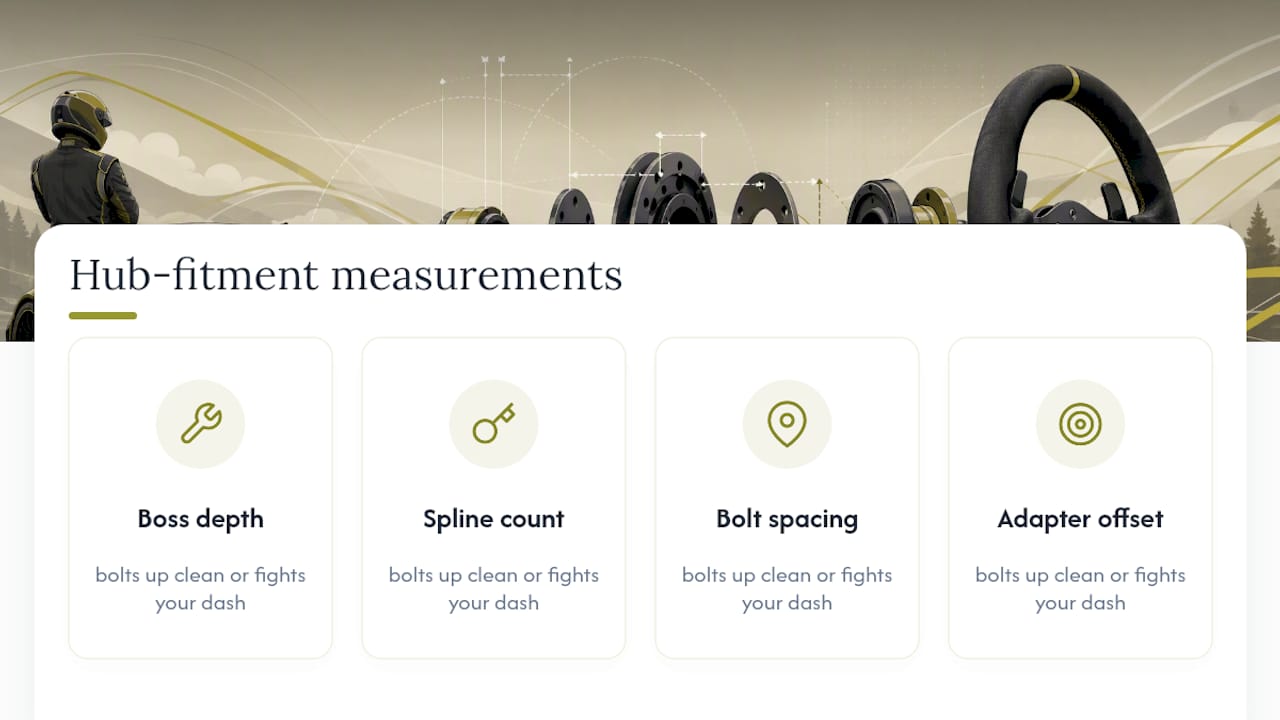
Getting the hub right matters as much as the diameter. Our hub-sizing checklist walks through the four measurements, boss depth, spline count, bolt spacing, and adapter offset, that decide whether a wheel bolts up clean or fights your dash. Mock up your 9-and-3 hand position with a cardboard template before ordering to check sightlines. After install, retorque mounting bolts following a short test lap, and give suede rims an occasional wipe down to keep grip consistent session after session.
Will Aftermarket Buttons and Paddle Shifters Still Work?
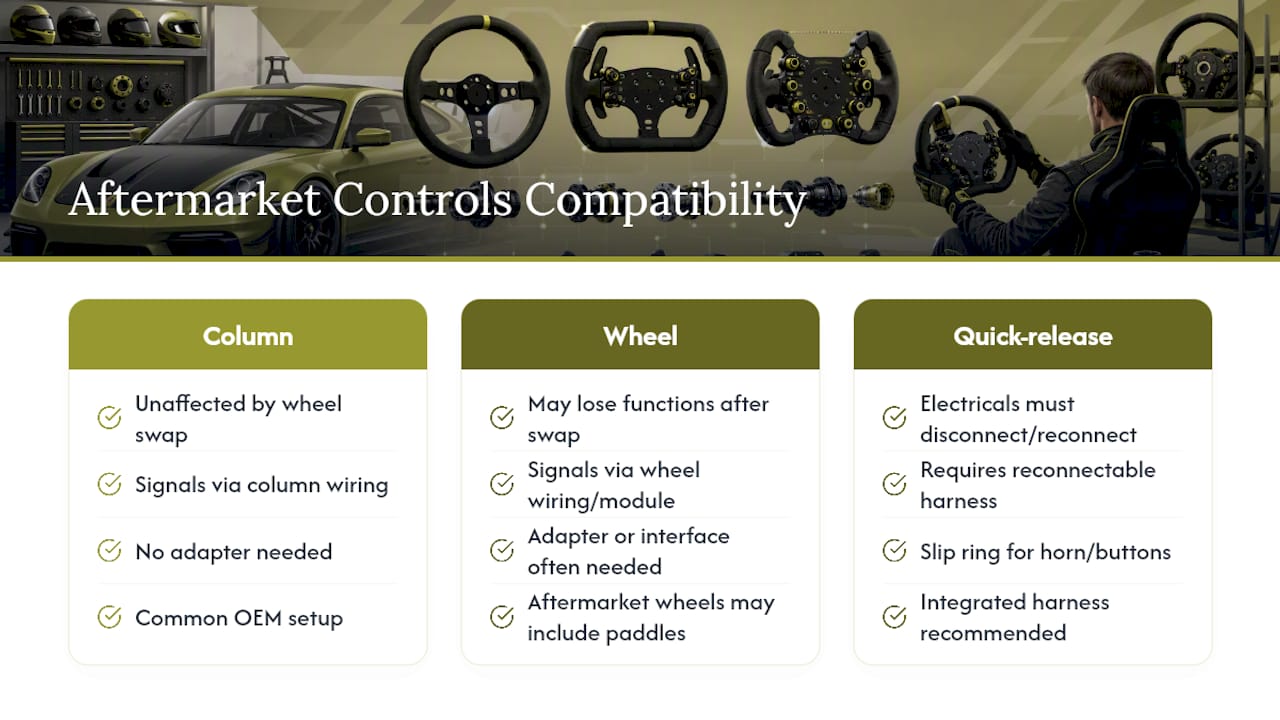
Most aftermarket wheels built for track use come wired for buttons, rotary switches, or paddle shifters, but compatibility depends on your car’s electronics, not just the wheel. Cars with factory paddle shifters or wheel-mounted controls route those signals through the factory steering column or a control module, so swapping the wheel alone can disable functions like cruise control, horn, or shift paddles unless you add a spacer, splined adapter, or a dedicated interface module.
Quick-release hubs complicate this further, since the electrical connection has to disconnect and reconnect cleanly every time you remove the wheel. Slip ring kits handle this for horn and basic buttons, but paddle shifters usually need their own resolved connection, either through steering column paddles retained separately from the wheel, or a wheel with integrated paddles wired through a quick-release-compatible harness.
If your car’s paddle shifters are mounted on the column rather than the wheel itself, a wheel swap won’t affect them at all, which simplifies things considerably. If they’re wheel-mounted, check whether the aftermarket wheel includes matching paddles or expects you to retain factory ones. Formula and GT-style aftermarket wheels aimed at track use often include integrated paddles and button pods specifically because so many buyers are replacing wheels that had factory shift controls. Confirm this before ordering rather than assuming plug-and-play, since a mismatch here is one of the more common install headaches.
Can You Customize or Adjust the Wheel After Installing It?
Modularity matters more once you’ve lived with a wheel for a season. Detachable spokes let you separate the rim from the hub-mounted spoke assembly, which is useful if you ever want to try a different rim shape without buying an entirely new hub setup. Some race-oriented wheels take this further with fully modular button pods and paddle assemblies that bolt to a common spoke plate, so upgrading electronics later doesn’t mean replacing the whole wheel.
Adjustable dish and rim depth exist on some higher-end aftermarket options too, letting you fine-tune reach without changing diameter. This matters more than it sounds, since a rim that’s a few millimeters closer or farther from your chest can be the difference between comfortable and cramped over a 20-minute session.
For most track-day builds, full modularity is a nice-to-have rather than a requirement. A fixed, well-matched wheel and hub combo will outperform a modular setup that’s poorly fitted. But if you’re actively experimenting with rim shape, dish, or button layout across a season, a modular spoke system saves real money over buying complete wheels each time you want to test a change.
What Safety Checks Matter Most With Wheel Size?
Clearance is the safety issue nobody thinks about until it’s a problem mid-session. A wheel too large for the cockpit can crowd your knees against the rim in a tight seating position, especially in cars with fixed-back racing seats mounted low and close to the column. A wheel that’s too small, paired with thick racing gloves, can make precise grip harder to maintain exactly when you need it most, like trail braking into a fast corner.
Check clearance with your actual gear on, not bare-handed. Helmet, gloves, and a harness all change how you sit and reach compared to a quick test drive in street clothes. A wheel that clears your knees when you’re relaxed on the street can suddenly feel tight once you’re strapped into a five-point harness with a HANS device limiting head and neck movement.
Instrument visibility is a safety item too, not just a convenience one. If spokes block your view of a shift light or coolant temperature gauge at the exact moment you need it, that’s a real risk on track, not a minor annoyance. Test this seated in your actual driving position, with the seat and wheel positioned exactly as you’d run them on track, before locking in a purchase.
Author Perspective: Chasing Precision Without Losing the Plot
Accept some heavier low-speed feel if it buys you real precision at speed, that trade is usually worth it on a dedicated track car. Test in small steps: 10 to 20mm changes, not a jump from 350 straight to 320, so you actually know what changed. If you’re unsure how your specific chassis and steering ratio will respond, seek fitment-specific guidance from experts before you commit.
— Ismael
How Underground Dynamics Helps You Get the Fit Right
Specialized retailers offer hub adapters, quick-release kits, and steering wheels with detailed fitment specs, bolt patterns, spline counts, and dish measurements to help avoid guessing during a wheel swap.
Start with our hub-sizing breakdown to measure your car correctly, then browse the catalog to match a wheel and adapter kit to your seating position and steering ratio. Measure your reach, pick your diameter, order the matched hub kit, and put it through a real test at your next track day.
FAQ
What Is the Standard Size of a Steering Wheel?
Most factory passenger cars run steering wheels between 14 and 15 inches, roughly 350 to 380mm. Aftermarket performance wheels typically run smaller, from 320 to 350mm, since track-focused driving favors quicker, lighter inputs over the extra leverage stock wheels are built for.
What Is the Best Rim Size for Track Driving?
A 320 to 340mm diameter covers most track-day and club racing needs, with 330mm being the most common sweet spot among aftermarket buyers. Dedicated single-seater and autocross setups often go smaller, down toward 300mm or the 26 to 28cm formula range noted by Fanatec.
What Size Is a Racing Steering Wheel?
Racing wheels built for circuit use commonly measure 300 to 330mm, smaller than the factory average, to maximize input speed and driver feedback. Formula and open-wheel cars often run even smaller, closer to 26 to 28cm.
Are All Steering Wheels 15 Inches?
No. Fifteen inches, about 380mm, describes many factory passenger car wheels, but it’s far from universal. Aftermarket and racing wheels commonly run smaller, from 320 to 350mm, precisely because track driving rewards quicker steering inputs over the extra leverage a larger wheel provides.