FREE SHIPPING ON ORDERS OVER $150

Cart
0

Stainless steel brake lines are worth it if you track your car, tow heavy loads, or hammer the brakes off-road, and optional for most street-only drivers running healthy OEM hoses. You’ll get a firmer, more consistent pedal and lines that shrug off abrasion and corrosion, but don’t expect a dramatic drop in stopping distance. Keep reading based on how you actually drive.
TL;DR:
- Stainless steel brake lines significantly improve pedal firmness and modulation during repeated hard stops, especially for track or off-road use.
- Quality lines with PTFE cores resist heat and pressure better than nylon, and coated braids allow easier inspection for internal wear and damage.
- For most street drivers with healthy OEM hoses, upgrading to stainless lines offers minimal reduction in stopping distance but enhances pedal feel and durability.
- Proper installation, including correct routing, fittings, bleeding, and inspection, is essential to ensure safety and optimal performance of brake lines.
- Pairing stainless lines with fresh pads and high-temperature brake fluid provides the best overall improvement in stopping performance.
Table of Contents
- What Stainless Steel Brake Lines Actually Are
- What Actually Improves, and Where the Hype Runs Out
- When the Upgrade Earns Its Keep: A Decision Guide
- Installation Pitfalls and a Simple Maintenance Routine
- Where Your Money Actually Buys More Stopping Power
- Do Stainless Lines Change How Your Brake Fluid Handles Heat?
- Warranty and Insurance Questions Before You Install
- An Enthusiast’s Take on the Upgrade
- Where to Find Fitment-Specific Brake Line Kits
- Sources
- FAQ
What Stainless Steel Brake Lines Actually Are
A stainless brake line is built in three layers. Inside sits a PTFE (Teflon) liner that carries the brake fluid. Wrapped around that liner is a braided stainless-steel sleeve, and on quality kits, an outer coating protects the braid itself.
That construction matters because rubber hoses flex and balloon slightly under hydraulic pressure. Every time you stand on the brake pedal, some of your pedal travel is being absorbed by the hose expanding, not the caliper clamping the rotor. Stainless braid resists that expansion, so pedal effort translates more directly into clamping force. That’s the entire reason enthusiasts chase this upgrade: a firmer pedal with less “sponge” at the top of the stroke.
Not all braided lines are built the same, though. Some budget kits swap the PTFE core for nylon, which handles heat and pressure cycling differently and tends to fail sooner under sustained hard use. Before you buy, know what you’re getting:
- PTFE inner liner: handles heat cycling and pressure better than nylon over the long haul.
- Stainless braid: the structural layer that resists expansion and physical damage.
- Outer coating (PVC or silicone): shields the braid from grit and makes visual inspection easier.
- Fittings: banjo bolts or threaded ends machined to match your caliper and master cylinder.
What Actually Improves, and Where the Hype Runs Out
The real-world benefits are specific, not universal. On a car with aging or long hose runs, swapping to stainless steel gives you a noticeably firmer pedal and better modulation, meaning you can feel small changes in braking force instead of guessing where the bite point is. That difference gets magnified during repeated hard stops, which is exactly when track-day drivers report the biggest gains.
Durability is the other half of the pitch. Stainless braid resists abrasion from road debris and doesn’t degrade from UV exposure or brake heat the way rubber does over years of service, and manufacturers commonly market these lines as long-lasting upgrades built to outlast a factory hose replacement cycle.
Where the hype runs out: stainless lines have a small effect on outright stopping distance for a street car with a healthy brake system. Independent testing and reviews consistently point to pads, rotors, and fluid as the bigger levers for shortening how far your car travels before it stops. The lines change how the pedal feels under your foot, not how much friction is happening at the rotor.
There’s also a real inspection problem. Braided steel wrapping hides the inner hose from view, so a hose that’s cracking or delaminating internally can look completely fine from the outside. That’s a legitimate downside worth weighing:
- Standard braided kits make it hard to spot internal hose degradation before it fails.
- Coated braid (PVC or silicone) reduces this risk and slows wear from grit embedding between the strands.
- A hose that looks pristine on the outside can still be collapsing internally, especially on cheaper nylon-core kits.
If you’re buying primarily for peace of mind, a coated kit costs a little more and buys you the ability to actually see problems coming.
When the Upgrade Earns Its Keep: A Decision Guide
Stainless lines make the most sense in a handful of specific situations, and street driving usually isn’t one of them.
Upgrade to stainless if you fall into any of these categories:
- You track your car regularly. Repeated heavy braking from high speed is where hose expansion becomes noticeable lap after lap, and where a firmer pedal actually changes how confidently you brake late into a corner.
- You off-road or drive on debris-heavy surfaces. Rocks, gravel kickback, and mud all chew through rubber faster than braided stainless, making protective upgrades like the Polaris Ranger Bolt-On Subframe Stiffener / Gusset Kit valuable in off-road scenarios.
- You tow or haul heavy loads often. Sustained brake heat under load stresses rubber hoses more than typical commuting does.
- Your current hoses are already showing age. Cracking, bulging, or a soft pedal are signs it’s time to replace hoses anyway, so upgrading to stainless while you’re in there costs little extra.
If none of those apply and you’re mostly commuting or doing the occasional spirited weekend drive, fresh OEM rubber hoses paired with better pads and fluid will likely give you more noticeable improvement per dollar than stainless lines alone.
Pro Tip: Before you spend a cent, run through this: inspect your current hoses for cracking or bulging, be honest about how you actually drive the car, set a real budget, and pair any line upgrade with fresh pads and fluid instead of doing it in isolation.
Installation Pitfalls and a Simple Maintenance Routine
Installing brake lines isn’t hard, but it’s not forgiving of shortcuts either. The most common mistakes come from rushing the job rather than from the parts themselves.
- Poor routing: lines rubbing against suspension components or the chassis will wear through over time.
- Wrong fittings: banjo bolts and thread sizes vary by application, and a mismatched fitting can leak under pressure.
- Over-tightening: crushing a banjo bolt or crossing threads can crack a fitting that looked fine going on.
- Incomplete bleeding: air trapped in the system after install produces a soft, unpredictable pedal that masks whether the lines are even working correctly.
Once installed, a simple visual check during every tire rotation or fluid service catches most issues early: look at the fittings for weeping fluid, check the braid for fraying or abrasion, and confirm the outer coating hasn’t split anywhere. Re-torque fittings if you notice any seepage, and if a line ever feels suspect internally, replace it rather than guessing.
Pro Tip: If you’re not confident bleeding brakes or torquing banjo fittings to spec, pay a shop to do the install. A brake line is the wrong place to learn on the job.
Where Your Money Actually Buys More Stopping Power
If your goal is genuinely shorter stopping distances rather than a firmer pedal feel, the order of operations matters. Most experienced builders rank upgrades in this sequence:
- Brake pads (compound): the single biggest lever for street and track grip, and usually the cheapest place to start.
- Brake fluid (higher boiling point): prevents fade during repeated hard stops and costs very little.
- Rotors (size or design): bigger or better-vented rotors help with heat management, especially under sustained use.
- Calipers and lines: improve pedal feel and consistency, but they’re refinements on top of a system that’s already gripping well.
If your current rubber hoses are old or degraded, replacing them, stainless or not, is a sensible, low-cost move that restores lost pedal firmness. On a tight budget, spend first on pads and fluid. If you’ve already upgraded those and still want a firmer pedal for track days, stainless lines are the logical next step.
Do Stainless Lines Change How Your Brake Fluid Handles Heat?
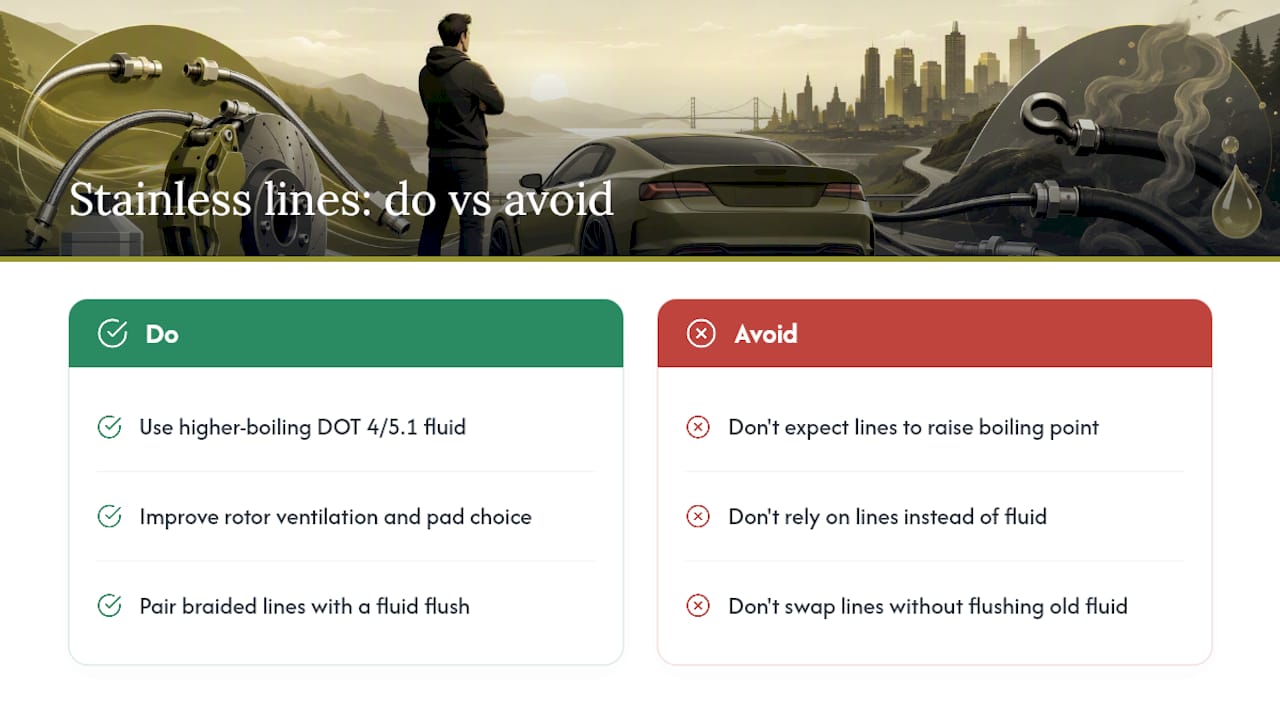
Stainless brake lines don’t lower your brake fluid’s boiling point or add heat capacity to the system on their own. The fluid’s resistance to boiling comes down to its DOT rating and how much moisture it’s absorbed over time, not the material of the hose carrying it.
Where lines do play a supporting role is in how consistently that fluid experiences pressure. Because stainless-braided lines expand less under hydraulic load, they hold pressure more efficiently through repeated hard stops, so the fluid inside is doing more of the useful work of clamping the caliper instead of stretching the hose. That’s a pedal-feel benefit, not a thermal one.
Heat dissipation at the caliper and rotor is a separate issue entirely, driven by rotor mass, ventilation design, and pad compound, not hose material. If you’re pushing your car hard enough to worry about fluid boiling, the fix is a higher-boiling DOT 4 or DOT 5.1 fluid and better-ventilated rotors, not stainless lines. Swapping to braided steel while running old, moisture-saturated fluid still leaves you exposed to brake fade on a track day. Pair the line upgrade with a fluid flush if it’s been more than a couple of years since your last one, and you’ll get the full benefit of both.
Warranty and Insurance Questions Before You Install
Modifying your brake system can raise legitimate questions about vehicle warranty coverage and insurance, and the answers depend on how the work is done and documented.
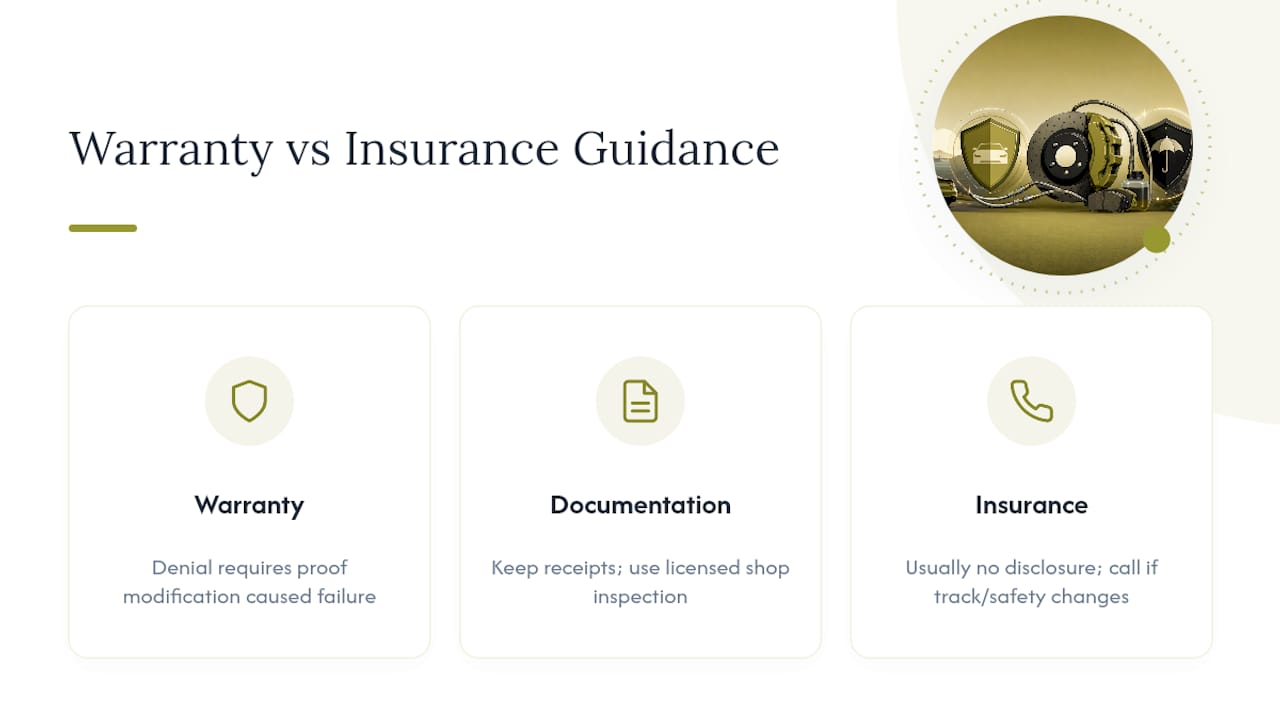
For warranty purposes, most manufacturers can only deny a claim if they can show the modification directly caused the failure being claimed, a standard that traces back to protections against blanket denials for unrelated aftermarket parts. In practice, that means a brake line failure caused by poor installation could jeopardize a related claim, but a properly installed stainless line generally won’t void coverage on unrelated systems like your engine or transmission. Keep your receipts and, if possible, have the work done or inspected by a licensed shop so you have documentation if a dealer pushes back.
Insurance is a separate conversation. Most standard auto policies don’t require you to disclose brake line upgrades, but if you’re modifying a car for track use or making changes that affect safety systems, it’s worth a call to your provider to confirm you’re still covered in the event of an accident. Some policies specifically exclude damage tied to unlisted modifications. A five-minute phone call before you install anything is cheaper than finding out the hard way that a claim got denied.
An Enthusiast’s Take on the Upgrade
Swapping to stainless lines on a project car makes the biggest difference the first time you brake hard from real speed, not during a Sunday cruise to the coffee shop. The pedal firms up and stops moving under your foot the way a tired rubber hose lets it. On the street, that improvement is real but subtle enough that most passengers would never notice.
Fitment-specific ISR Performance brake-line kits are available for platforms like the Miata and 240SX/300ZX, which matters more than people think. A kit built for your exact chassis avoids the routing and fitting headaches that come with universal lines. Pair it with fresh pads and quality fluid, and have a shop bleed it properly if you’re not confident doing it yourself.
— Ismael
Where to Find Fitment-Specific Brake Line Kits
If you’ve decided stainless lines fit your build, the fastest way forward is buying a kit engineered for your exact chassis rather than a universal one you’ll have to adapt. Underground Dynamics stocks ISR Performance rear brake line kits for the Nissan 240SX and 300ZX and matching front kits built to the same fitment standard, so the banjo bolts and lengths line up without modification.
Before ordering, confirm your model year and suspension setup against the product page, since small chassis differences can affect fitment. If you’re already in there upgrading, this is also the right moment to check your pad compound and fluid age since a line swap works best as part of a full system refresh, not a standalone fix. Browse the full performance parts catalog for pads, fluid-compatible components, and other braking upgrades, or head to the Underground Dynamics homepage to search by your specific make and model. If you’re unsure about installing it yourself, a qualified shop can handle the bleed and torque specs in under an hour.
Sources
- Installing braided steel brake lines is an easy and effective track modification — The Drive (2022)
- Stainless steel vs rubber brake line comparison — Jalopnik
FAQ
What’s the best material for a brake line, stainless or rubber?
Stainless steel with a PTFE inner liner resists expansion and abrasion better than rubber, giving a firmer pedal and longer service life, but rubber hoses in good condition still meet OEM safety standards for daily driving.
Are steel brake lines actually good for street cars?
They’re good, but the improvement is modest for most street driving. You’ll notice a firmer pedal and better durability, while stopping distance gains are usually small compared to upgrading pads or fluid.
How long do stainless steel braided brake lines last?
Quality PTFE-core stainless lines are commonly marketed as long-lasting upgrades that outlast a typical rubber hose replacement interval, though a braided cover can hide internal wear, so periodic inspection still matters.
Is stainless steel brake line harder to flare or install than rubber?
Stainless lines generally come pre-assembled with fittings from the manufacturer, so most installs don’t require flaring at all; the harder part is correct routing, torque, and bleeding, which is why unsure installers should use a professional shop.
Are stainless brake lines necessary for daily driving?
No. If your current rubber hoses are healthy, fresh OEM hoses paired with good pads and fluid usually deliver more noticeable improvement for daily driving than a stainless upgrade alone.