FREE SHIPPING ON ORDERS OVER $150

Cart
0
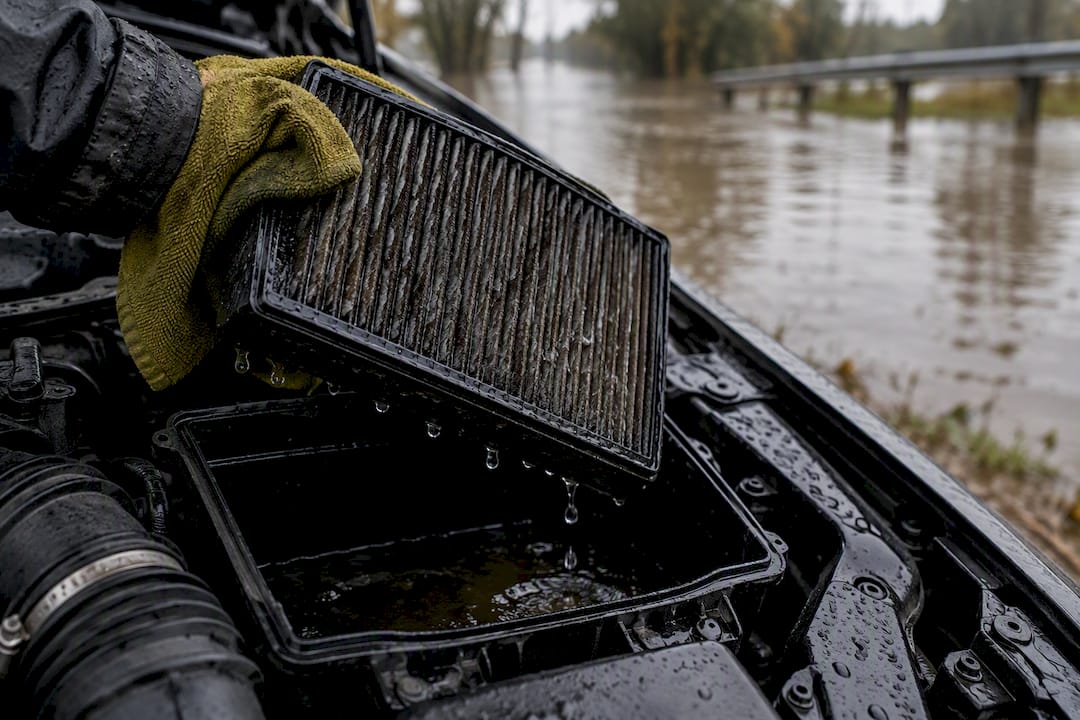
Intake hydrolock risk is real, but it takes a genuine slug of water, not a damp filter, to bend a rod. Low-mounted intakes and flooded roads raise your odds significantly. If you suspect water made it past the filter, the single most important move is to stop and not crank the engine. Cranking a water-filled cylinder is what turns a wet air filter into a five-figure repair bill.
TL;DR:
- Water must fill about 80% of the cylinder to deform the connecting rod; catastrophic failure often occurs past 110-120% fill, so quick shutdown prevents major damage.
- Low-mounted filters and open setups near the bumper increase hydrolock risk, especially on flooded roads or during high-speed wave splashes.
- Sealed intake systems at or above stock height, splash shields, and tight couplers significantly reduce water ingress, making aftermarket intakes safer if properly installed.
- Immediate engine shutdown, avoiding cranking, and inspection of the filter are critical steps if hydrolock is suspected, as cranking can cause severe engine damage.
- Proper fitment, routing, and shielding are essential for water resistance; checking these details before upgrading is more effective than relying on brand claims.
Table of Contents
- Understanding Intake Hydrolock Risk and How It Damages an Engine
- How Intake Design and Placement Change Your Exposure
- When Hydrolock Actually Happens: Real Scenarios, Not Just Theory
- Recognizing the Symptoms and Damage of a Hydrolocked Engine
- Preventing Intake Hydrolock: Hardware and Habits That Actually Work
- What to Do the Moment You Suspect Hydrolock
- Fitment-First Thinking Reduces Intake Water Damage Risk
- A Builder’s Take on Performance Intakes vs. Intake Water Damage
- Ready to Cut Your Intake Water Exposure? Here’s Where to Start
- Sources
- FAQ
Understanding Intake Hydrolock Risk and How It Damages an Engine
Hydrolock happens when liquid, which can’t compress the way air can, gets trapped in the combustion chamber as the piston tries to complete its stroke. The piston has nowhere to go. Something has to give, and it’s usually a connecting rod, a cracked block, or a bent crank. Hydrolock occurs whenever a cylinder fills with liquid instead of air, and water intrusion through the intake is the most common civilian cause, followed by coolant leaking internally past a blown head gasket or oil pooling from a stuck valve.
The damage isn’t binary. Engineering research on conrod behavior during liquid interaction found that deformation of the connecting rod starts once the cylinder is roughly 80% filled with liquid, and catastrophic rod or crank failure becomes common once fill levels exceed about 110% to 120% of chamber volume. That window matters because it means a small amount of water sloshing into a cylinder isn’t automatically game over. It’s the difference between a rod that’s slightly bent and one that’s punched through the block.
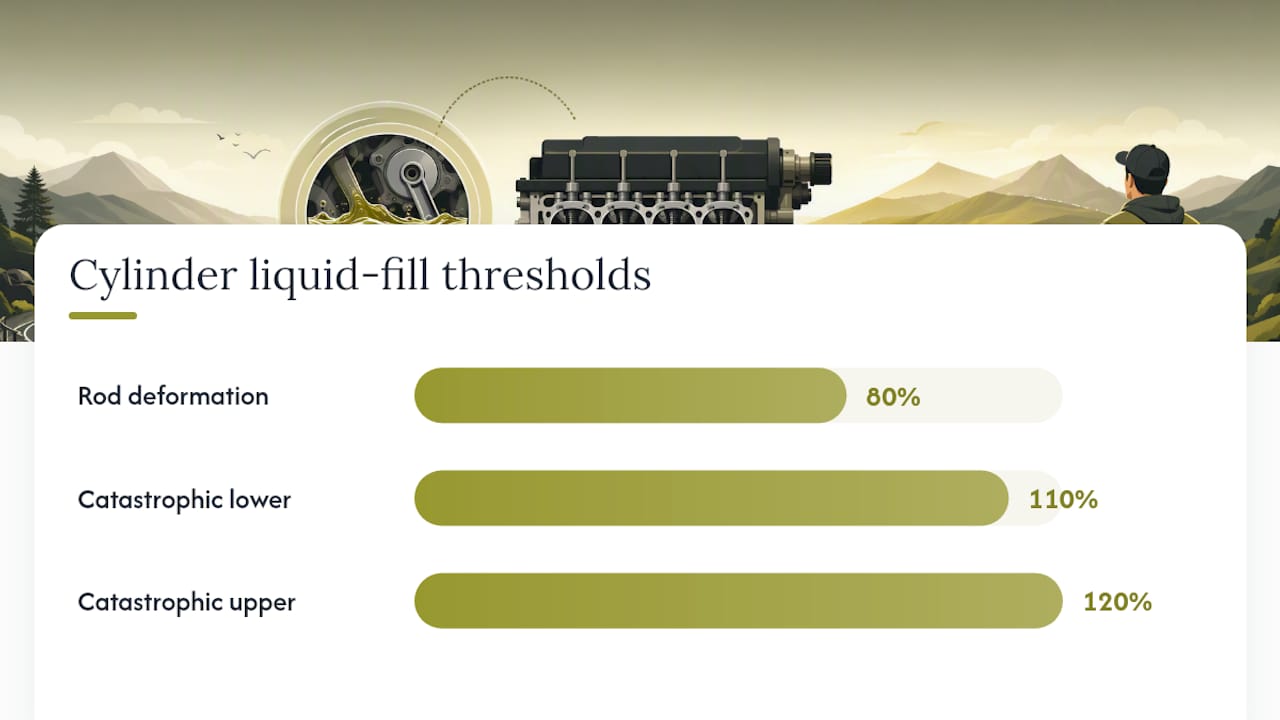
Statistic Callout: Rod deformation begins near an 80% liquid fill ratio in the cylinder; failure becomes catastrophic past roughly 110 to 120% of chamber volume. That gap is exactly why cutting the ignition the instant you suspect water beats trying to “power through” a puddle.
Diesel engines carry extra risk here. Their combustion chambers run smaller final volumes at top dead center, and diesel starter torque tends to force more damage through once hydrolock starts, because there’s no throttle body choking airflow the way there is on most gas engines. If you’re running a diesel truck through a flooded crossing, treat the margin for error as thinner than it would be on a gas-powered build.
How Intake Design and Placement Change Your Exposure
Where your filter sits changes everything about intake water damage risk. A stock airbox is usually tucked high in the engine bay, fed through routing that acts like a built-in snorkel, with drain points designed to shed water before it reaches the filter element. Aftermarket intakes trade some of that protection for airflow and sound.
- Open cone filters mounted low, near the bumper or behind a front fascia opening, sit closer to bow waves kicked up by other traffic and closer to puddle depth on flooded roads.
- Tubing that routes outside the factory airbox cavity, a common trait of cold air intake kits, places the filter lower to the ground and increases the chance of pulling in water compared to a stock setup.
- Closed, sealed in-bay intake kits keep the airflow benefit of a larger filter and heat shield while staying at or above the stock airbox height, which cuts exposure without sacrificing much performance.
- Intact splash shields and fender liners block spray and standing water from reaching the intake tract in the first place, and they’re one of the cheapest, most overlooked safeguards on a modified car.
- Sealed couplers and clamps matter as much as the filter location. A loose factory clamp can let water bypass the filter entirely and drip straight into the intake tube.
None of this means cone filters are reckless by default. It means placement and sealing do more for your intake water damage exposure than the filter media itself. A well-routed cone intake mounted at stock height with tight couplers can be just as safe as a factory box. A cheap open intake dropped low behind a front bumper, on the other hand, is asking for trouble the first time you hit a flooded intersection at speed.
When Hydrolock Actually Happens: Real Scenarios, Not Just Theory
Hydrolock causes tend to cluster around a small set of predictable situations, and almost all of them involve either standing water deeper than your intake or a wave of water thrown up faster than your intake can shed it.
- Standing water on a flooded road. If water depth reaches or exceeds the height of your intake opening, even slow driving can pull water past the filter. This is the single most common trigger for daily drivers.
- High-speed bow waves. Driving through a shallow puddle at speed, or getting hit by the wake from an oncoming car in the opposite lane, throws water higher than the puddle’s actual depth. A six-inch puddle can splash water a foot or more into a low intake opening.
- Off-road water crossings. Stream fords, muddy trail crossings, and flooded low points on off-road routes routinely exceed stock intake height, which is why serious off-roaders run raised snorkels as standard equipment rather than an accessory.
- Parking or idling in rising water. A car sitting in a flooding parking lot or a rapidly rising storm surge can take on water through the intake even without the engine moving, since the intake opening doesn’t care whether the car is stationary.
Ground clearance and intake height do more to determine outcome than horsepower or displacement. A lifted truck with a factory-height snorkel can cross water that would drown a lowered sports car’s intake in inches.
Signs your intake got soaked rather than just splashed include a wet or dripping filter element, standing water visible in the bottom of the airbox, a rough idle or stall right after driving through water, and a distinct hesitation or loss of power the moment you hit the puddle. Any one of those is a reason to pull over immediately rather than keep driving and hope it clears itself.
Recognizing the Symptoms and Damage of a Hydrolocked Engine
A hydrolocked engine announces itself fast. The car stalls the instant water hits the chamber in enough volume, and it will not restart, sometimes with a loud mechanical knock or thud as the starter tries to force the piston through liquid that has nowhere to go.
- Engine stalls immediately while driving through water and refuses to crank back over.
- A knocking or grinding sound from the starter trying to turn an engine that’s mechanically locked.
- Visible water in the air filter housing or dripping from the intake tube when you check it.
- Misfires or rough running in the minutes after a water crossing, even if the engine didn’t fully stall.
Statistic Callout: Damage severity tracks the fill ratio almost exactly: below roughly 80% cylinder fill, rods may bend but often hold; push past 110 to 120% and you’re typically looking at broken rods, a cracked head, or a compromised block.
The safe move for an owner is a visual check only, meaning you can open the airbox and look for water, but you should never crank the engine to “see if it starts.” Cranking is exactly what turns a bent rod into a punched-through block, since the starter has enough torque to force the issue.
Repair severity spans a wide range, from a filter swap and an oil change if you caught it in time, up to a full engine replacement if a rod let go. There’s no single number that covers every case, because the outcome depends entirely on how much water got in and how quickly the engine was shut down.
Preventing Intake Hydrolock: Hardware and Habits That Actually Work
Preventing intake hydrolock starts with behavior, because it’s free and it works. Slow down through standing water instead of powering through it, avoid flooded roads entirely when you have another route, and know roughly how high your intake sits off the ground so you can judge a puddle at a glance.
Hardware backs up good judgment for the situations you can’t fully avoid.
- Splash shields and fender liners block spray from wheels and road wash before it ever reaches the intake tube, and they’re often the cheapest fix available.
- Sealed in-bay intake kits keep your filter at or near stock height while still improving airflow over a restrictive factory box.
- Raised snorkel setups make sense if you’re regularly off-roading or crossing water on a routine basis, not just for the occasional flooded street.
- Sealing couplers and clamps properly is a five-minute check that prevents water from bypassing the filter media entirely.
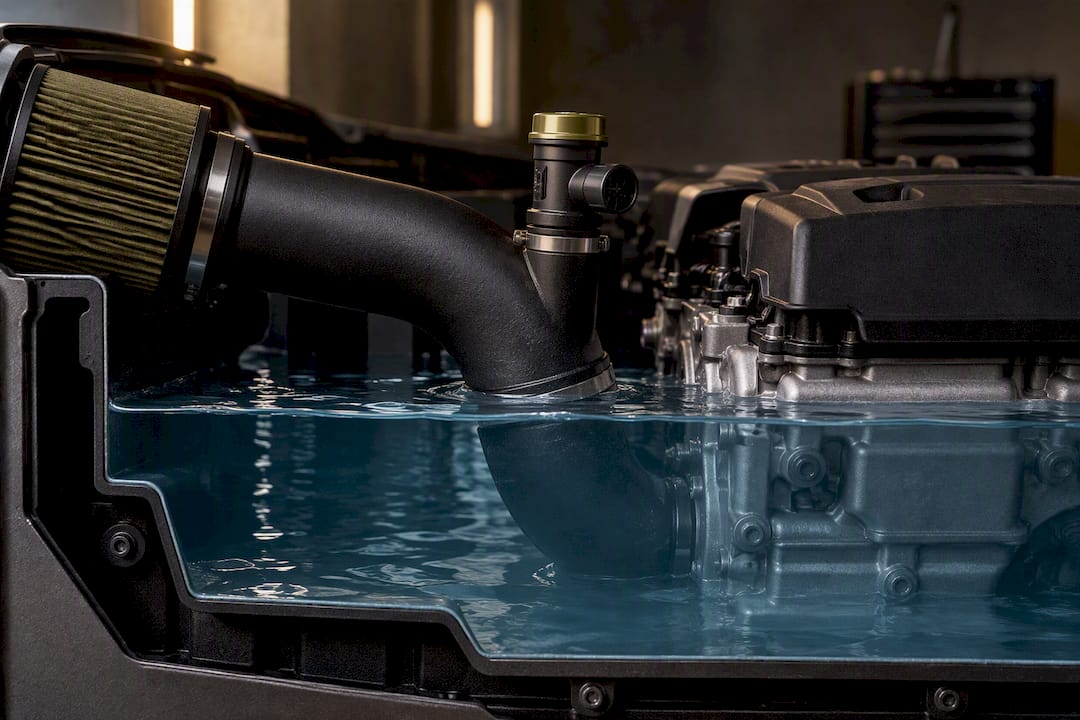
An intake bypass valve is worth understanding on its own, because it’s one of the few retrofits built specifically for this problem. The valve provides a secondary, higher-mounted air source that kicks in if the main low-mounted filter becomes submerged, keeping the engine breathing even when the primary intake path is underwater. It’s inexpensive insurance for a low-mounted cold air intake, but it has a hard limit worth remembering.
Pro Tip: A bypass valve only helps if its inlet stays above the water line. It won’t save you in a full fording situation where the whole engine bay goes under. Treat it as protection against puddles and bow waves, not deep-water crossings.
If you’re deciding between an open cone filter and a sealed airbox for a daily driver that occasionally sees bad weather, lean toward the sealed option unless you’ve already confirmed your local roads rarely flood. Performance loss between the two is usually marginal; risk exposure is not.
What to Do the Moment You Suspect Hydrolock
Acting fast is the difference between a filter swap and an engine rebuild.
- Stop and shut off the engine immediately. Do not attempt to restart it, and do not crank it “just to check.” Cranking a hydrolocked engine is the single most common cause of turning bendable rods into broken ones.
- Disconnect the battery if you can safely do so, to remove any chance of an accidental start attempt.
- Open the airbox and inspect the filter for visible water or saturation. This is safe for any owner to check.
- Leave spark plug removal and manual rotation to someone who knows the process, since pulling plugs and turning the engine over by hand is how a shop safely purges trapped water without forcing it against a piston.
- Have the car towed to a mechanic rather than driving it, even if it seems to idle fine afterward.
A shop’s process typically starts with pulling the plugs and rotating the engine by hand to expel any remaining liquid, then running a compression test and checking the oil and coolant for contamination before deciding whether the engine can be saved or needs to come apart. Early intervention, caught before a hard crank, sometimes avoids a full teardown entirely. Once a rod has already bent or broken, you’re into rebuild or replacement territory, and there’s no shortcut around that.
Fitment-First Thinking Reduces Intake Water Damage Risk
Fitment detail built into intake listings is important for exactly this reason. Filter height, tube routing, and coupler sealing all affect how exposed a build is to water, and vague spec sheets make that call impossible. Before swapping in an aftermarket intake, confirm three things: where the new filter sits relative to your stock airbox, whether the tube routing runs through a splash-prone area, and whether the kit includes or accommodates a proper splash shield. Products like ISR Performance’s fuel system components show the level of fitment documentation to expect. Buying with that detail in hand beats guessing every time.
A Builder’s Take on Performance Intakes vs. Intake Water Damage
Performance intakes aren’t the enemy here. Routing and shielding matter more than the intake brand you pick. Occasional puddle drivers usually need nothing more than an intact splash shield and some common sense. If you’re fording water regularly, spend the money on a raised or sealed setup and check the fitment data before you buy, not after.
— Ismael
Ready to Cut Your Intake Water Exposure? Here’s Where to Start
Some brands sell hardware that turns “hope it doesn’t flood today” into an actual plan: air intakes, splash-shield-friendly kits, and fitment data to match them to your chassis instead of guessing off a generic listing.
If you’re shopping for a replacement intake or shield setup, start with the air intake and body panel categories to compare filter height and routing across options for your platform. Lowering your ride height changes intake exposure too, so if you’re planning a coilover or air suspension install, factor ground clearance into that decision before you drop the car. And once you’ve got a repair or refresh underway, Diamond Brite’s guide to water spot removal covers safe cleanup steps that won’t spread contamination while your engine bay dries out. Check fitment on the product page for your make and model, confirm intake height against your typical routes, and order the part that actually matches your chassis instead of a universal kit.
Sources
- Hydrolock - Wikipedia
- Study of the conrod deformation during piston interaction with liquid in the internal combustion engine cylinder | Journal of Mechanical Engineering and Sciences
- How a Cold Air Intake Bypass Valve Works to Prevent Engine Hydrolock — OnAllCylinders
- Hydrolocked Engines Explained: What It Is and How to Avoid It — Burt Brothers
FAQ
Can a Hydrolocked Engine Be Saved?
Yes, if caught early. If water is purged before you crank the engine and rods haven’t already bent, a shop can often clear the cylinders, check compression, and get the car running without a rebuild. Once cranking has already bent or broken a rod, you’re generally looking at a rebuild or replacement.
Can Cold Air Intakes Cause Hydrolock?
Low-mounted cold air intakes don’t cause hydrolock on their own, but they raise exposure by sitting closer to the ground than a stock airbox. Pairing a low intake with flood driving or deep puddles is what actually creates the risk.
Is It Okay If My Air Intake Gets Wet?
A damp or lightly splashed filter usually isn’t a problem, since research on chamber fill ratios shows deformation only starts once the cylinder is around 80% filled with liquid, which takes a real volume of water and not surface dampness. A dripping-wet filter or standing water in the airbox is a different situation and warrants an immediate stop and inspection.
Is It Expensive to Fix a Hydrolocked Engine?
Cost ranges widely depending on how much water got in and how fast you shut the engine off. A caught-early case might mean a filter, oil change, and inspection, while a full hydrolock with bent rods often means an engine rebuild or replacement, since broken rods, a cracked head, or block damage are the typical failure points.