FREE SHIPPING ON ORDERS OVER $150

Cart
0
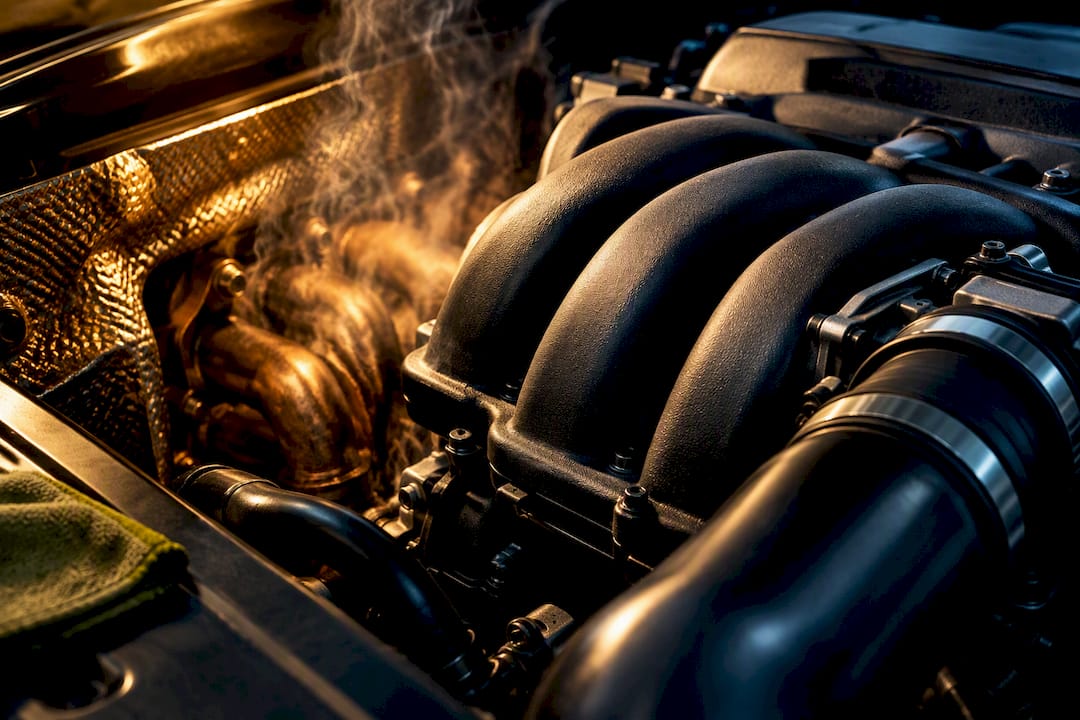
Intake heat soak is what happens when your intake manifold, tubing, or air filter absorbs heat from the engine bay and passes it into the air your engine breathes. Hot air is less dense, so the engine loses power and can feel sluggish off the throttle. Before you buy anything, grab a cheap infrared thermometer and check your intake floor temp and IAT readings. That single step tells you whether you actually have a problem worth fixing.
TL;DR:
- Installing a thermal barrier or I-M shield can reduce intake-floor temperatures by roughly 43°F, significantly lowering IATs and improving power.
- Open-element and short-ram intakes near hot components or exhaust are more susceptible to heat soak, especially in tight engine bays with poor airflow.
- Heat soak symptoms include throttle hesitation, reduced top-end power, and rising IAT readings during idling, with measurable dyno gains from effective fixes.
- Maintaining and cleaning intercoolers, replacing old gaskets, and improving airflow management help minimize heat transfer related to turbocharged setups.
- Proper placement, sealing, and material choice for aftermarket intakes are critical to prevent hot engine bay air from raising intake temperatures above stock levels.
Table of Contents
- How intake heat soak works: heat transfer, thermal mass, and residence time
- How heat soak affects drivability and measurable performance
- What makes intake heat soak worse: common causes and vulnerable setups
- Proven fixes and how they work: thermal barriers, cold-side routing, and intercooler care
- How to diagnose and measure intake heat soak
- Do aftermarket cold-air intakes cause damage or reliably help?
- Quick field fixes and preventive maintenance to minimize heat soak
- What actually matters when you’re fighting heat soak
- Where to find heat-soak parts built for your platform
- Sources
- FAQ
How intake heat soak works: heat transfer, thermal mass, and residence time
Heat gets into your intake system three ways: radiation from hot exhaust and turbo housings, conduction through metal or plastic surfaces that are physically touching hot components, and convection from stagnant engine-bay air that circulates around the intake tract. All three are working against you at once, especially at idle or in stop-and-go traffic when there’s no ram-air effect to push cooler outside air through.
Material matters more than most people think. A thin-wall aluminum intake sheds heat fast once airflow resumes, but it also picks up heat fast when it’s sitting near an exhaust manifold. A composite or plastic intake manifold behaves differently: it holds heat longer after the engine shuts off because of its thermal mass, and that stored heat transfers into the next batch of air that sits inside it.
That’s where residence time comes in. Residence time describes how long air spends inside a given space, and inside an intake manifold, longer residence time means more contact with hot surfaces and more heat picked up before that air ever reaches the cylinder. At idle, air moves slowly and lingers, so it heats up more. At speed, airflow increases and residence time drops, which is part of why heat soak feels worse in traffic than on the highway.
The practical result is straightforward:
- Hotter intake air is less dense, so each intake stroke pulls in fewer oxygen molecules.
- Less oxygen per cycle means less fuel can be burned efficiently, which caps power output.
- A manifold that stays hot after shutdown creates a heat soak spike the moment you restart, before airflow has a chance to cool things down.
- Components with high thermal mass (thick plastic, cast composite) take longer to recover once heat builds up.
None of this requires a defective part. It’s just physics working against a hot engine bay, and it’s why heat soak shows up on nearly every enthusiast build to some degree.
How heat soak affects drivability and measurable performance

You’ll usually notice heat soak before you ever hook up a scan tool. The classic symptoms are hesitation when you mash the throttle after sitting in traffic, a soft bog on initial acceleration, reduced top-end pull compared to a cold-engine run, and a general sense that the car feels lazier after idling for a few minutes than it did on a cold start.
Underneath those symptoms, the ECU is reacting to what its sensors are telling it. Rising intake air temperature (IAT) readings can trigger timing retard as a knock-prevention measure, and the fueling table may adjust to compensate for the less dense air. Both responses are protective, but they cost you power, and that’s why heat soak often feels worse than a simple density calculation would suggest.
- Hesitation or bogging under full throttle after idling or crawling in traffic.
- Noticeably reduced top-end power compared to a cold-engine baseline run.
- Throttle response that feels delayed, especially right after a stop.
- IAT readings climbing well above ambient with the engine at operating temperature but the car stationary.
One documented example puts real numbers behind this. MotorTrend’s dyno test of the Heatshield Products I-M Shield recorded an intake-floor temperature drop of roughly 43°F, from about 146°F down to around 103°F, after the shield was installed on the test vehicle, which corresponded with measurable dyno horsepower gains. That’s the kind of before-and-after data that turns “it feels hotter” into a number you can act on.
What makes intake heat soak worse: common causes and vulnerable setups
Some setups are simply more exposed to heat soak than others, and knowing where your car falls on that spectrum tells you how urgent this is.
- Open-element and short-ram intakes pull air straight from the engine bay instead of a sealed, ducted source, so they ingest whatever hot air is circulating around the exhaust and turbo.
- Proximity to exhaust or turbo hardware means radiant heat has a short, direct path to the intake tract, especially in tightly packaged engine bays where clearance is already tight.
- Crowded engine bays trap hot air with nowhere to escape, so temperatures climb steadily during idle and low-speed driving instead of venting off.
- Aging cooling components, like a tired fan shroud or a thermostat stuck partially open, raise baseline engine bay temperature and give heat soak more fuel to work with.
- High thermal-mass intake materials, particularly thick composite manifolds, stay hot longer after shutdown and transfer more of that stored heat into fresh air on restart.
If your car checks two or more of these boxes, especially an open-element filter sitting near turbo plumbing, heat soak is worth diagnosing before you chase power anywhere else.
Proven fixes and how they work: thermal barriers, cold-side routing, and intercooler care
Not every fix costs the same, and not every fix is worth doing first. Here’s the order that tends to make sense for most enthusiast builds, cheapest and most proven first.
Thermal barriers and I-M shields are usually the highest return-on-investment move available. These are adhesive-backed heat shields that stick to the underside of the intake manifold, and the MotorTrend I-M Shield test is the clearest published example of what one can do: a notable drop in intake-floor temperature that translated into lower intake air temps and measurable dyno gains on the test car. Kits like this exist for specific LS-series intakes as well as universal DIY versions, and they’re a reasonable first mod precisely because installation is simple and the ceiling on cost is low.
Cold-side routing and closed-box intakes solve a different part of the problem: where the air comes from in the first place. A sealed airbox with ducting to a cooler source, rather than an open-element filter breathing engine-bay air, keeps the intake charge cooler before it ever reaches a hot manifold. This matters more on cars where the filter itself sits close to the exhaust or turbo.
Intercooler and charge-air maintenance applies to turbocharged builds specifically. A clean, unobstructed intercooler core does the job of cooling compressed air before it hits the intake manifold, and neglecting that maintenance means the intake tract starts hotter than it needs to on every single pull.
- Adhesive I-M shields: low cost, simple install, strong ROI on many V8 and LS-series applications.
- Closed cold-air intakes: moderate cost, addresses the source of hot air rather than just the symptom.
- Intercooler cleaning or upgrades: essential maintenance for turbo cars, not optional.
- Engine-bay heat reduction (turbo blankets, radiator shrouds): lowers the baseline temperature everything else has to fight against.
Pro Tip: Start with the cheapest, most reversible fix. A shield you can peel off and reapply teaches you more about your car’s heat soak than a full intake swap you’re stuck with.
How to diagnose and measure intake heat soak
You don’t need a dyno to confirm heat soak, though it helps if you have access to one. A basic diagnostic kit is an infrared thermometer, an IAT probe or scan tool capable of reading live IAT data, and an OBD-II datalogger. Between those three tools, you can measure everything that matters.
- Take a cold-start baseline reading of intake manifold floor temp, throttle body temp, and IAT before the engine has run at all.
- Drive to steady-state operating temperature, then log IAT and manifold floor temp again under normal cruising conditions.
- Sit at idle for several minutes to simulate traffic, then take a heat-soaked reading at both the manifold floor and the IAT sensor.
- Install your fix, whether that’s a thermal shield or intake relocation, and repeat the exact same sequence under the same conditions.
Controlling variables matters here. Ambient temperature, traffic conditions, and even fuel temperature can shift your numbers, so back-to-back runs on the same day, same route, same fuel level give you a cleaner comparison than readings taken weeks apart.
| Measurement point | What it tells you |
|---|---|
| Intake manifold floor | Direct read on stored heat inside the intake tract |
| Throttle body | Secondary heat pathway close to the engine block |
| IAT sensor | What the ECU actually sees and reacts to |
| Charge-air temp (turbo cars) | Effectiveness of intercooler cooling before the manifold |
A meaningful result looks like a manifold floor temp drop of dozens of degrees after a fix, paired with a corresponding drop in IAT readings during the same heat-soak idle test. If your numbers barely move, the fix wasn’t the bottleneck and the problem is likely somewhere else, like engine-bay airflow or exhaust proximity.
Do aftermarket cold-air intakes cause damage or reliably help?
A cold-air intake (CAI) isn’t inherently good or bad for heat soak. It depends entirely on where the intake actually pulls air from. A true cold-air intake with a sealed box and ducting to a low-heat zone, away from the exhaust and turbo, can lower intake air temps and support a real power gain. An open-element filter mounted in the same crowded space as the stock airbox, without any shielding or ducting, often ends up breathing hotter engine-bay air than the factory setup it replaced.
- A sealed cold-air box with proper ducting reduces IATs without adding thermal risk.
- An unshielded open-element filter near the exhaust or turbo can raise IATs above stock levels.
- CAIs don’t inherently damage an engine, but poor fitment or a filter mounted too close to a heat source undermines the benefit you’re paying for.
- Check that any aftermarket intake seals cleanly against the factory airbox opening or fender liner to avoid drawing in hot underhood air through gaps.
The lesson isn’t to avoid CAIs. It’s to treat placement and sealing as seriously as the intake’s advertised flow numbers, since a cooler intake charge matters just as much as a bigger one.
Quick field fixes and preventive maintenance to minimize heat soak
You don’t need a full shielding project to make a dent in heat soak. Some of the highest-value moves are also the cheapest.
- Apply reflective heat tape or a temporary shield to exposed intake tubing before a track day, and pull it off afterward if you want a factory look on the street.
- Replace old, hardened intake gaskets, since a leaking gasket lets hot air sneak in exactly where you don’t want it.
- Clean or replace a dirty air filter, which restricts flow and forces the engine to work harder to pull in the air it needs.
- Check your fan shroud and thermostat, since a worn shroud or a thermostat stuck open raises baseline engine bay temperature for everything downstream.
Pro Tip: If cheap fixes stop moving the needle on your IAT readings, that’s your signal to graduate to permanent shielding or relocating the intake itself, not to keep throwing tape at the problem.
What actually matters when you’re fighting heat soak
Most people jump straight to buying a new intake when the real issue is a hot manifold sitting three inches from the header. Diagnose first. A $20 infrared thermometer and ten minutes of testing will tell you more than any forum thread about whether your setup actually has a heat soak problem worth solving.

If the numbers confirm it, start with a thermal barrier or I-M shield before spending real money on bigger changes. Only move to a full cold-air intake swap or charge-cooling upgrade if the cheap fix doesn’t close the gap. That order saves most builders from spending on parts that were never the bottleneck.
When picking intake-related parts for a catalog, it’s important to rely on real fitment data and material specs, because a part that doesn’t seal or clear properly on your specific platform won’t fix anything. Expect a shield or gasket fix to show up in your IAT readings within one test drive. A bigger mod should show up on a dyno sheet, not just in how the car feels.
— Ismael
Where to find heat-soak parts built for your platform
If your diagnosis points to a real fix, Underground Dynamics carries the pieces that address it directly: air intake components, turbo blankets, and radiator shrouds, all listed with real fitment detail instead of generic sizing.
 A turbo blanket like the ISR Performance titanium turbo blanket for the Genesis Coupe 2.0T cuts radiant heat right at the source, and a shroud kit like the ISR Performance radiator fan shroud for the SR20DET lowers baseline engine bay temperature so your intake isn’t fighting an uphill battle. Platform-specific fitment is the whole point: a shroud or blanket that doesn’t match your chassis won’t seal or clear correctly, so check the full catalog for your exact make and model before you order.
Sources
For the mechanics of residence time, see Wikipedia’s entry. For measured dyno results, see MotorTrend’s I-M Shield test. For engine bay cleaning, see Diamondbrite’s guide.
- Heatshield Products I-M Shield install and dyno test: More horsepower for less
- Residence time — Wikipedia
FAQ
How do I reduce intake heat soak?
Start by measuring your intake manifold floor temp and IAT readings to confirm the problem, then install a thermal barrier or I-M shield, since a MotorTrend test recorded a notable intake-floor temperature drop from that single fix. If temps stay high after that, look at cold-side intake routing and engine bay airflow before moving to bigger mods.
Can a cold-air intake damage my engine?
A cold-air intake itself doesn’t damage an engine, but poor fitment or a filter mounted too close to the exhaust or turbo can raise intake air temperatures above stock levels. Choose a sealed, properly ducted design and confirm it fits your specific platform to avoid drawing in hot engine bay air through gaps.
Does heat soak take away horsepower?
Yes, hotter intake air is less dense, which reduces the oxygen available for combustion and can trigger ECU timing retard as a protective measure. A MotorTrend dyno test showed measurable horsepower gains after reducing intake-floor temperature with a thermal shield, confirming the link between heat and lost power.
What does heat soak mean in a car engine?
Heat soak means the intake system has absorbed heat from the engine bay, exhaust, or turbo, raising the temperature of the air entering the engine. This happens because of residence time: the longer air sits inside a hot manifold, the more heat it picks up before combustion, which is why the effect is worse at idle than at speed.