FREE SHIPPING ON ORDERS OVER $150

Cart
0
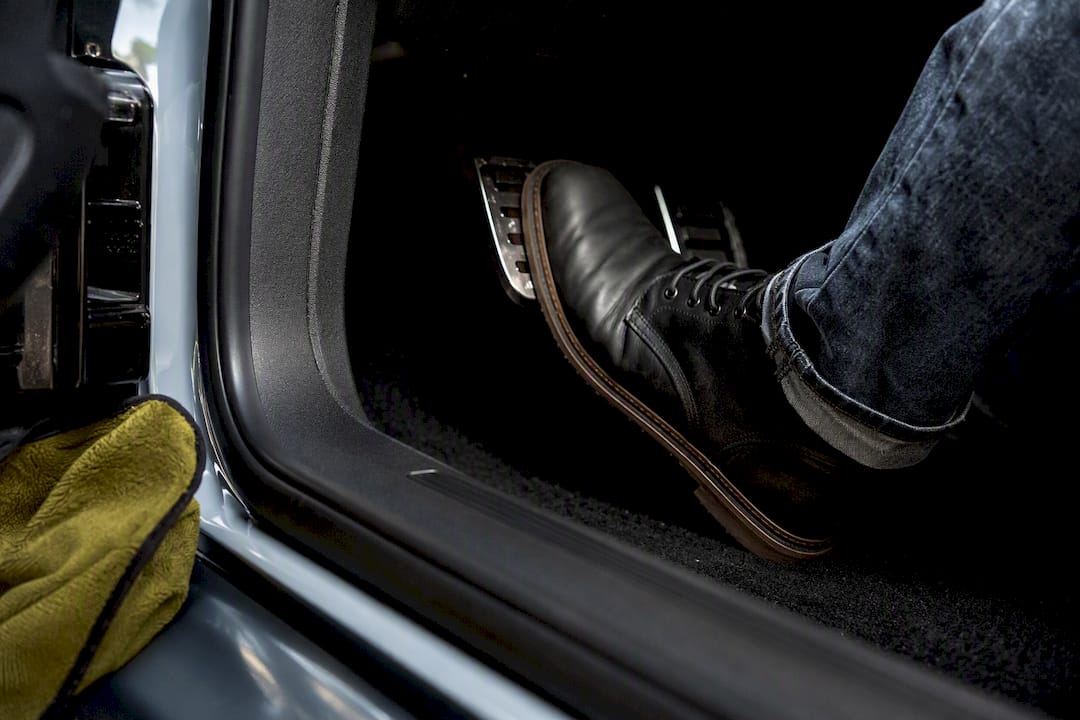
Brake fade is a heat-driven loss of braking performance, usually caused by pad outgassing or brake fluid boiling, and it’s largely preventable once you know what to look for. Heat buildup is the root cause behind almost every fade event, whether that heat is cooking your pad compound or turning your brake fluid into compressible vapor. The fix comes down to three things: the right pad material for how you actually drive, fresh high-boiling fluid, and giving your brakes a chance to cool before you ask for another hard stop.
TL;DR:
- Brake fade primarily occurs when heat exceeds the pad’s kneepoint or the brake fluid’s boiling point, leading to reduced stopping power or sponginess.
- Handling fade effectively requires matching pad materials to your driving style, maintaining clean and undamaged rotors, and regularly flushing high-boiling brake fluid.
- Fade risks increase during long downhill descents, towing, repeated emergency stops, or track days, especially if the brake system isn’t properly maintained or upgraded.
- Tools like infrared temperature guns and moisture test strips can diagnose specific fade types, such as pad or fluid fade, before real driving issues develop.
- Upgrading to larger, ventilated rotors and performance parts alongside routine maintenance helps prevent fade and ensures predictable, safe braking under demanding conditions.
Table of Contents
- What Causes Brake Fade at the Component Level
- What Are the Different Types of Brake Fade?
- How Do You Recognize Brake Fade While Driving?
- When Is Brake Fade Most Likely to Happen?
- How Do You Prevent and Fix Brake Fade?
- What Do the Pros Recommend for Fade Prevention?
- How Does Brake Fade Affect Stopping Distances and Safety?
- How Does Brake System Design Affect Fade Resistance?
- What Tools Help Diagnose Brake Fade Beyond Pedal Feel?
- The Real Tradeoff Between Street Comfort and Fade Resistance
- Upgrading Your Brake System the Right Way
- Sources
- FAQ
What Causes Brake Fade at the Component Level
Every brake system fights the same enemy: friction generates heat, and heat has to go somewhere. When it can’t dissipate fast enough, the components that make braking work start to fail in predictable ways.
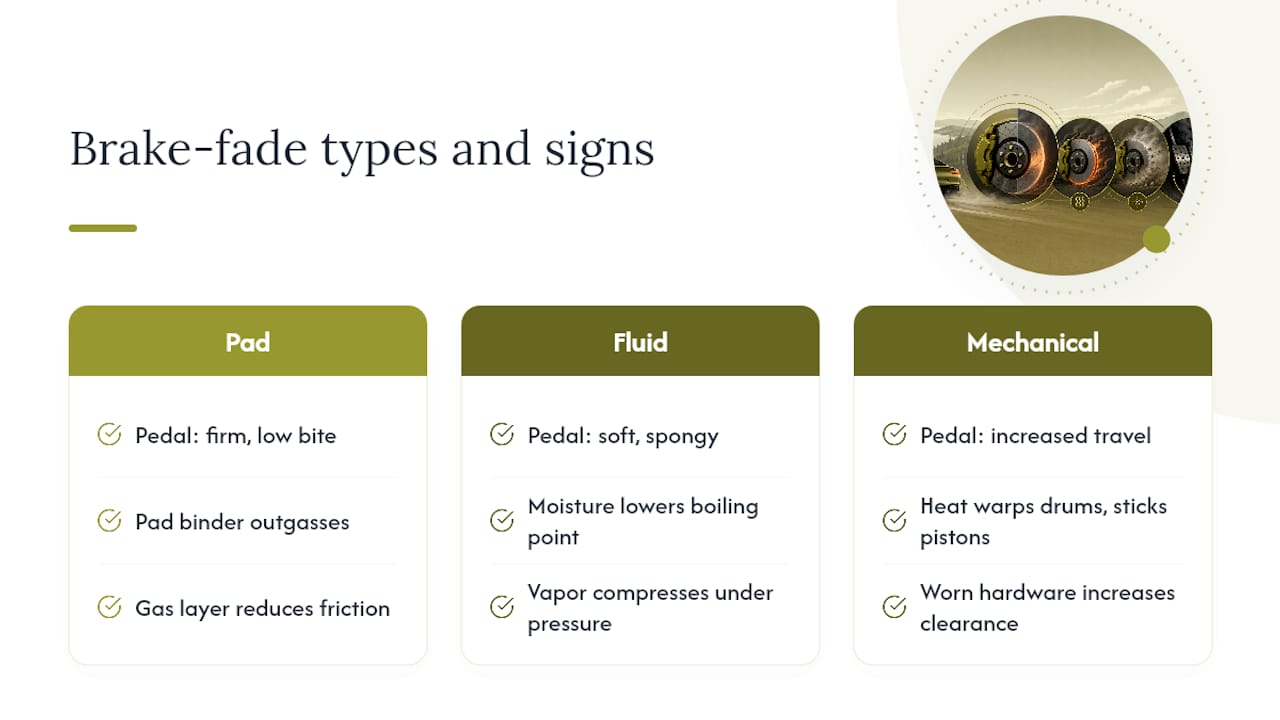
Pad fade shows up first on a temperature-friction curve that engineers call the “kneepoint.” Below that temperature, more pedal pressure means more stopping force, plain and simple. Push past it, and the pad’s resin binder starts to outgas, releasing a thin layer of gas between the pad and rotor, which acts almost like a lubricant. The pedal still feels firm because the hydraulic system is intact, but the car just doesn’t slow down the way it should. Grassroots Motorsports breaks this down well: pad fade happens when overheating causes the binder to break down, and the result is a firm pedal paired with inadequate stopping.
Fluid fade is a different animal entirely. Brake fluid is hygroscopic, meaning it absorbs moisture from the air over time, and that moisture drops its boiling point significantly. Push the fluid past its boiling point during hard or repeated braking, and it flashes into vapor. Vapor compresses under pressure. Liquid does not. That’s why fluid fade produces a soft, long, or spongy pedal instead of a firm one that just doesn’t bite.
Mechanical fade gets less attention but matters just as much on older or neglected systems. Drums expand when they get hot, growing away from the shoes and increasing the pedal travel needed to make contact. Caliper pistons and seals can stick or drag under sustained heat, and worn hardware loses the tight tolerances that keep braking predictable. The Wikipedia technical summary on brake fade covers all three mechanisms as heat-driven failures, but they each need a different fix, which is exactly why misdiagnosing the type of fade wastes time and money.
What Are the Different Types of Brake Fade?
Not all fade behaves the same way, and knowing which type you’re dealing with changes what you do next.
- Pad fade (friction fade): Caused by outgassing and glazing once temperatures exceed the pad’s rated range. Standard street pads typically tolerate roughly 300 to 400°F, ceramic pads run 500 to 700°F, and dedicated track compounds go higher still. Cross the threshold and stopping power drops fast.
- Fluid fade (vapor lock): Water contamination lowers the fluid’s boiling point, and once it boils, you get a soft or sinking pedal rather than a firm one.
- Mechanical fade: Drum expansion, sticking calipers, or worn hardware reduce clamping force under heat. Usually points to a maintenance issue rather than a driving mistake.
- Green fade (early-life fade): New pads outgas during their first heat cycles before a proper transfer layer forms on the rotor. It’s temporary and normal, but it demands a careful bedding-in process rather than aggressive driving straight off the shelf, according to Delphi’s technical explainer on brake fade.
How Do You Recognize Brake Fade While Driving?
Your pedal is talking to you, and the message differs depending on which failure you’re experiencing.
A firm pedal that doesn’t slow the car the way it should usually points to pad fade. A pedal that sinks toward the floor or feels spongy and long usually means the fluid is boiling. Either symptom deserves your full attention immediately.
- Pump the pedal three or four times. If pressure builds back up and stopping improves, you’re dealing with vapor in the fluid. If nothing changes, the pads are the problem. This pedal-pump test is a genuinely reliable field diagnostic that takes seconds to perform.
- Check for smell or smoke. A sharp burning odor or visible smoke from a wheel well confirms overheating and means you need to stop.
- Find a safe pull-off and let things cool. Ten to fifteen minutes off the brakes, ideally with some airflow, can restore normal function if the damage isn’t permanent.
Pro Tip: Downshift instead of riding the brakes on a long descent. Engine braking sheds speed without adding heat to a system that’s already working overtime.
If your pedal feels soft or inconsistent even after cooling, that’s a sign of fluid contamination or air in the lines, not something to drive through on hope.
When Is Brake Fade Most Likely to Happen?
Certain situations load your brakes with more heat than they’re designed to shed continuously, and knowing the pattern helps you plan ahead instead of reacting mid-emergency.
- Long downhill grades where you’re riding the brakes instead of managing speed with gears.
- Towing a trailer, which adds mass and momentum your factory brake system wasn’t necessarily sized for.
- Repeated hard stops in traffic or during aggressive street driving.
- Track days or autocross events, where sustained high speeds and hard braking zones stack heat cycle after cycle.
Component condition matters just as much as the scenario. Thin pads, glazed rotors, old fluid, sticking calipers, and blocked cooling ducts all concentrate heat faster than a well-maintained system would. Heavier vehicles, roof racks, and anything that restricts airflow to the rotors make the problem worse before you even hit the brake pedal.
How Do You Prevent and Fix Brake Fade?
Prevention beats diagnosis every time, and most of it comes down to routine maintenance rather than exotic parts.
- Flush your brake fluid on schedule, typically every two years or more often under heavy use, since wet boiling points drop as fluid absorbs moisture even when the fluid looks fine.
- Match your pad compound to how you actually drive. OEM pads are tuned for daily street use, not sustained high-heat events, so towing or track driving calls for a higher-temperature compound.
- Bed new pads and rotors properly before pushing them hard. A handful of moderate stops from speed, allowing cooldown between each, builds the transfer layer that prevents green fade later.
- Inspect rotors for glazing or heat cracks. Light glazing can sometimes be resurfaced away; visible cracking means replacement, not a second opinion.
- Consider heat management upgrades like slotted or drilled rotors, coolshims, or heat shields for vehicles that see repeated high-load braking, since cooling devices measurably reduce caliper temperatures in demanding applications.
Pro Tip: If fade hits mid-drive, don’t just mash the brakes harder. Ease off, downshift, and use gentle, spaced-out stops to let the system recover instead of compounding the heat.
Grasping brake dust and glazing on the rotor surface also matters for long-term pad life. Regular cleaning with a product designed for safe brake dust removal keeps residue from baking onto hot components and contributing to uneven friction over time.
What Do the Pros Recommend for Fade Prevention?
Bedding procedure matters more than most drivers realize. A rushed break-in on a fresh set of pads and rotors sets you up for green fade the first time you drive hard, even with premium parts.
If you tow regularly, live somewhere hilly, or spend weekends at the track, upgraded pads or rotors with better thermal capacity are a reasonable investment, not an overreaction. Thermal barriers and heat shields make sense once you’re pushing factory parts past their comfort zone.
Get a professional involved if you notice ABS warning lights, a pedal that stays spongy after a fluid flush, or visible scoring and cracking on a rotor. Those symptoms point to something beyond routine maintenance.
How Does Brake Fade Affect Stopping Distances and Safety?
Fade doesn’t just feel unsettling. It measurably extends the distance your car needs to stop, and that gap grows with every degree past a component’s safe operating range. A car that normally stops from 60 mph in roughly 120 feet can need dramatically more pavement once pads are outgassing or fluid is boiling, and that difference is often the gap between a close call and a collision.
The danger compounds because fade rarely announces itself gradually. A driver descending a mountain grade might get three or four fully effective stops, then suddenly find the fifth one delivers a fraction of the expected force. Predictable, consistent braking is central to crash avoidance, which is why NHTSA’s crash and safety research treats braking performance as a core factor in preventable accidents.
Fade also affects more than straight-line stopping. Reduced front braking force shifts weight transfer and can affect vehicle stability during hard stops, particularly in vehicles already carrying extra load from towing or cargo. A car with fading brakes brakes unevenly if one caliper or pad set overheats faster than another, which introduces pull or instability exactly when you need the car to track straight.
This is the core reason fade deserves more respect than a minor inconvenience. It’s not just slower stopping. It’s less predictable stopping, at the exact moments (steep grades, emergency maneuvers, loaded vehicles) when predictability matters most.
How Does Brake System Design Affect Fade Resistance?
Not every brake system handles heat the same way, and the differences come down to mass, materials, and airflow.
Larger rotors have more thermal mass and more surface area to shed heat, which is why performance and towing-oriented vehicles often ship with bigger discs than economy cars. Ventilated (internally finned) rotors move air through the disc itself, pulling heat away faster than solid rotors can manage. Slotted or drilled designs add surface area and help gases escape from between the pad and rotor face during hard use.
Pad compound is just as much a design choice as a maintenance one. Organic pads are quiet and gentle on rotors but fade earlier. Semi-metallic pads handle more heat at the cost of noise and rotor wear. Ceramic compounds split the difference for most street driving. Full race compounds resist fade at extreme temperatures but often need real heat in them before they grip well at all, which makes them a poor daily-driver choice.
Caliper design matters too. Fixed, multi-piston calipers generally resist heat-related flex and fluid displacement better than single-piston floating calipers, which is part of why performance platforms favor them. Brake lines matter as well: rubber lines can expand slightly under pressure and heat, absorbing some pedal firmness, while braided stainless lines hold their shape and transmit pedal feel more directly.
None of this means factory components are inadequate for their intended use. It means the intended use has limits, and exceeding those limits (via towing, track driving, or aggressive mountain descents) is exactly when design shortcomings show up as fade.
What Tools Help Diagnose Brake Fade Beyond Pedal Feel?
Pedal feel is the fastest diagnostic tool you have, but it isn’t the only one, and pairing it with a couple of others gives you a clearer picture before you assume the worst or ignore a real problem.
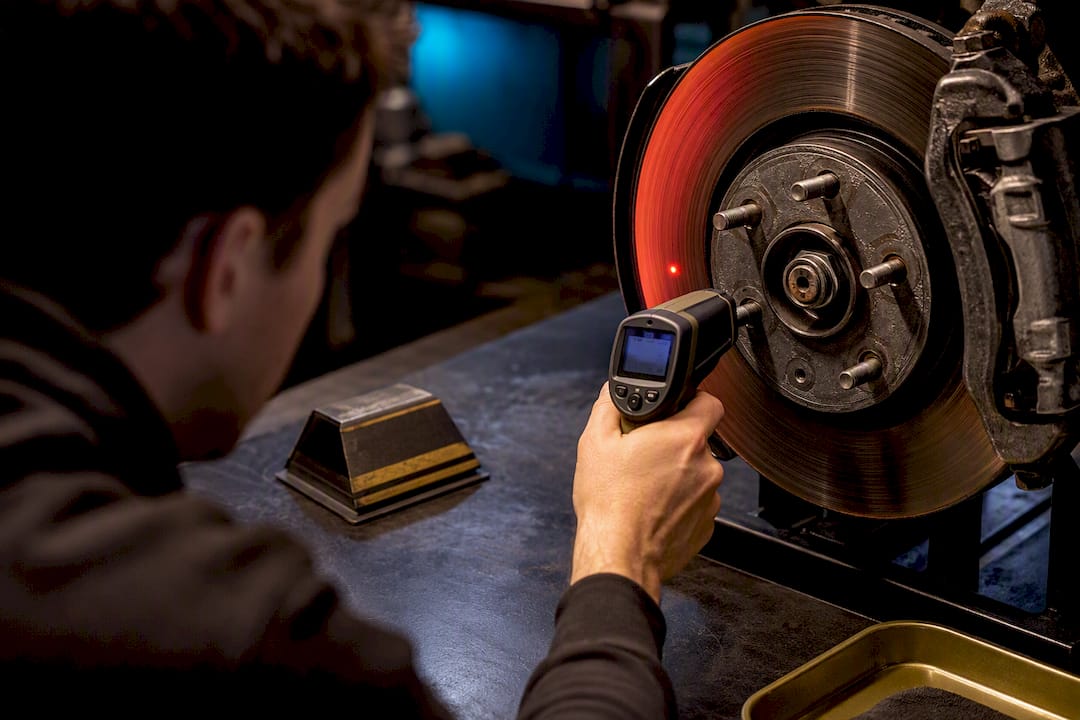
An infrared temperature gun is inexpensive and genuinely useful. Point it at a rotor after a hard stop, and you can compare readings side to side. A significant difference between wheels on the same axle often points to a sticking caliper or uneven pad wear rather than fluid or pad fade across the whole system.
A brake fluid test strip or a dedicated boiling point tester checks moisture content directly instead of guessing by fluid age. Fluid can look clean and still have absorbed enough water to drop its boiling point meaningfully, which is exactly the scenario the pedal-pump field test is designed to catch on the road.
Visual inspection still matters. Blueing or discoloration on a rotor surface is a clear sign it’s seen more heat than it should have. Glazing shows up as a shiny, glass-like surface on the pad face, and it reduces friction even when the pad has plenty of material left. None of these tools replace the pump test behind the wheel, but together they turn a guess into an informed decision about whether you’re looking at routine wear or a genuine fade risk.
The Real Tradeoff Between Street Comfort and Fade Resistance
Track-oriented pads resist heat better, but they’re often noisier and dustier at normal street temperatures, since they need heat to work well at all. Before upgrading anything, figure out exactly which failure you had. Fluid problems and worn hardware are safety issues that need fixing regardless of what pads you’re running. Performance upgrades come after that, not instead of it.
— Ismael
Upgrading Your Brake System the Right Way
There are parts catalogs that include rotors, performance pads, and heat management components with fitment data for popular platforms, helping match parts to your actual chassis instead of hoping they fit.
Beyond brakes, we carry coilovers and lowering springs that reduce nose-dive under hard braking, which takes some of the load off your brake system during aggressive stops. Everything in the body kit and aero catalog is built around the same idea: functional performance backed by fitment detail, not generic parts guessing.
Brake work is safety-critical. If you’re installing rotors, pads, or lines yourself, double check torque specs and bedding procedure, or have a qualified shop handle the install. Browse the full catalog to check what fits your build before you order.
Sources
- NHTSA technical/CrashStats resource
- Brake fade: What it is and how to fix it | Grassroots Motorsports
- Brake Fade: Symptoms, Causes & How to Prevent It — Car Care Total
- Brake fade — Wikipedia
FAQ
How Do You Fix Brake Fade?
Let the brakes cool by pulling over safely for ten to fifteen minutes, then diagnose the type: flush contaminated fluid if the pedal was soft, or switch to a higher-temperature pad compound if the pedal stayed firm but stopping power dropped.
How Can I Prevent Brake Fade?
Flush your brake fluid on the manufacturer’s schedule, match your pad compound to your actual driving conditions, and avoid sustained heavy braking on long descents by downshifting instead.
What Are the Four Main Types of Brake Fade?
The main categories are pad (friction) fade from binder outgassing, fluid fade from boiling and vapor lock, mechanical fade from drum expansion or hardware issues, and green fade, which is temporary underperformance in new, unbedded pads.
When Would Brake Fade Most Likely Happen?
Brake fade is most common on long downhill grades, while towing, during repeated hard stops in traffic, and on track days or spirited drives where heat builds faster than the system can shed it.
Does Underground Dynamics Sell Parts That Help With Brake Fade?
Underground Dynamics carries performance rotors, pads, and heat management components with detailed fitment data, along with suspension upgrades that reduce brake load during hard stops; current pricing is listed on the site.