FREE SHIPPING ON ORDERS OVER $150

Cart
0
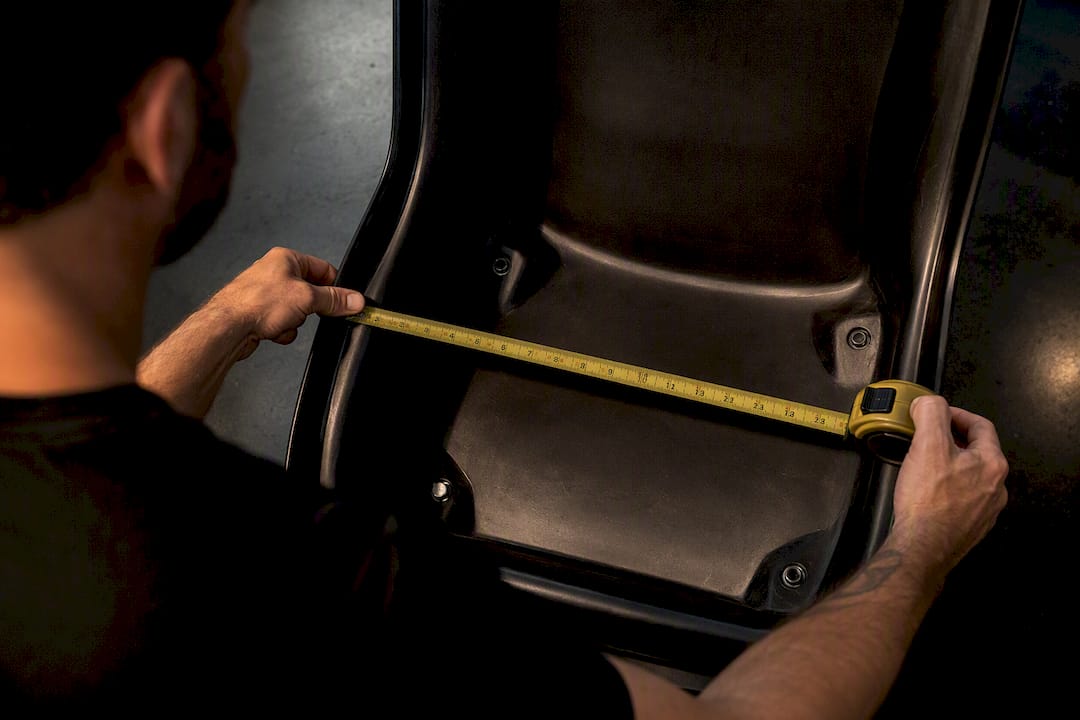
Measure your seated hip width and match it to the seat’s production width. If you land between sizes, size up. Beyond that number, check shoulder height and harness slot clearance before you buy anything. Most riders fall into a 17 to 19 inch production width if their seated hip width runs 15 to 18 inches, with anything narrower or wider pushing toward small or XL territory.
TL;DR:
- Most riders with seated hip widths of 15 to 18 inches should select a seat width between 17 and 19 inches, rounding up if between sizes.
- Accurate measurement of seated hip width, shoulder height, and torso depth on a hard surface is essential for proper fit and safety.
- Highback seats with deep bolsters may feel tighter than lowback seats of the same width, requiring consideration of torso and shoulder measurements.
- Harness slot alignment is critical; measure shoulder to harness slot and ensure the seat’s published locations match your body, especially with layered racing gear.
- Confirm vehicle fit by measuring cabin opening, rail spacing, and clearance to steering wheel and pedals before purchase, accounting for seat height and rake adjustments.
Table of Contents
- Getting Your Bucket Seat Sizing Numbers Right
- What Seat Width, Depth, and Backrest Height Actually Mean
- Lowback vs. Highback: Sizing Changes With Seat Type
- Harness Slot Alignment: The Safety Check You Can’t Skip
- Checking Vehicle Fitment Before You Commit
- How Underground Dynamics Approaches Fitment
- Why Correct Bucket Seat Sizing Is a Safety Issue, Not Just Comfort
- Common Bucket Seat Sizing Mistakes and How to Avoid Them
- How Adjustability Features Change Your Sizing Decision
- Basic Bucket Seat Sizing Chart for Reference
- Body Shape Variables That Change Your Ideal Seat Size
- Choosing Between Medium, Large, and XL Seats
- Balancing Containment and Comfort: An Editorial Take
- How Underground Dynamics Helps You Confirm the Right Fit
- Manufacturer Sizing Charts Worth Checking
- Sources
- FAQ
Getting Your Bucket Seat Sizing Numbers Right
Three measurements decide whether a seat fits: seated hip width, shoulder height, and torso depth. Skip any one of them and you’re buying blind.
Here’s the method that actually gives you numbers you can trust:
- Seated hip width. Sit on a hard bench or a stack of phone books, legs hanging naturally with a slight gap between your knees. Place two rigid straight objects (wood blocks, a couple of clipboards, anything with a flat edge) against the widest point of your hips, then measure the inside-to-inside distance with a metal tape or a yardstick. Don’t let the tape curve around your body. A rigid measurement setup reduces variance compared to a flexible tape that follows your curves, and that difference matters when you’re choosing between adjacent sizes.
- Shoulder height. From the same seated position, measure straight up from the bench surface to the top of your shoulder in a relaxed driving posture, arms roughly where they’d sit on a wheel.
- Torso depth and seat depth. Measure from the seated surface to the back of your head for torso length, then from the front edge of the bench to your mid-thigh for depth. These numbers tell you whether a seat’s backrest will support your head properly and whether the bottom cushion will choke off circulation behind your knees.
Wear what you’d actually wear behind the wheel. Jeans and a t-shirt measure differently than a winter jacket with your phone still in the back pocket. Pull everything out and measure like it’s race day, even if it’s not.
Pro Tip: Write these three numbers down somewhere permanent, like a note in your phone or a build log. You’ll need them again the next time you shop for a seat, a harness, or even a steering wheel.
What Seat Width, Depth, and Backrest Height Actually Mean
A manufacturer’s “18-inch” seat isn’t measuring your body. It’s measuring the widest point of the shell’s interior, and that number is what you compare directly against your seated hip width. The standard rule: match your hip measurement to the closest production width, and round up if you’re between two sizes. A tight seat that pinches your hips isn’t just uncomfortable, it becomes a distraction the moment you need to move quickly.
Seat depth and backrest height carry their own trade-offs:
- Depth affects thigh support. Too shallow and your legs dangle unsupported; too deep and the front edge digs into the back of your knees, cutting circulation on longer drives.
- Backrest height determines shoulder and head containment. Taller backrests suit taller torsos and give more lateral support during hard cornering.
- Bucket seats generally run 18 to 22 inches wide, 18 to 24 inches deep, and 24 to 30 inches in backrest height, which gives you a rough range to sanity check any spec sheet.
You’ve probably seen the so called 1 inch rule, the idea that a seat should sit about an inch wider than your hips for comfortable daily use. It’s a decent shorthand for street cars, but it falls apart for race applications where a snugger fit improves lateral control. Treat it as a starting point, not gospel.
Lowback vs. Highback: Sizing Changes With Seat Type
A lowback seat and a highback seat with identical hip width numbers won’t feel the same. Highback shells wrap more aggressively around your torso, which means bolsters that read “18 inches” on paper can feel tighter than a lowback rated at the same width.
- Lowback seats work well for daily drivers who want support without the aggressive hug, and they play nicer with tall drivers who need headroom.
- Highback seats with deep bolsters deliver serious lateral containment for cornering, but bigger side bolsters mean you often need to size up compared to a lowback equivalent.
- Autocross and track drivers can usually accept a tighter fit since lateral support wins over long-haul comfort.
- Daily drivers should lean toward a slightly roomier fit, since a seat that’s perfect for a 20-minute track session gets old on a three-hour highway drive.
- XL or custom seats make sense for larger body types, drivers who wear multi-layer race suits, or anyone stacking extra padding for comfort. If you’re consistently between “large” and “XL” on a manufacturer’s chart, XL is almost always the safer buy.
Harness Slot Alignment: The Safety Check You Can’t Skip
Getting the width right doesn’t matter if your harness routes wrong. A shoulder belt that rubs your neck or sits below your collarbone is a fit failure with real consequences in a crash.
- Measure the vertical distance from your seated shoulder to where you’d want the harness slot, then compare that to the seat’s published slot locations.
- If you race in a suit or heavier gear, add extra clearance. Thicker layers change how a harness sits across your chest, and drivers wearing multi-layer suits should confirm harness slot clearance rather than strictly matching hip width alone.
- Once the seat is mounted, put the harness on, move through a full range of motion, and check for pinching, chafing, or restricted circulation.
If the slots don’t line up, you’ve got options: adjust the mounting position, switch to a harness with different slot spacing, or reconsider the seat shape entirely. Don’t force a mismatched harness through a slot that’s clearly too high or too low.
Pro Tip: Buy the harness before you finalize the seat if you can. Slot geometry varies enough between shells that it’s easier to match a belt to a confirmed seat than to hope a seat works with a harness you already own.
Checking Vehicle Fitment Before You Commit
A seat that fits your body still has to fit your car. Measure the cabin opening, the rail bolt locations, and clearance to the steering wheel, shifter, and center console before you order anything.
- Seat height and rake change your effective legroom and sightlines, so sit in a mockup or test-fit with hands on the wheel and feet on the pedals whenever possible.
- If space is tight, slim-mount seats or sliders with an offset can recover clearance without cutting into trim.
- Modifying interior trim to fit a wider seat is sometimes necessary, but understand the safety trade-offs before you start cutting.
- Always confirm your mounting hardware and brackets meet SFI recommended mounting practices for racing applications, especially if you’re stepping up to a highback or containment seat.
How Underground Dynamics Approaches Fitment
We build our catalog around chassis-specific fitment data because a spec sheet without real dimensions is a guess dressed up as a product listing. When you’re cross-shopping seats, wheels, or suspension parts, having the actual numbers in front of you beats trusting a generic size label.
- Our approach mirrors what we walked through for steering wheel hub sizing, where four measurements determine a correct fit instead of one.
- We apply the same chassis-specific fitment practices across body kits, suspension, and interior parts, not just seating.
- Recording your seated hip width, shoulder height, and harness slot distance once means you can reuse those numbers across every future seat, wheel, or restraint purchase.
Why Correct Bucket Seat Sizing Is a Safety Issue, Not Just Comfort
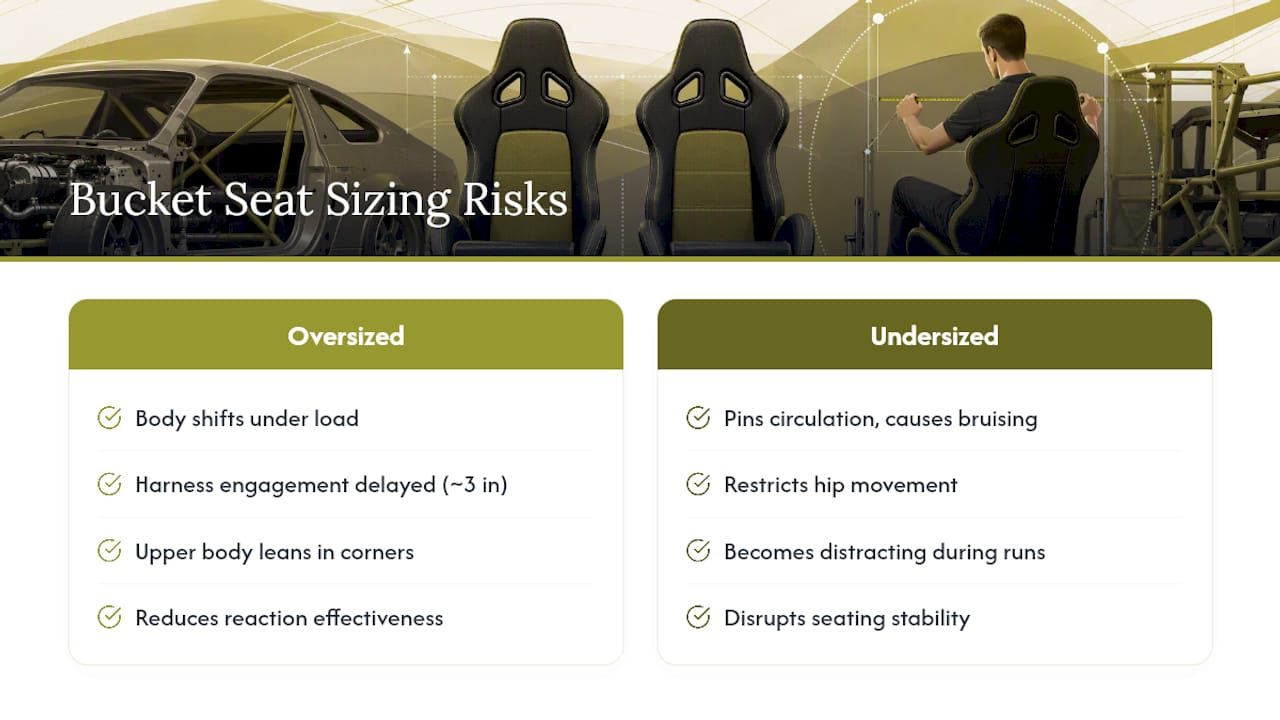
An oversized bucket seat lets your body shift during hard cornering or a sudden stop, which delays how quickly you can react and reduces how effectively a harness restrains you. A seat that’s too small pinches circulation, restricts hip movement, and can leave bruising after a few hours behind the wheel. Neither failure mode is minor.
Correct sizing means your body stays planted against the bolsters under lateral load instead of sliding across the seat pan. That stability is what lets a harness do its job: a belt only restrains you properly if your torso doesn’t have three inches of side-to-side travel before the webbing even engages. Racing sanctioning bodies build harness geometry rules around a properly seated driver, not one floating inside an oversized shell.
Comfort and safety overlap more than people expect. A seat that pinches your hips at minute ten of a 20 minute autocross run becomes a distraction exactly when you need full attention on the wheel. A seat that’s too wide lets your upper body lean into corners instead of staying fixed, which throws off your sense of the car’s limits. Getting the size right isn’t about chasing a perfect number on a spec sheet. It’s about making sure your body and the seat move as one unit when the car doesn’t.
This is also why manufacturers publish detailed charts instead of vague “small, medium, large” labels. A seat rated for a 34-inch waist on one chart might correspond to an 18 inch production width, but that number only means something once you’ve measured your own hips the same way the manufacturer measured theirs.
Common Bucket Seat Sizing Mistakes and How to Avoid Them
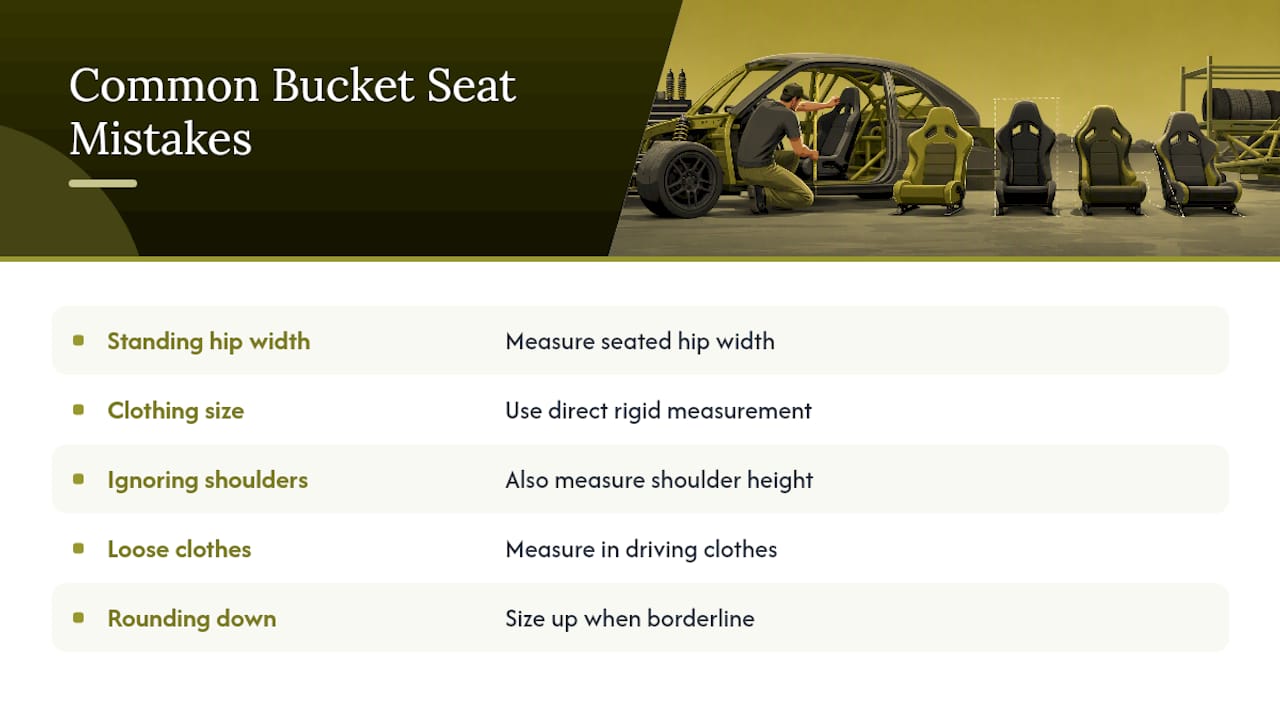
The single biggest mistake is measuring standing hip width instead of seated hip width. Your hips spread when you sit, sometimes by an inch or more, so a standing measurement will consistently steer you toward a seat that’s too tight.
A close second: trusting a shirt or pants size as a proxy for seat size. Waist measurements and hip measurements aren’t the same number, and clothing sizes have zero standardization across brands anyway. Always go back to a direct, seated measurement with a rigid tool.
Another frequent error is ignoring shoulder height entirely and sizing based on hip width alone. You can nail the width and still end up with a backrest that leaves your head unsupported or a harness slot that sits in the wrong spot for your torso length.
People also skip the “wear driving clothes” step and measure in loose sweatpants, then wonder why the seat feels different once they’re wearing jeans and a jacket on race day. Measure in what you’ll actually wear.
Finally, plenty of buyers round down when they’re between sizes because the smaller seat “looks” more aggressive or contains better in photos. Rounding down on a borderline measurement almost always ends in a seat that’s uncomfortable within an hour and potentially unsafe if it restricts your movement during an emergency maneuver. When in doubt, size up.
How Adjustability Features Change Your Sizing Decision
Not every bucket seat is a fixed shell with a single fit. Reclinable backrests, adjustable bolsters, and removable inserts all shift how much wiggle room you have on sizing.
A reclinable seat with adjustable lumbar support can accommodate a slightly wider range of torso lengths than a fixed-back racing shell, since you can fine-tune the angle to compensate for a shorter or longer back. Fixed-back seats, by contrast, lock you into one geometry, which is exactly why fixed-back buyers need to be more precise with their initial measurements.
Some highback seats offer removable or adjustable side bolsters, letting you tighten containment for track days and loosen it for a comfortable daily commute. If a seat offers this feature, you get more flexibility to size toward the snugger end of your range, since you can always open up the bolsters later.
Seat sliders and adjustable mounting brackets also affect sizing indirectly. A slider with more range compensates for a seat that sits slightly further back or forward than ideal, which matters if you’re also adjusting for a shorter or taller driving position. None of these features change your actual hip or shoulder measurements, but they do change how much margin for error you have once the seat is installed.
If you’re choosing between two adjacent sizes and one seat offers reclining or adjustable bolsters while the other is fixed, the adjustable option gives you more room to correct minor sizing misses after the fact.
Basic Bucket Seat Sizing Chart for Reference
Manufacturer charts vary, but most follow a similar pattern mapping seated hip width to production seat width:
| Seated Hip Width | Typical Production Seat Width | Common Size Label |
|---|---|---|
| Under 15 inches | 15 inches | Small |
| 15 to 17 inches | 17 to 18 inches | Medium |
| 17 to 19 inches | 18 to 19 inches | Large |
| 19 inches and up | 20 inches and up | XL |
Treat this as a starting reference, not a final answer. Manufacturer charts commonly publish banded ranges by vehicle type and racing series, and those bands shift slightly depending on the shell design and bolster depth. Always cross-check your own measurement against the specific seat’s listed width rather than relying on a size label like “medium” across different brands, since one company’s medium can run an inch narrower than another’s.
Body Shape Variables That Change Your Ideal Seat Size
Hip width gets most of the attention, but torso length and leg length quietly complicate the picture. A driver with a short torso and long legs might have hips that map perfectly to a large seat, but the same person could need a taller backrest or a seat with more depth adjustment to avoid feeling swallowed by the shell.
Torso length affects harness slot alignment more than seat width does. Two drivers with identical hip measurements can need harness slots positioned two or three inches apart if one has a noticeably longer or shorter torso. This is why shoulder height, measured independently from hip width, stays a mandatory check rather than an optional nice-to-have.
Leg length interacts with seat depth. A driver with long legs and a shorter torso might find that a seat sized correctly for their hips still feels too deep, cutting into the back of the knee before the pedals are even reachable. In these cases, a seat with adjustable depth or a slightly shallower shell often solves the problem better than chasing a different width entirely.
Broader body types, or drivers who carry more weight through the torso than the hips, sometimes find that standard hip-width-to-seat-width charts undersell how snug a seat will feel across the chest and shoulders. If that describes your build, size up on width and pay closer attention to backrest and bolster geometry rather than trusting the hip number alone.
Choosing Between Medium, Large, and XL Seats
The decision point usually comes down to where your seated hip width falls relative to the gap between two sizes. If you measure exactly on the line between medium and large, the safer default is sizing up, since a slightly roomier fit costs you a bit of lateral support but a too-tight seat costs you comfort and circulation on every single drive.
Medium seats suit narrower-hipped drivers who prioritize containment for autocross or track work, where the tighter fit actually helps keep you planted through hard corners. Large seats are the practical middle ground for most enthusiasts, wide enough for extended comfort without sacrificing meaningful support.
XL seats make sense in a few specific situations: larger body types where a large seat measures uncomfortably tight, drivers who regularly wear multi-layer race suits that add bulk, or anyone stacking additional padding for long-distance comfort. If you find yourself consistently between large and XL across multiple manufacturer charts, that’s a strong signal to go XL rather than fight a marginal fit for years.
Balancing Containment and Comfort: An Editorial Take
A seat that locks you in place through a hard corner can feel punishing three-hour into a road trip. The trade-off between containment and comfort isn’t a flaw in bucket seat design, it’s the entire design problem. Document your measurements the moment you get them, because you’ll reuse those numbers for harnesses, future seats, and steering wheel choices for years. If you’re stuck between sizes, reach out before you buy. It’s a cheaper mistake to fix on paper than after the seat is bolted in.
— Ismael
How Underground Dynamics Helps You Confirm the Right Fit
Some companies aim to provide chassis-specific fitment specs and product detail pages with actual dimensions, so customers can match their measurements against real numbers instead of a marketing label like “race seat, fits most.”
If you’ve already got your seated hip width, shoulder height, and harness slot numbers from this guide, you’re most of the way to a confident purchase. Reach out through our support channels if you want a second set of eyes on your measurements before you commit, or browse our suspension and coilover lineup if a lowering setup is part of your build alongside a new seat. Start by checking our full catalog for chassis-specific parts that match the fitment data you just measured.
Manufacturer Sizing Charts Worth Checking
Before you finalize a purchase, cross-reference your own numbers against a few manufacturer resources:
- Kirkey’s racing seat tech and sizing charts for production width examples by series.
- RCI Safety’s sizing charts for banded width ranges by vehicle type.
- A downloadable bucket seat measurement chart covering lowback and highback shells for a visual reference on where headrests and adjusters affect fit.
Always compare a seat’s published spec against your own measurements rather than relying on a chart’s size label alone.
Sources
- Ultra Shield Racing Seat Measurement Charts
- Racing Seats - Kirkey Racing Tech Info and Sizing Charts
- Bucket Seat Dimensions
FAQ
What Is the 1 Inch Rule for Car Seats?
The 1 inch rule suggests a bucket seat should measure about an inch wider than your seated hip width for comfortable daily driving. It’s a useful starting point for street cars, but track and autocross drivers often size closer to their exact hip measurement for better lateral support.
Do Any Bucket Seats Fit Any Car?
No. Seat shells vary in width, depth, and mounting geometry, and your vehicle’s cabin opening, rail spacing, and console clearance all limit which seats will physically fit. Checking chassis-specific fitment data, like the specs Underground Dynamics lists on its product pages, is the reliable way to confirm compatibility before buying.
How Do You Properly Fit a Bucket Seat?
Measure your seated hip width, shoulder height, and torso depth using a rigid tool on a hard surface, then match those numbers to the seat’s published production width and backrest height. Confirm harness slot alignment and test-fit clearance to the wheel and pedals before finalizing the purchase.
When Should You Get XL Bucket Seats?
Choose an XL seat if your seated hip width sits at the top of a large seat’s range, if you regularly wear multi-layer race suits that add bulk, or if you consistently measure between large and XL across multiple charts. Sizing up avoids the circulation and comfort problems that come with a too-tight fit over long drives.