FREE SHIPPING ON ORDERS OVER $150

Cart
0
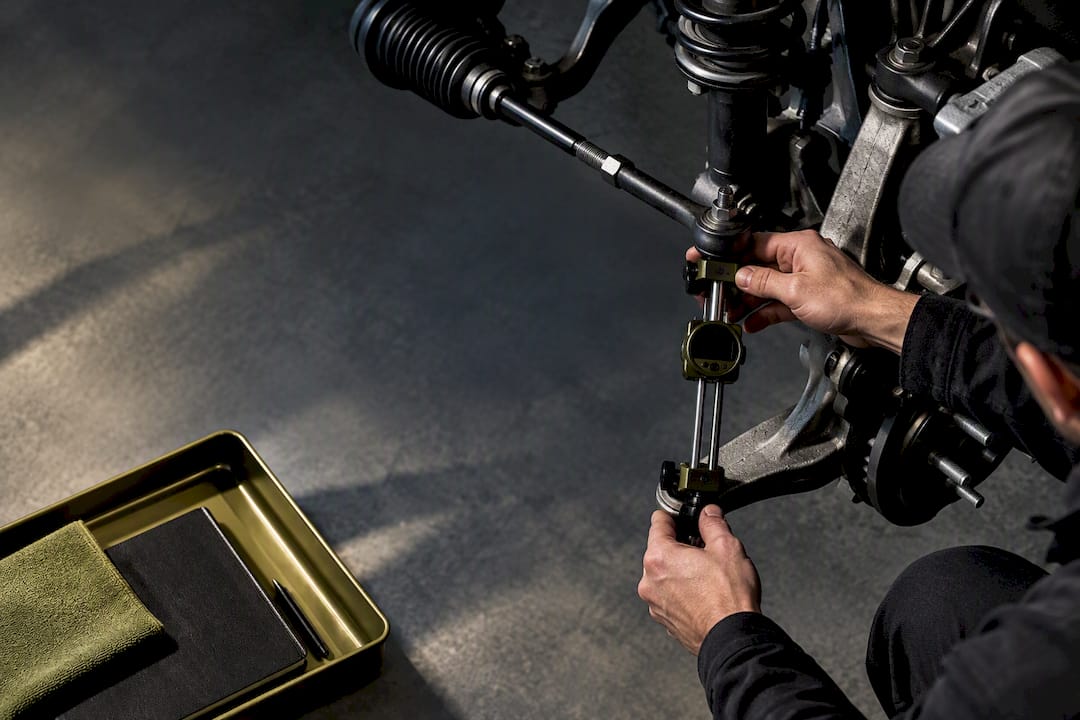
Air suspension is defined as a pneumatic vehicle suspension system that replaces traditional coil or leaf springs with reinforced rubber air bags that inflate or deflate to deliver adjustable ride height and variable spring rates. The industry term is “air ride suspension,” and you’ll hear both names used interchangeably in the enthusiast community. The system pairs air bags with a compressor, reservoir, sensors, and an electronic control unit to manage ride height within milliseconds. Whether you’re building a slammed show car, hauling heavy loads in a truck, or chasing a more comfortable daily driver, understanding what is air suspension explained in full technical detail gives you a real edge before you spend a dollar.
How does air suspension work?
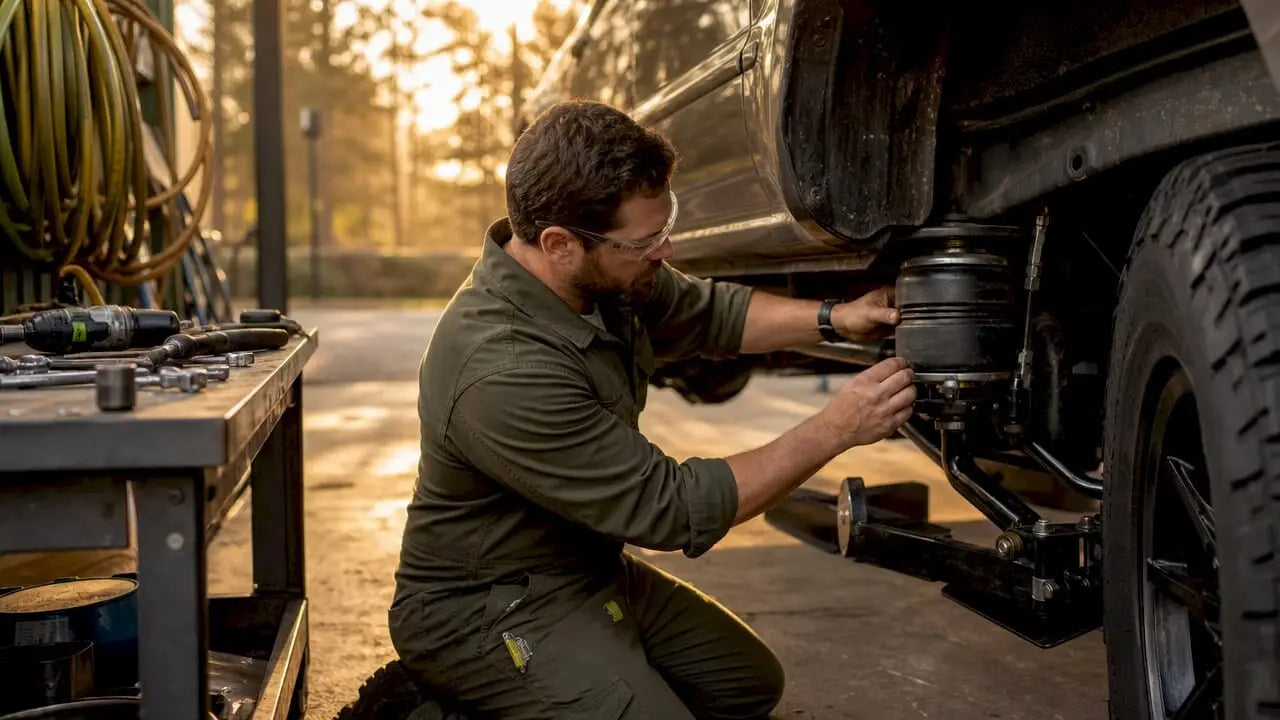
Air suspension works by replacing fixed metal springs with rubber bellows, also called air bags, that sit between the chassis and the wheel assembly. When you add air pressure, the bag inflates and raises the vehicle. When you release pressure, it deflates and lowers it. The components of air suspension include air bags, a compressor, an air reservoir, height sensors, a control module, air lines, and solenoid valves. Each part has a specific job, and the system only performs well when all of them work together.
The role of the compressor and reservoir
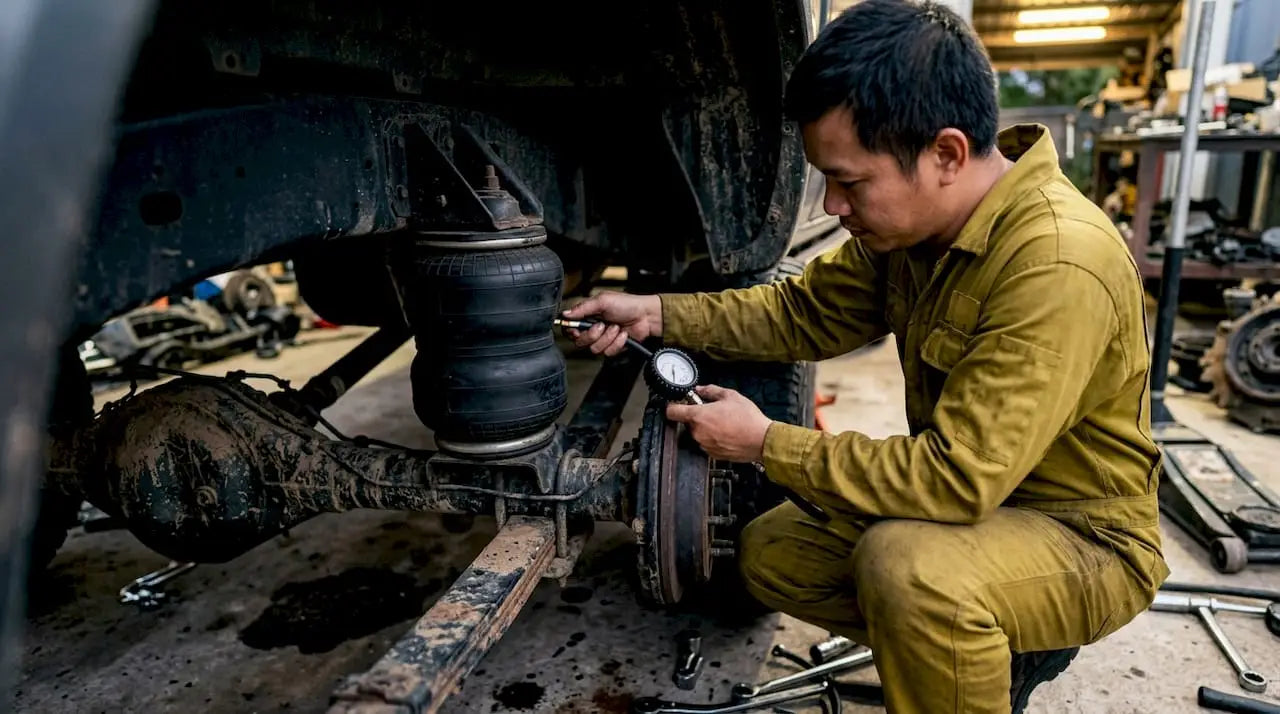
The compressor pumps air into the reservoir, which acts as a storage tank for pressurized air. When the control module calls for a height change, it opens the appropriate valve and air flows from the reservoir to the target air bag. The reservoir allows the system to respond quickly without waiting for the compressor to build pressure from scratch. Without a properly sized reservoir, response times slow down and compressor wear accelerates.
How height sensors and electronic controls work
Height sensors monitor the distance between the chassis and the axle at each corner of the vehicle. The control module reads that data and opens or closes valves to maintain a target ride height. This happens continuously while you drive, which is why air suspension adapts to road conditions in real time. On a well-tuned setup, the system corrects for bumps, load shifts, and cornering forces without any input from the driver.
Manual vs. automated air management
Manual setups use paddle valves or toggle switches to control air flow. The driver decides when to raise or lower the vehicle and by how much. Automated systems use digital manifolds with solenoid valves that respond to sensor input automatically. The speed and precision of height adjustment depend directly on the air management system you choose. Advanced digital manifolds with solenoid valves offer per-corner control, faster response, and more accurate height targeting than manual alternatives.
Pro Tip: If you’re building a performance-focused setup, invest in a quality air management controller first. The air bags get all the attention, but the controller is what separates a sloppy setup from a repeatable, dialed system.
What are the advantages and drawbacks of air suspension?
Air suspension offers real, measurable benefits over traditional springs, but it also comes with trade-offs that matter for long-term ownership. Knowing both sides helps you decide if the upgrade fits your build and budget.
Advantages
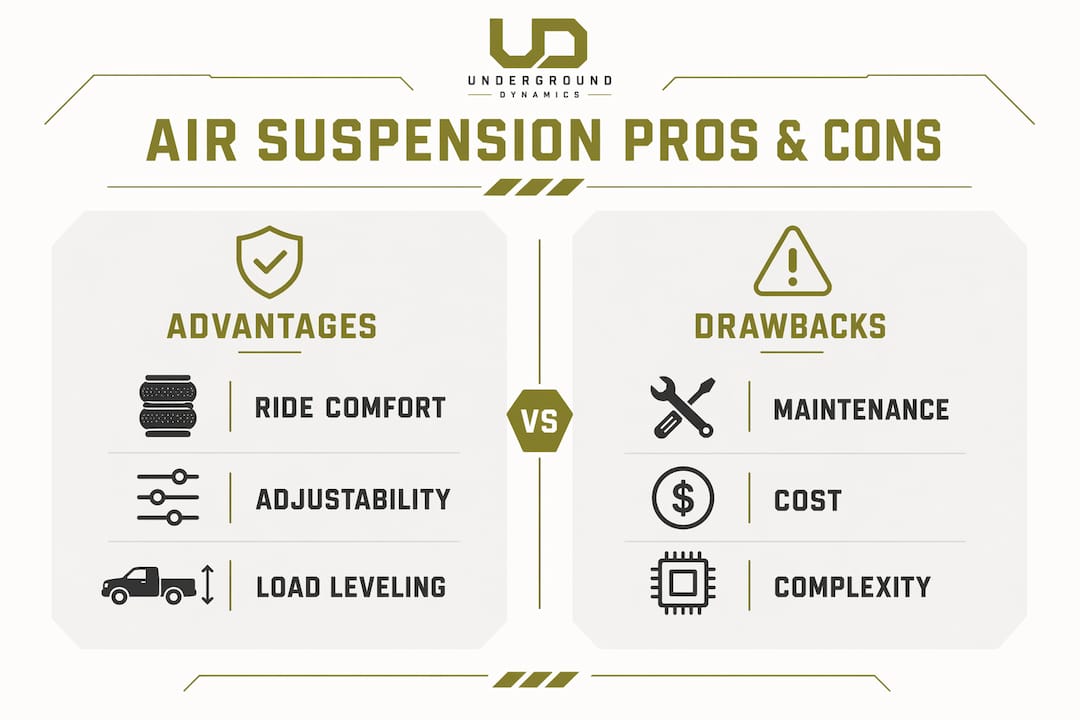
Air suspension improves ride comfort by absorbing high-frequency road vibrations better than fixed-rate metal springs. Air bags provide a softer, more adaptive spring action that reduces driver fatigue on long trips. Beyond comfort, the system delivers on-the-fly ride height adjustability, which means you can raise the car for a steep driveway and drop it back down on the highway without any tools. Automatic load leveling keeps the vehicle balanced under varying loads, which reduces stress on tires, brakes, and chassis components over time.
Air suspension also solves a problem that traditional springs cannot. Fixed springs force engineers to compromise between stiffness for heavy loads and softness for empty driving. Air suspension eliminates that compromise by adjusting spring rate dynamically based on actual conditions. That is a genuine engineering advantage, not just a marketing claim.
Drawbacks
| Category | Air suspension | Traditional springs |
|---|---|---|
| Ride height | Fully adjustable | Fixed |
| Comfort | Superior vibration absorption | Adequate, spring-rate dependent |
| Load leveling | Automatic | Manual adjustment or add-ons |
| Maintenance | Higher, requires regular inspection | Lower, minimal upkeep |
| Cost | Higher upfront and ongoing | Lower overall |
| Complexity | Multiple components and electronics | Simple mechanical system |
Air suspension requires higher maintenance than traditional springs. Air lines, pneumatic seals, compressors, and sensors all need periodic inspection. A single failed solenoid or cracked air line can take the whole system down. Moisture buildup inside the reservoir is a common failure point that most enthusiasts ignore until it causes real damage.
Pro Tip: Check your air lines every time you do an oil change. A small crack in a line costs almost nothing to fix. Ignoring it until the compressor burns out costs a lot more.
Who benefits most from air suspension?
Air suspension is not a one-size-fits-all upgrade. It delivers the most value in specific use cases where traditional springs fall short.
- Show and stance builds. Enthusiasts who want to run the car slammed for shows and raised for daily driving get the most out of air ride. You get the look without destroying your front lip every time you hit a parking lot entrance.
- Truck and tow rig owners. Air suspension prevents sagging, sway, and bottoming out during towing or heavy hauling. The system levels the vehicle automatically as load increases, which improves braking stability and reduces wear on rear suspension components. For a deeper look at suspension maintenance specific to trucks, the Ram truck suspension guide covers practical upkeep steps worth reading.
- Luxury and long-distance drivers. Reduced vibration and adaptive spring rates translate directly to less fatigue on extended drives. Vehicles with air ride feel noticeably smoother on rough pavement compared to coilover or spring setups at similar ride heights.
- Off-road and performance builds. Adjustable ride height lets you raise the vehicle for rough terrain and lower it for high-speed stability on pavement. That kind of flexibility is impossible with a fixed spring setup.
The common thread across all these groups is the same: air suspension addresses the foundational compromise that factory suspensions cannot avoid. If your driving involves wildly different conditions or loads, air ride earns its cost.
What to consider when installing air suspension
Installing air suspension is more involved than swapping coilovers. Getting it right the first time saves you from chasing leaks and electrical gremlins for months.
-
Choose the right air management system. The controller and valve manifold determine how fast and accurately your system responds. A basic manual setup works for a budget build, but a digital manifold with solenoid valves gives you per-corner control and faster adjustments. The air management controller is the brain of the setup. Do not cut corners here.
-
Size your reservoir correctly. A larger reservoir means more stored air and faster response times. For a four-corner setup on a performance build, undersizing the tank is one of the most common mistakes. Match the tank volume to your compressor output and the number of air bags in the system.
-
Route air lines carefully. Keep lines away from heat sources, sharp edges, and moving components. Zip-tie them securely and use grommets wherever they pass through metal panels. A chafed line will fail, and it usually fails at the worst possible moment.
-
Drain moisture from the reservoir regularly. Draining moisture from the air tank prevents internal corrosion and compressor failure. This is the most overlooked maintenance step in the enthusiast community. Add it to your monthly routine.
-
Plan your electrical routing before you start. The compressor draws significant current. Run a dedicated fused circuit directly from the battery. Undersized wiring causes voltage drop, which slows compressor performance and shortens its life.
-
Test the system at full pressure before closing up the interior. Pressurize the system, spray soapy water on every fitting and connection, and look for bubbles. Fix every leak before the car goes back together. Chasing a leak inside a finished interior is a miserable job.
For platform-specific suspension guidance, the Acura TL suspension upgrade breakdown at Undergrounddynamics covers how air ride interacts with chassis geometry on a real build.
Key Takeaways
Air suspension delivers adjustable ride height, superior vibration absorption, and automatic load leveling by replacing fixed metal springs with electronically controlled air bags, making it the most versatile suspension option for builds that demand performance across multiple conditions.
| Point | Details |
|---|---|
| Core definition | Air suspension uses rubber air bags, a compressor, and electronic controls to replace fixed metal springs. |
| Air management matters | The controller and valve manifold determine system speed and accuracy as much as the air bags themselves. |
| Maintenance is non-negotiable | Drain moisture from the reservoir monthly and inspect air lines regularly to prevent compressor failure. |
| Best use cases | Show builds, tow rigs, luxury daily drivers, and off-road vehicles benefit most from adjustable ride height. |
| Cost vs. value | Higher upfront and maintenance costs are justified when your build demands flexibility that fixed springs cannot deliver. |
Why I think most enthusiasts install air suspension backward
Most builders spec the air bags first and treat the air management system as an afterthought. That is the wrong order. The bags are passive components. They do exactly what the controller tells them to do. If your manifold is slow, your solenoids are cheap, or your reservoir is undersized, the bags cannot compensate. You end up with a system that wallows, responds slowly, and frustrates you every time you try to set a consistent ride height.
The other thing I see constantly is neglected moisture management. Enthusiasts spend thousands on a quality setup and then never drain the tank. Moisture corrodes the reservoir from the inside, contaminates the air lines, and eventually kills the compressor. The fix is free. It takes two minutes. But it gets skipped because it is not visible and it does not feel like a performance task.
Air suspension technology is moving toward fully integrated digital systems where the controller reads vehicle speed, steering angle, and load sensors simultaneously to make real-time adjustments without driver input. That direction makes the air management system even more critical than it is today. If you are building now, buy a controller with firmware update capability. The hardware you install today should be able to grow with the software.
For anyone on the fence about air ride versus coilovers, read the coilover handling guide at Undergrounddynamics first. Understanding what coilovers do well makes it much clearer where air suspension fills the gaps.
— Ismael
Undergrounddynamics has the suspension parts your build needs
If you are ready to move from research to hardware, Undergrounddynamics carries suspension upgrades built for enthusiast platforms with real fitment specs, not guesswork.

The catalog at Undergrounddynamics covers air suspension kits, coilovers, and lowering springs with chassis-specific fitment data so you know exactly what you are ordering before it ships. Every part is sourced from established suppliers and listed with the technical detail you need to make a confident decision. Whether you are building a stance car, a tow rig, or a track-focused daily, the right suspension setup starts with parts that actually fit your platform. Browse the full suspension catalog and find the components that match your build.
FAQ
What is air ride suspension?
Air ride suspension is a pneumatic system that replaces traditional coil or leaf springs with rubber air bags inflated by a compressor and controlled by an electronic module. It delivers adjustable ride height and variable spring rates based on driving conditions and load.
How does air suspension differ from coilovers?
Coilovers use a fixed spring rate set at installation, while air suspension adjusts spring rate and ride height dynamically using compressed air. Air suspension offers more flexibility, but coilovers are simpler, lighter, and typically lower cost.
Is air suspension worth it for a daily driver?
Air suspension is worth it for daily drivers who need to navigate varied terrain, manage changing loads, or want adjustable ride height without sacrificing comfort. The higher maintenance requirement is the main trade-off compared to a fixed spring setup.
What maintenance does air suspension require?
Air suspension requires regular inspection of air lines and pneumatic seals, periodic draining of moisture from the air reservoir, and monitoring of compressor and sensor function. Skipping moisture drainage is the most common cause of premature compressor failure.
Can you install air suspension on any car?
Air suspension kits exist for a wide range of platforms, but fitment is chassis-specific. You need to verify that a kit is engineered for your exact vehicle before purchasing, since universal setups often require significant fabrication and may compromise geometry.