FREE SHIPPING ON ORDERS OVER $150

Cart
0

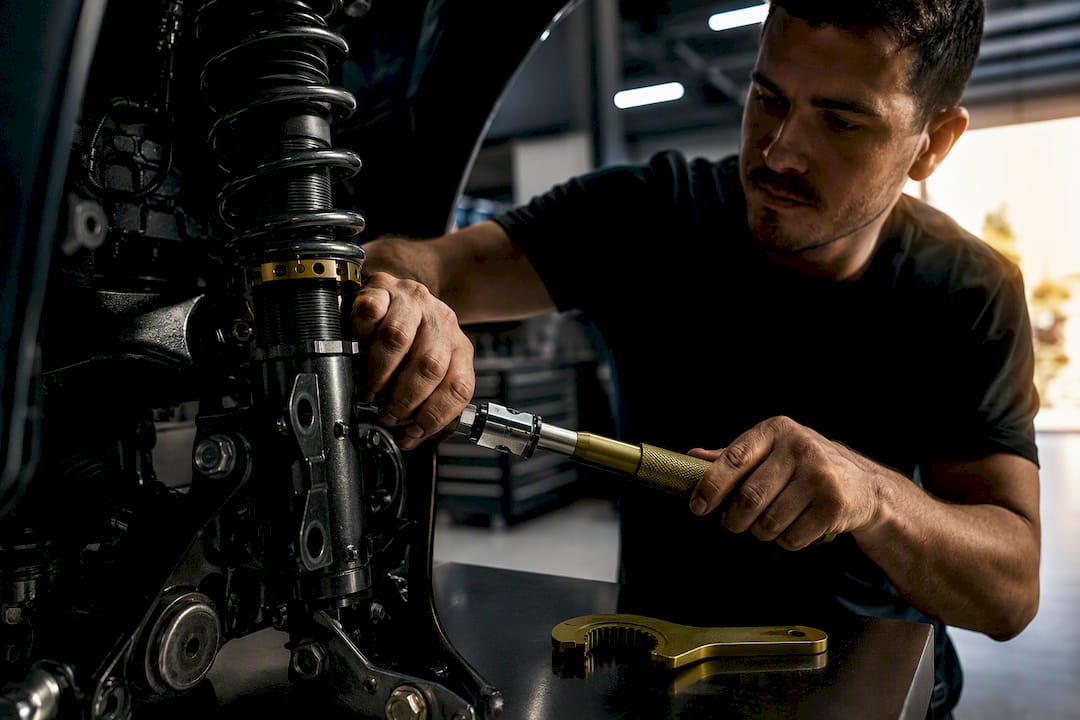
Coilover damping is defined as the mechanism that controls how fast your suspension compresses and rebounds over any surface, and it is the single biggest variable in how well your tires grip the track. Most drivers obsess over spring rates, ride height, and preload, but damping settings have a greater impact on handling, stability, and lap times than any of those adjustments. Get damping wrong and your tires skip, bounce, and lose contact at exactly the moments you need grip most. Get it right and you unlock mechanical grip, driver confidence, and the kind of consistency that actually shows up on the timer. Understanding why coilover damping matters for lap times starts with understanding what it physically does to your car.
Why coilover damping matters for lap times
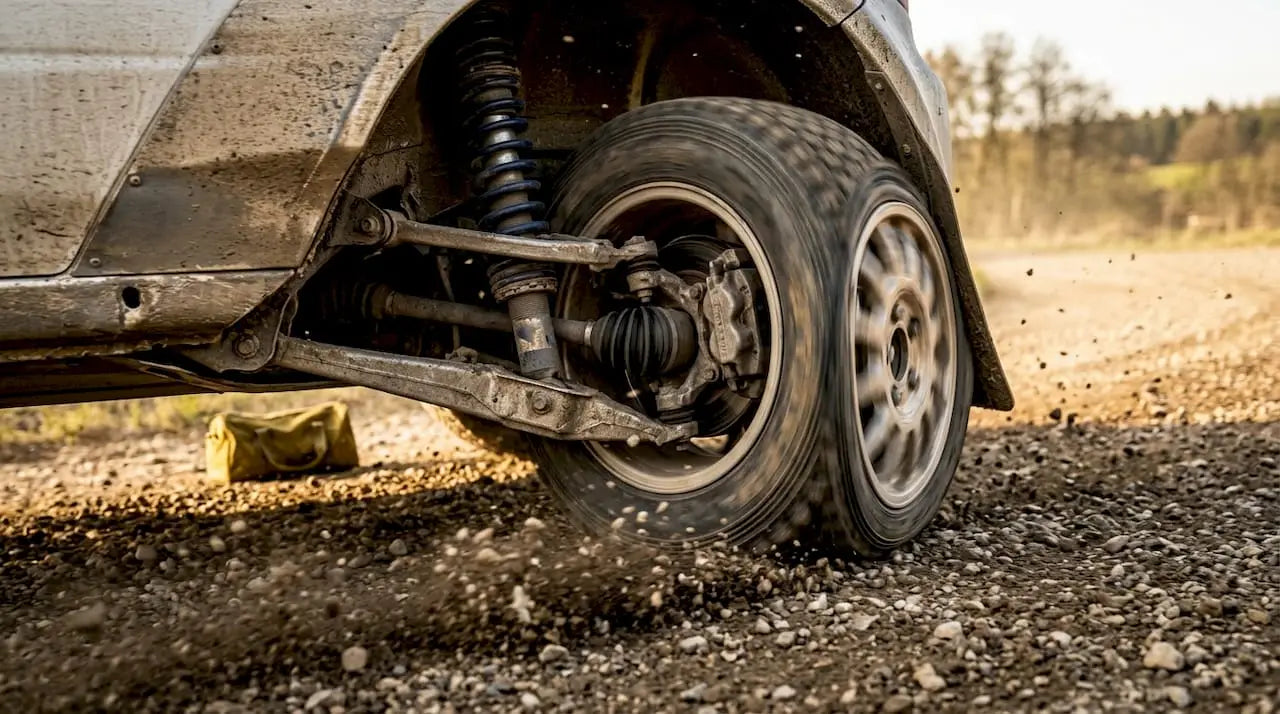
Coilover damping controls the speed at which your spring compresses and returns to its resting position. Without proper damping, the spring would bounce freely, sending the tire in and out of contact with the pavement in an uncontrolled rhythm. That loss of contact is lost grip, and lost grip is lost time.
Every coilover has two damping phases you need to understand:
- Compression damping controls how fast the suspension collapses when you hit a bump, brake hard, or load the outside tire in a corner.
- Rebound damping controls how fast the suspension extends back after compression. Too fast and the car bounces. Too slow and the suspension packs down and loses travel.
Weight transfer is where damping becomes critical for lap times. Under hard braking, the front suspension compresses. Compression damping slows that dive, keeping the front tires loaded and steering responsive. On corner exit, rebound damping controls how quickly the rear suspension returns, which directly affects how early you can apply throttle without the rear stepping out.
Underdamping causes the car to wallow and bounce, making it unpredictable. Overdamping causes the suspension to act like a rigid platform, transmitting every track imperfection directly into the tire contact patch and causing it to skip. Both conditions reduce grip and add lap time. The sweet spot is a damping level that lets the suspension follow the road surface accurately at all times.
Pro Tip: Never jump straight to full stiff or full soft when testing. Start at the manufacturer’s baseline and move in increments of two to three clicks at a time. Extreme settings almost always hurt lap times before they help.
How much lap time can proper damping actually save?
The honest answer is that damping improvements produce measurable gains, but the number depends on the driver as much as the hardware. Telemetry combined with video analysis can help drivers improve lap times by 1–2 seconds per lap through corrected driving inputs alone. When you pair that with a properly dialed damping setup, the gains compound.
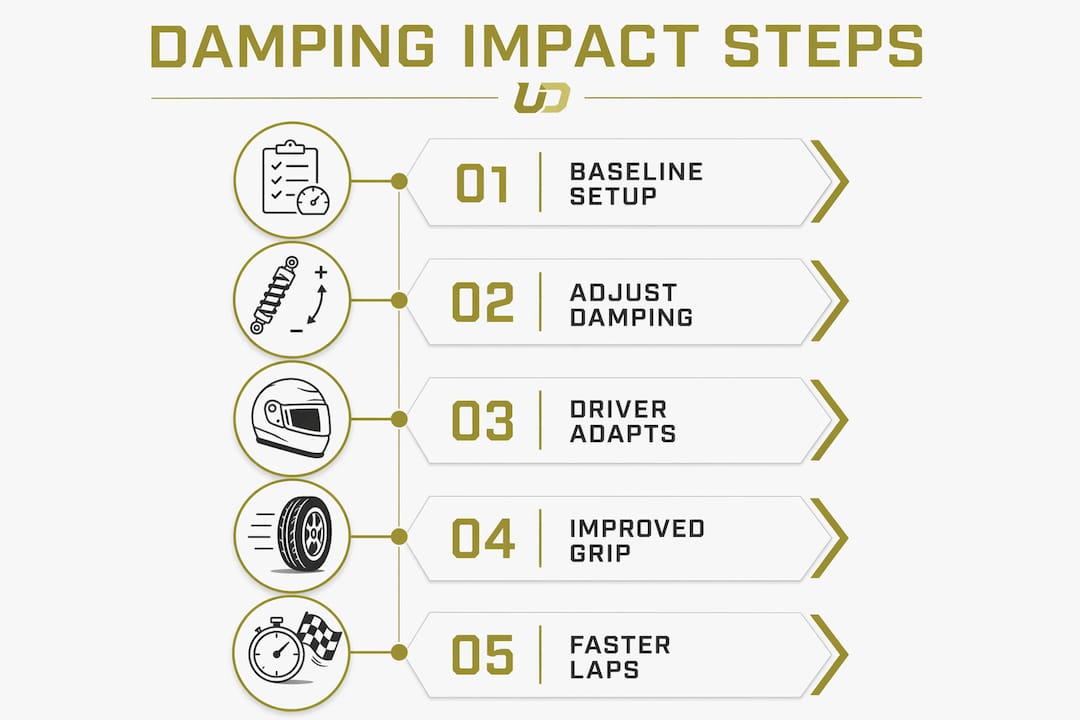
Here is how damping improvements translate into lap time reductions across different phases of adaptation:
| Phase | Driver state | Lap time effect |
|---|---|---|
| Immediately post-upgrade | Adapting to new feedback | Times may stay flat or increase slightly |
| Early adaptation (2–5 sessions) | Building confidence in new setup | Incremental gains, more consistent laps |
| Fully adapted | Exploiting improved grip | Consistent 1–2 second improvements possible |
| Optimized damping + telemetry | Hardware and inputs aligned | Maximum lap time reduction |
The table reflects a pattern that experienced coaches see constantly. Improved chassis feedback creates driver confidence, but lap time gains follow after adaptation, not immediately. Drivers who expect instant results after a damper upgrade often misread the first few sessions and revert to a worse setup.
The real mechanism is confidence. When the rear end is stable and predictable, you commit to throttle earlier on corner exit. When the front stays planted under braking, you carry more speed into the corner. Those two behaviors alone account for the bulk of lap time improvement that proper damping enables.
Pro Tip: Use your telemetry to track throttle application point relative to the apex. If that point moves earlier as you adapt to a new damping setup, you are gaining time even before the lap timer confirms it.
Common myths and mistakes in coilover damping tuning
The most damaging myth in coilover tuning is that stiffer always means faster. Running damping full stiff is a common but detrimental mistake that reduces tire contact by causing the car to skip over bumps rather than absorb them. A tire that is bouncing is not gripping.
The second myth is that preload is the primary performance variable. Preload sets ride height and spring preload tension, but it does not control suspension motion speed. Damping does. Confusing the two leads drivers to spend sessions adjusting the wrong parameter and wondering why the car still feels loose.
Here is a direct comparison of common mistakes versus recommended practices:
| Common mistake | Recommended practice |
|---|---|
| Setting damping to full stiff for “track feel” | Start at baseline, adjust in 2–3 click increments |
| Adjusting preload to improve grip | Adjust damping; preload affects ride height, not motion control |
| Lowering ride height without adjusting damping | Match damping to new suspension travel range after lowering |
| Making multiple changes at once | Change one variable per session to isolate the effect |
| Ignoring front-to-rear damping balance | Balanced front-to-rear damping prevents unpredictable chassis behavior |
Excessive lowering without recalibrating damping is a trap that catches a lot of enthusiasts. When you lower the car, the suspension travel changes. Damping settings that worked at stock ride height may now overdamp the shorter travel range, making the car harsh and twitchy. The fix is not to raise the car back up. The fix is to soften damping to match the new geometry.
The pattern behind all these mistakes is the same: large, uncontrolled changes that make it impossible to know what actually helped or hurt. Dialing in coilover damping is an iterative process that requires discipline. Jumping to extremes reduces grip instead of improving it.
How to dial in coilover damping step by step
A systematic approach to damping tuning produces results. Random changes produce frustration. Follow this sequence and you will have a repeatable system that actually tells you something useful after each session.
- Start at the manufacturer’s baseline. Every quality coilover ships with a recommended starting point. Use it. That baseline is calibrated for the spring rate in the kit and gives you a known reference.
- Drive three to five laps at baseline. Do not change anything yet. Get a feel for how the car behaves and note specific problems: does it bounce on exit? Does the front dive too fast under braking? Does the rear feel loose mid-corner?
- Change one end at a time. If the front is diving, add two clicks of compression damping at the front only. Drive again. Evaluate. Never adjust front and rear simultaneously.
- Document every change. Write down the click count, the session conditions, and your subjective feedback. Memory is not reliable after a full track day.
- Use telemetry and video as confirmation. Subjective feel is a starting point, but braking consistency and throttle application data from telemetry will confirm whether the change actually improved your inputs or just felt different.
- Test in consistent conditions. Tire temperature, track temperature, and fuel load all affect how the car feels. Try to run your damping tests at the same point in the session each time.
A few non-negotiable rules for tuning sessions:
- Never tune on cold tires. The car will feel different once tires are up to temperature.
- Do not chase setup changes caused by tire degradation. Recognize when the tire is the variable, not the damping.
- Pair any suspension change with a systematic tuning review of your overall vehicle setup to avoid chasing one problem into another.
- Keep a dedicated notebook or app log for every session. Patterns emerge over multiple track days, not just one.
How driver behavior and damping work together
The best damping setup in the world does not produce fast lap times if the driver is fighting it. Driver inputs like braking consistency and throttle rate interact directly with suspension behavior to determine what the lap timer shows. Hardware and human factors are not separate problems.
The key telemetry parameters to watch when evaluating your damping setup include:
- Braking point consistency: If your braking points vary by more than a car length lap to lap, the data is noisy and damping changes are hard to evaluate.
- Throttle application point: This is where damping confidence shows up most clearly. A stable rear end lets you apply throttle earlier and harder.
- Lateral G consistency: Inconsistent lateral G through a corner often indicates the car is moving around under you, which points to a damping imbalance.
- Minimum corner speed: Better damping keeps the car flatter and more predictable, which lets you carry more speed through the apex.
Drivers need to adapt their style after upgrading dampers, because improved feedback changes the optimal line and throttle timing. This adaptation period is not a sign that the upgrade failed. It is the process working as intended. The car is giving you more information. Your job is to learn to use it.
Synchronizing onboard video with telemetry data is the fastest way to close that gap. You can see exactly where you are hesitating on throttle, where you are braking early, and where the car is unsettled. Those observations feed directly back into your damping tuning decisions, creating a loop where hardware improvements enable driver growth, and driver growth reveals the next hardware limitation to address.
Key Takeaways
Coilover damping is the most impactful suspension variable for lap times because it controls tire contact, weight transfer, and driver confidence across every phase of a lap.
| Point | Details |
|---|---|
| Damping outranks preload and ride height | Adjusting damping has more effect on grip and handling than preload or ride height changes. |
| Full stiff is a grip killer | Running maximum damping causes the car to skip over bumps, reducing tire contact and adding lap time. |
| Adaptation takes multiple sessions | Lap time gains from a damper upgrade appear after the driver adapts, not immediately after installation. |
| Telemetry confirms what feel suggests | Track throttle application point and braking consistency to verify that damping changes are producing real gains. |
| Front-to-rear balance matters | Unbalanced damping front to rear creates unpredictable chassis behavior that costs time and confidence. |
What I have learned from watching drivers chase damping gains
The pattern I see most often is this: a driver installs a quality coilover kit, goes out for a session, and comes back slower than before. They assume the parts are wrong. They are not. The car is giving more feedback than the driver is used to, and that extra information feels like instability until you learn to read it.
The drivers who gain the most from damping upgrades are the ones who treat the first two sessions as data collection, not performance runs. They are not trying to set a personal best. They are learning where the new setup wants them to brake, where it wants them to rotate, and how early it will let them get on throttle. That patience pays off in session three and four.
The other thing I will say plainly: do not skip the documentation. I have watched drivers make five changes across a weekend and have no idea which one actually helped. A two-line note after each session, click counts and a sentence on how the car felt, is the difference between a repeatable system and a guessing game. The drivers who improve fastest are not the ones with the most expensive parts. They are the ones who know exactly what their car is doing and why.
Pair your mechanical tuning with honest self-analysis using video. The combination of a well-damped car and a driver who understands their own inputs is where the real lap time lives.
— Ismael
Performance parts that support your suspension goals
Dialing in your damping setup starts with having the right hardware under the car. Undergrounddynamics carries chassis-specific coilover options built for enthusiasts who want real fitment data and technical specs before they buy, not vague compatibility claims.

The TruHart StreetPlus coilovers for the 04–08 Acura TL are a strong example of what Undergrounddynamics stocks: a full coilover kit with adjustable damping, designed for drivers who want a functional track setup without a race-only price tag. Every product on the Undergrounddynamics catalog is listed with real specs and fitment detail so you can buy with confidence and get to tuning faster.
FAQ
What does coilover damping actually control?
Coilover damping controls the speed at which your suspension compresses and rebounds. It determines how well the tires maintain contact with the road surface through bumps, braking, and cornering.
Is damping more important than spring rate for lap times?
Damping has a greater direct impact on handling consistency and grip than spring rate alone. Spring rate sets the load threshold, but damping controls how the suspension moves within that range.
Why did my lap times get worse after a damper upgrade?
Drivers need time to adapt their driving style after upgrading dampers because improved feedback changes the optimal braking and throttle timing. Lap time gains typically appear after two to five sessions of adaptation.
How many clicks should I adjust at a time?
Adjust in increments of two to three clicks and test between each change. Large jumps make it impossible to isolate what actually changed the car’s behavior.
Does front-to-rear damping balance matter?
Maintaining balanced damping front to rear prevents unpredictable chassis behavior and improves lap consistency. An imbalanced setup creates oversteer or understeer that no driving technique can fully compensate for.