FREE SHIPPING ON ORDERS OVER $150

Cart
0
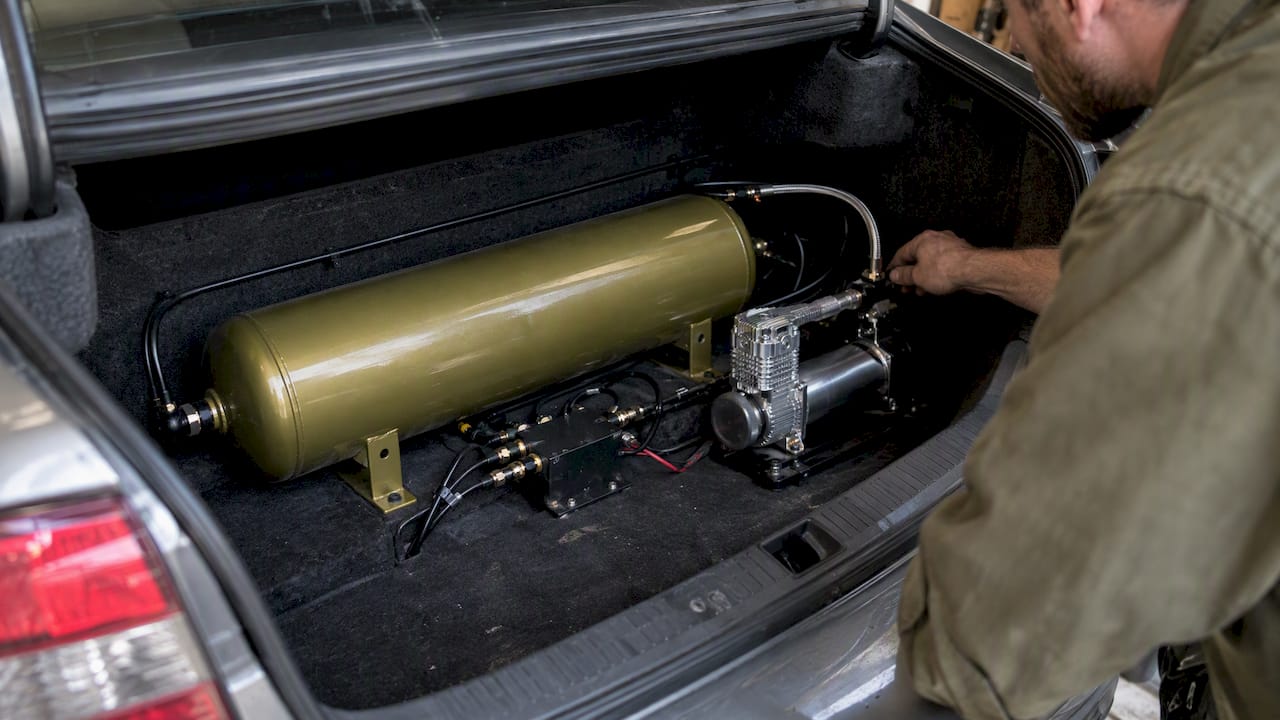
For most air-ride builds, a 3- to 5-gallon tank covers the job. A 3-gallon tank handles light or occasional adjustments with a modest compressor, while a 5-gallon tank suits frequent cycling or multi-bag setups that need steadier pressure. The quick rule of thumb: plan for 3 to 5 gallons per CFM of compressor output, then adjust based on how often you air up and down.
TL;DR:
- A 1.5 to 2 CFM compressor with four bags points to 5 to 10 gallons on paper, though 5 gallons works for occasional adjustments.
- A 3 gallon tank suits occasional airing and tight spare tire wells, while daily cycling or four bag setups favor a 5 gallon tank.
- A typical 3 gallon tank measures 12 to 16 inches long, while a 5 gallon model spans 20 to 24 inches; check mounting clearances.
- More than six compressor starts per hour suggests the tank is undersized; aim for roughly 60 seconds of operation per normal cycle.
- Drain the tank regularly and inspect fittings for leaks; humid climates or frequent cycling may also call for an air dryer or separator.
Table of Contents
- Factors That Determine Correct Tank Capacity for Your Car
- A Simple Sizing Method and Quick Calculator
- How Tank Size and Compressor Pairing Affect Recovery and Equipment Life
- 3 Gallon vs 5 Gallon: Common Setups and Decision Guide
- Mounting Space, Tank Dimensions, and Fitment Tips
- Maintenance and Common Mistakes That Hurt Tank Performance
- Underground Dynamics’ Fitment-First Approach to Tank Selection
- Builders’ Quick Takeaway
- Where to Go Next for Air Suspension Parts and Fitment Data
- FAQ
- Sources
Factors That Determine Correct Tank Capacity for Your Car
Tank size isn’t a guess. It’s a function of how much air your bags need, how fast your compressor can replace it, and how often you’re cycling the system.
Start with air demand: more bags and valves mean more air displaced per adjustment, which raises your effective CFM requirement. Compressor output matters just as much. A compressor rated at 1.5 CFM can’t refill a tank as fast as one rated at 3 CFM, so the tank has to pick up the slack during peak demand.
- Usage pattern matters: a show car that airs out once a parking session needs far less reserve than a daily driver airing up and down at every stoplight.
- Acceptable pressure drop plays in too; if you want rock-steady ride height under load, you need more stored volume to buffer demand.
- Physical space and weight are real constraints, especially in a spare-tire well or trunk corner where every inch counts.
Get these variables straight first, and the gallon number practically picks itself.
A Simple Sizing Method and Quick Calculator
The formal formula compressed-air engineers use is V = (T × Q × Pa) / (P1 - P2), where T is hold time in minutes, Q is air demand in CFM, Pa is atmospheric pressure, and P1/P2 are your working pressure limits. It looks intimidating, but for a car setup you rarely need to run the full equation.
Instead, lean on the heuristic from the sizing calculator guide: 3 to 5 gallons per CFM covers typical air-ride use, while 5 to 10 gallons per CFM suits high, intermittent demand like rapid-fire adjustments at a meet.
- Identify your compressor’s CFM rating from its spec sheet.
- Multiply by 3 for a baseline tank size, and by 5 if you cycle often or run four bags instead of two.
- Round up to the nearest common tank size, usually 3 or 5 gallons.
A 1.5 to 2 CFM compressor running a typical four-bag setup lands you in the 5 to 10 gallon range on paper, but most builds find 5 gallons livable if adjustments stay occasional rather than constant.
Pro Tip: When your calculation lands between two common sizes, size up if you have the space. It costs you fill time, not reliability.

How Tank Size and Compressor Pairing Affect Recovery and Equipment Life
Tank size and compressor output work as a pair, not independently. A tank that’s too small for its compressor forces frequent, short run cycles, which stresses the motor and shortens its working life; consider options like remanufacture to save on air suspension module faults to maintain reliable system electronics.
The sizing guide notes a properly matched system should let the compressor run for roughly 60 seconds per cycle under normal load. Frequent starts, more than six per hour, signal an undersized tank.
- A 1 to 2 CFM compressor paired with a 3-gallon tank works fine for occasional airing, but will cycle often under repeated adjustments.
- A 3 to 5 CFM compressor paired with a 5-gallon tank recovers faster and holds pressure steadier through back-to-back cycles.
A tank sized correctly for its compressor buffers demand and keeps pressure stable, while an undersized one causes frequent cycling, pressure dips, and added wear. This comes straight from the receiver sizing guidance that governs general compressed-air systems, and it holds just as true under a trunk floor as it does in a shop.
3 Gallon vs 5 Gallon: Common Setups and Decision Guide
Most builders end up choosing between these two sizes, and the right call depends on how the car gets used day to day.
- Compact spare-tire installs: a 3-gallon tank often fits where a 5-gallon won’t, making it the default for tight trunks.
- Low-frequency show cars: 3 gallons is plenty if you air out once and leave it parked for the event.
- Commuter daily drivers: 5 gallons gives smoother recovery for the repeated up-and-down of regular driving.
- Multi-bag loadouts (four corners cycling together): 5 gallons, sometimes paired with a stronger compressor, keeps pressure from sagging mid-cycle.
Go larger than 5 gallons only if you’re running a high-output compressor, multiple air management valves, or want extended hold time between fills without the compressor kicking on.
Mounting Space, Tank Dimensions, and Fitment Tips
Gallons don’t tell you whether a tank fits your car, so translate capacity into physical dimensions before you buy. A typical 3-gallon tank runs roughly 12 to 16 inches long with an 8-inch diameter, while 5-gallon tanks stretch closer to 20 to 24 inches at a similar diameter, though exact dimensions vary by brand.
- Measure your intended mounting spot (spare-tire well, trunk corner, or under-floor bracket) in all three dimensions before ordering.
- Vertical mounting saves floor length but needs headroom clearance above the tank.
- Horizontal mounting suits low-clearance spots but needs accessible drain positioning, per the receiver tank selection guide.
- Keep plumbing runs short between the tank, compressor, and valves to minimize pressure loss over distance.
Maintenance and Common Mistakes That Hurt Tank Performance
A correctly sized tank still needs upkeep to perform the way it should over the long run.
- Drain the tank regularly to clear condensed moisture, which otherwise promotes rust and valve corrosion from the inside out.
- Inspect fittings and check valves periodically for slow leaks that quietly rob your reserve pressure.
- Don’t rely on the tank alone for moisture control; if you’re in a humid climate or cycling often, add a dryer or separator to the line.
Pro Tip: Mount the drain valve where you can reach it without pulling trim panels. A drain you can’t access is a drain that never gets used.
Underground Dynamics’ Fitment-First Approach to Tank Selection
We build our air suspension catalog around chassis-specific fitment data, not generic part numbers, because tank size only matters once it actually fits your car.
- Technical specs and fitment details are provided alongside each kit to help you match tank dimensions to your mounting space before ordering.
- It’s recommended to take physical mock-up measurements in your trunk or spare-tire well against published dimensions, not just compare spec sheets.
- Pairing a tank with the right compressor and bracket hardware starts with knowing your vehicle’s actual clearances, not assumptions.
Builders’ Quick Takeaway
Pair your tank to your compressor’s real output first, leave a little headroom for future mods, and confirm physical fit before you buy. When in doubt, go with 5 gallons if your compressor supports it and the space allows.
— Ismael
Where to Go Next for Air Suspension Parts and Fitment Data
Once you’ve landed on a tank size, the next step is matching it to a kit that fits your platform without guesswork. We stock air suspension systems with chassis-specific fitment specs so you’re not left measuring blind or hoping a tank clears your spare-tire well.
- Browse fitment data by platform before committing to a tank and compressor pairing.
- Reach out to support teams if unsure whether a given mounting location will clear your chosen tank size.
Check our full storefront for air suspension components and related suspension upgrades built around real fitment detail, not generic listings.
FAQ
How long will a 5-gallon air tank last?
Hold time depends on your bag volume and how many corners you’re cycling, not a fixed number. A 5-gallon tank paired with a well-matched compressor typically holds pressure through several adjustments before the compressor needs to kick on again.
What are the dimensions of a 5-gallon air tank?
Dimensions vary by brand and shape, but a 5-gallon tank commonly runs in the range of 20 to 24 inches long with roughly an 8-inch diameter. Always check the specific product’s published dimensions against your mounting space before buying.
Does tank size affect CFM?
Tank size doesn’t change your compressor’s CFM output, but it does change how often that compressor needs to run. A larger tank sized to 3 to 5 gallons per CFM buffers demand better and reduces how frequently the compressor cycles.
How many PSI can a 5-gallon air tank hold?
Most 5-gallon tanks used in air-ride setups are rated for pressures well above typical ride-height operating pressure, but exact maximum pressure varies by manufacturer. Always check the specific tank’s pressure rating rather than assuming a standard figure since it differs by product.
What’s the simplest way to pick between a 3-gallon and 5-gallon tank?
Match your compressor’s CFM rating to the 3 to 5 gallons per CFM rule of thumb, then confirm the resulting tank size physically fits your mounting space. If both sizes fit, choose 5 gallons for steadier pressure during frequent adjustments.
Sources
- Air Compressor Tank Sizing Calculator & Complete Guide
- Air Receiver Tank Selection Guide: Sizing, Pressure & ASME — Air Compressor Zone